Is Titanium Stronger Than Stainless Steel? Grade-by-Grade
Is titanium stronger than stainless steel? Compare 304, 316, 17-4 PH and 440C with Ti-6Al-4V on tensile, yield, hardness, stiffness and specific strength.
By Rapid Model CNC Manufacturing Team · 2026-11-13 · 15 min read ·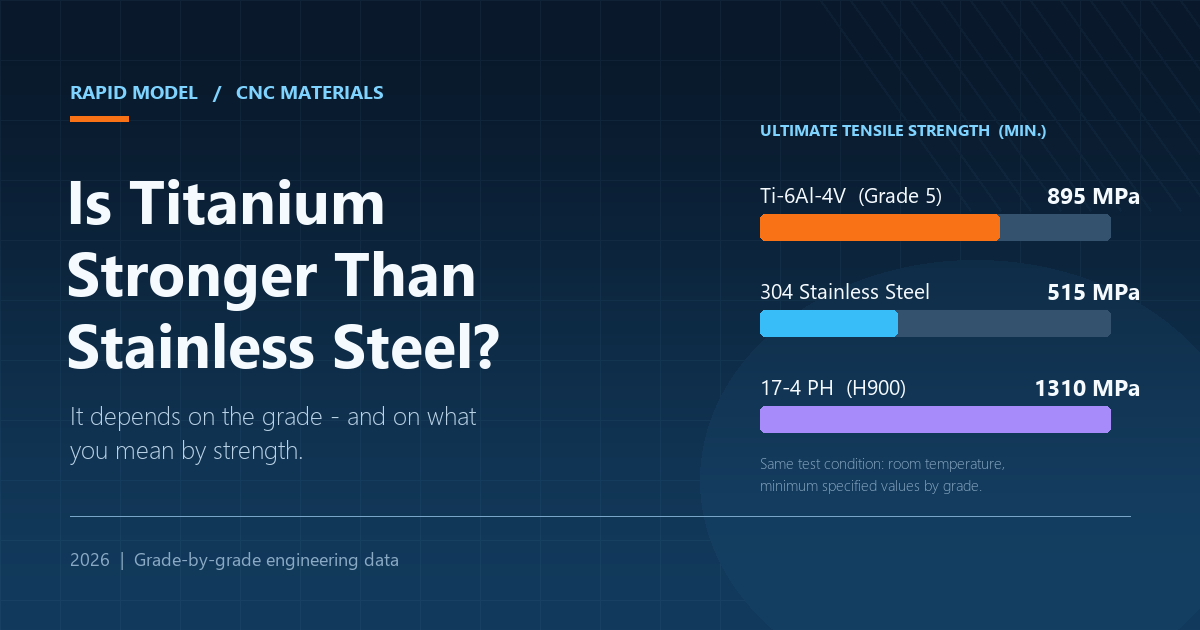
Yes, against the stainless steel most machine shops quote. No, against every stainless steel.
Annealed Ti-6Al-4V (Grade 5) carries specification minimums of 895 MPa ultimate tensile strength and 828 MPa yield strength under ASTM B348/B265, while annealed 304 stainless is specified at 515 MPa and 205 MPa (MatWeb, 304 Stainless Steel, annealed). That is roughly 1.7 times the tensile strength and four times the yield strength. But 17-4 PH stainless in the H900 condition reaches 1310 MPa tensile and 1172 MPa yield (Cleveland-Cliffs, 17-4 PH product data, May 2021), and hardened 440C about 1965 MPa (Carpenter Technology, CarTech 440C datasheet). Both are stainless steels, and both are stronger than the titanium grade you are most likely to buy.
So the useful answer depends on which stainless grade, which titanium grade, which heat-treatment condition, and which of four different properties you mean by "strength". This guide works through each with datasheet values, then turns them into a selection rule for CNC-machined parts. For corrosion, finishing and procurement detail, see our titanium vs stainless steel for CNC machined parts guide. If your real question is surface indentation rather than load capacity, our titanium versus carbon steel hardness guide covers that separately.
Key Takeaways - Against annealed 304 or 316, Ti-6Al-4V is clearly stronger: 895 MPa minimum tensile and 828 MPa minimum yield, versus 515 MPa and 205 MPa. - Against hardened stainless it is not: 17-4 PH (H900) reaches 1310/1172 MPa and hardened 440C about 1965/1896 MPa, at roughly 1.7 to 1.8 times the density. - Titanium's unambiguous win is specific strength: about 202 kN·m/kg for annealed Grade 5 versus 64 for annealed 304. Stainless wins on stiffness (193 GPa versus 114 GPa). - "Harder" is a different question. Grade 5 titanium is around 36 HRC, hardened 440C around 60 HRC, and titanium galls readily in sliding contact. - "Titanium" and "stainless steel" are families, not materials. Grade 2 CP titanium at 345 MPa tensile is weaker than plain annealed 304. Name the exact grade on the drawing.
What Does "Stronger" Mean in This Question?
Four independent properties get collapsed into the word "stronger", and they point to different winners.
Ultimate tensile strength (UTS) is peak stress before fracture; it governs parts that must not snap. Yield strength is where permanent deformation begins, and it governs precision brackets that must hold calibration. Hardness measures indentation and wear resistance, not bulk load capacity. Stiffness (elastic modulus) governs deflection. A fifth, derived metric, specific strength (strength divided by density), decides which material wins when mass is constrained.
A bracket that must not stay bent is a yield problem; a bearing race that must not wear is a hardness problem; a long thin arm that must not sag is a stiffness problem. This is why our hardness guide reaches a different verdict. What a machinist feels at the spindle is different again, driven by thermal conductivity and work hardening.
The Grade-by-Grade Numbers
Room-temperature values, with strengths as specification minima except where marked typical.
| Material and condition | Density (g/cm³) | Tensile (MPa) | Yield (MPa) | Modulus (GPa) | Hardness | Specific tensile (kN·m/kg) |
|---|---|---|---|---|---|---|
| Grade 2 titanium, CP annealed | 4.51 | ≥345 | ≥275 | 103 | ~HRB 80 / 145 HV | 76 |
| Ti-6Al-4V Grade 5, annealed | 4.43 | ≥895 | ≥828 | 114 | ~HRC 36 / 349 HV | 202 |
| Ti-6Al-4V Grade 5, STA | 4.43 | 1170 | 1100 | 114 | HRC 41 / 396 HV | 264 |
| 304 stainless, annealed | 8.00 | 515 | 205 | 193 | ≤92 HRB / ~200 HV | 64 |
| 316/316L stainless, annealed | 8.00 | 485 to 515 | 170 to 205 | 193 | ≤95 HRB | 61 to 64 |
| 17-4 PH stainless, H900 | 7.75 | 1310 | 1172 | 196 | HRC 40 to 48 | 169 |
| 440C stainless, hardened | 7.62 | ~1965 (typ.) | ~1896 (typ.) | 200 | ~HRC 60 / 580 HB | ~258 (typ.) |
Sources: MatWeb Grade 5 STA, MatWeb Grade 2, MatWeb 304, MatWeb 17-4 H900, Outokumpu Core range, Cleveland-Cliffs (2021) and Carpenter Technology. Specific tensile strength is UTS divided by density; 1 MPa per g/cm³ equals 1 kN·m/kg.
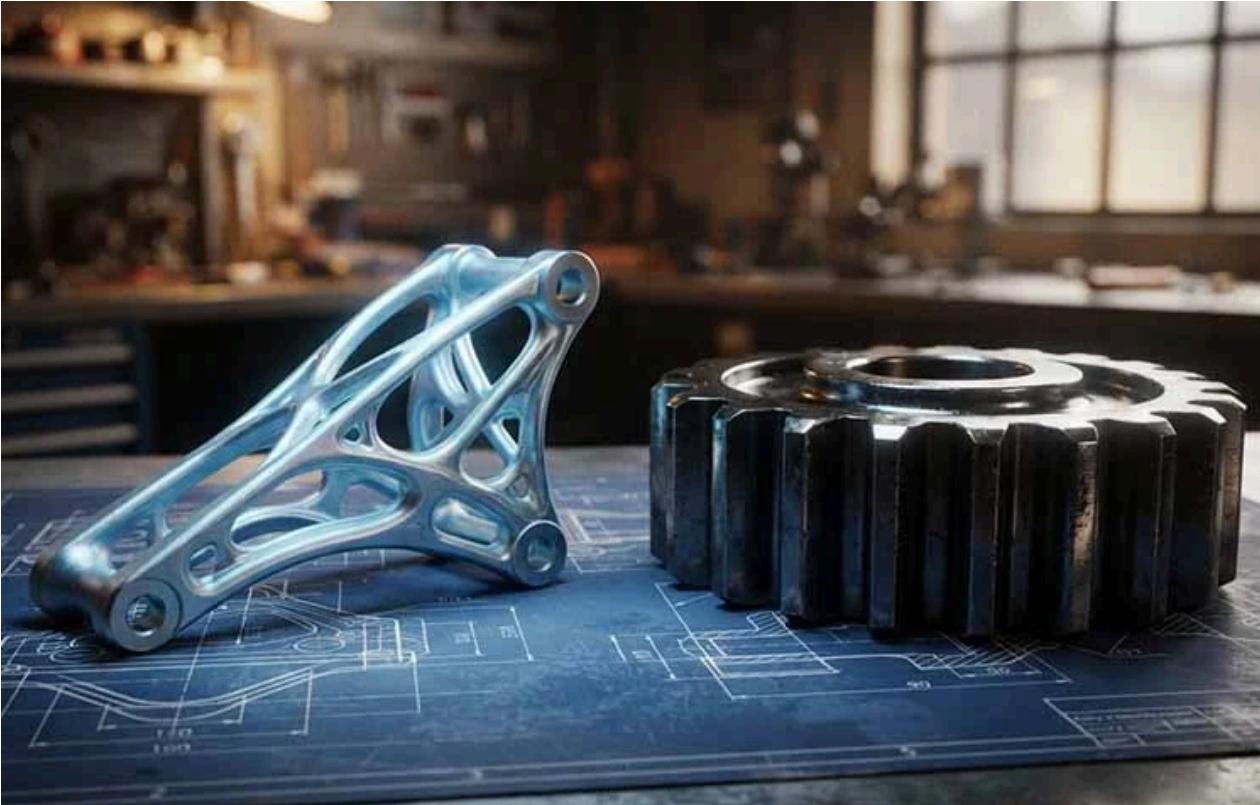
Two rows deserve a second look. Commercially pure Grade 2 titanium is weaker than annealed 304 in absolute terms, and hardened 440C outranks annealed Grade 5 on both absolute and specific tensile strength. Neither fits the usual "titanium is stronger" headline, and both matter when a drawing simply says "titanium".
Is Ti-6Al-4V Stronger Than 304 or 316 Stainless Steel?
Yes, and by a wide margin on yield strength: at least 828 MPa against 205 MPa for annealed 304, a fourfold difference. The gap comes from metallurgy. 304 and 316 are austenitic stainless steels that cannot be hardened by heat treatment, while Ti-6Al-4V is an alpha-beta alloy that responds to solution treating and aging. The Outokumpu Core range datasheet lists austenitic minimums in the 485 to 515 MPa tensile band across 304L, 316L and related grades, so switching from 304 to 316 buys chloride resistance, not strength. Our 304 vs 316 comparison explains where that switch does pay off.
Cold work is the nuance. Strain-hardened 304 bar in Condition B can reach roughly 860 MPa tensile and 690 MPa yield, closing much of the tensile gap while remaining well below Grade 5 yield. "Annealed" is doing heavy lifting in any comparison, and austenitic stainless keeps oxidation resistance far above the service range of Grade 5 titanium. Our broader Is Titanium Stronger Than Steel? guide covers heat-treated alloy steels that exceed 1800 MPa tensile.
Verdict: against annealed 300-series stainless, Grade 5 titanium wins on tensile and yield, with the largest advantage in yield.
Which Stainless Steels Are Actually Stronger Than Titanium?
Precipitation-hardening and martensitic grades beat annealed Ti-6Al-4V on absolute strength. 17-4 PH in the H900 condition is the practical example: Cleveland-Cliffs specifies 1310 MPa minimum tensile, 1172 MPa minimum yield and HRC 40 to 48. It is used for high-load shafts, valve parts and aerospace fittings, costs less than titanium, and machines more predictably.
Hardened 440C is the extreme case. Carpenter Technology's datasheet reports about 1965 MPa tensile, 1896 MPa yield and roughly HRC 60, the highest hardness of any stainless steel. That sounds like a complete win until the same table shows 2 percent elongation and "restricted" salt-spray resistance. A 440C part is a bearing race or a valve seat, not a load-bearing aircraft bracket.
The density penalty is the second qualifier. At 7.75 and 7.62 g/cm³, 17-4 PH and 440C are about 1.75 times as dense as Grade 5 titanium, so a strength-matched stainless part is usually heavier. As the full engineering comparison on our site notes, neither family is universally better: titanium wins on specific strength and chloride pitting resistance, stainless on stiffness, cost and high-temperature strength.
Verdict: for maximum absolute strength, hardened stainless wins. For a structural part that must also be light, ductile and corrosion-resistant, it usually does not.
Strength-to-Weight: Where Titanium Wins Without an Asterisk
Specific strength is the one metric where titanium's advantage survives almost every grade comparison. Dividing minimum tensile strength by density gives about 202 kN·m/kg for annealed Ti-6Al-4V, 264 for the solution-treated and aged condition, and 64 for annealed 304.
The weight arithmetic is direct. A 100 cm³ block of Grade 5 titanium weighs about 443 g; the same volume of 304 stainless weighs about 800 g. That 44.6 percent reduction at equal volume is the source of the "as strong as steel but 40% lighter" shorthand used on Rapid Model's titanium CNC machining service page.
Stiffness is the catch. Grade 5 titanium has a modulus near 114 GPa against 193 GPa for 304 (MatWeb Grade 5 STA; MatWeb 304). Divide modulus by density and they are almost tied: roughly 25.7 versus 24.1 MN·m/kg. A deflection-limited part needs thicker titanium sections, so the real weight saving falls well below 44 percent. Savings are largest for strength-limited parts and smallest for stiffness-limited ones. See also titanium vs aluminum.
One exception: hardened 440C also scores around 258 kN·m/kg on paper, though 2 percent elongation rules it out for structural work. "Best strength-to-weight ratio" is shorthand, not a law.
Hardness Is a Different Question
Hardness rankings do not follow strength rankings, and mixing them is the most common error in wear-part selection.
Our earlier hardness comparison against carbon steel sets the baseline: commercially pure Grade 2 titanium sits around HRB 80 (145 HV), annealed Ti-6Al-4V around HRC 36 (349 HV), and an AISI 1045 medium-carbon steel about HRB 84 (170 HV). Untreated steel can therefore be harder than pure titanium, while hardened tool steels exceed even Grade 5.
Add stainless and the spread widens. Annealed 304 is capped around 92 HRB (about 200 HV), 17-4 PH H900 reaches HRC 40 to 48, and hardened 440C about HRC 60. Titanium also galls readily, which makes it a poor choice for sliding fits and unlubricated threads unless the design uses dissimilar mating materials or coatings. So "is titanium harder than stainless steel" is yes against annealed 304 and no against 440C. A designer who says "stronger" but means "won't scratch" will specify the wrong alloy.
Why Titanium "Feels" Stronger on the Shop Floor
Titanium's reputation for toughness comes as much from machining behaviour as from its datasheet. The mechanism is heat, not hardness.
Ti-6Al-4V has a thermal conductivity of about 6.7 W/m·K, less than half the 16.2 W/m·K of annealed 304 (MatWeb Grade 5 STA; MatWeb 304). Cutting heat stays at the tool edge rather than leaving with the chip, accelerating crater wear and edge chipping. A lower modulus lets thin walls spring away from the cutter, producing chatter and dimensional drift. As our titanium versus carbon steel hardness guide puts it, titanium can feel much harder to machine than steel even when its Rockwell number is lower.
Austenitic stainless is difficult for a different reason: it work-hardens, leaving a hardened skin for the next pass. Both need sharp carbide tools, rigid setups and uninterrupted feeds. Rapid Model's titanium CNC machining workflow uses coated carbide tools, controlled feed rates, rigid fixturing and optimised coolant flow and cutting paths specifically to manage that heat.
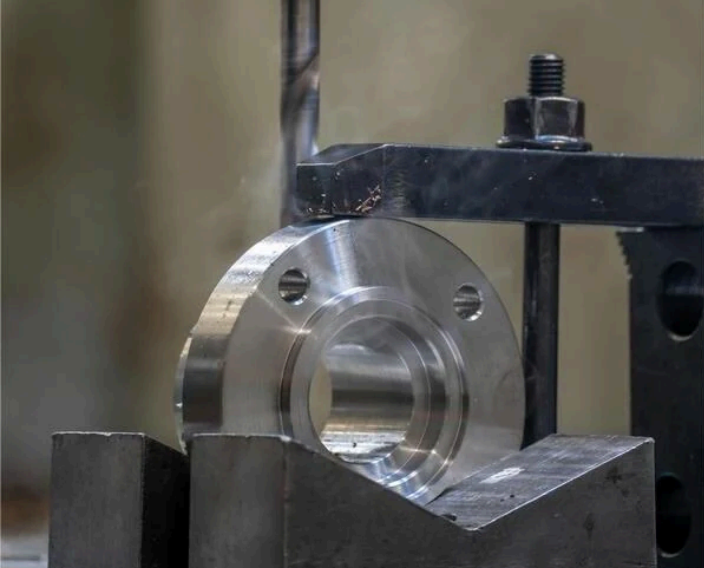
This is why a "stronger" titanium part costs more to make. The premium is raw material, slower cycles, tooling consumption and the inspection needed to hold tolerance on a part that moves under the tool.
What This Means for an Actual CNC Part
The datasheet number describes a test coupon, not your geometry. Thin walls, deep pockets, threaded holes and datum structures decide whether the alloy's strength is usable. Rapid Model's published material selection table for precision titanium parts distinguishes four common choices:
| Titanium grade | Mechanical character | Machining behaviour | Typical parts |
|---|---|---|---|
| Grade 2 (CP) | Excellent corrosion resistance, moderate strength, high ductility | Gummy; needs sharp tools and low cutting speeds | Chemical processing, marine hardware, heat exchangers |
| Grau 5 (Ti-6Al-4V) | Superior strength-to-weight, heat treatable, high hardness | Poor thermal conductivity, high cutting forces | Aerospace structures, turbine blades, racing parts |
| Grade 23 (ELI) | Extra low interstitials, enhanced toughness, high biocompatibility | Similar to Grade 5; needs precise coolant delivery | Medical implants, orthopaedic screws, surgical instruments |
| Grade 7 (Ti-Pd) | Maximum corrosion resistance in reducing acids | Rapid work hardening; requires rigid setups | Salt production, pressure vessels, chemical valves |
The same page lists compliance with ASTM B348 / F136, AMS 4911 / 4928 and ISO 5832-3, plus ±0.01 mm tolerance, Ra 0.8 µm finish, 3/4/5-axis control and 0.5 mm minimum thin walls for Grade 5. Read its 500°C thermal-stability figure as a shop-floor statement, not a sustained-load design allowable. For the full grade breakdown, see Grade 2 vs Grade 5 vs Grade 23 titanium.
Two examples on the titanium CNC machining service page show the decision in practice. An aerospace Ti-6Al-4V bracket with thin ribs, deep pockets and 0.01 mm flatness reached a reported 98 percent yield at a 65-minute cycle using low-feed coated carbide tools and single-setup finishing. A Grade 2 implant housing used rough turning and finish boring in one cycle. Specific strength justified the first alloy; corrosion resistance and biocompatibility justified the second.
How to Choose: A Five-Step Strength Check
- Name the load and the failure mode. Is the part limited by fracture, permanent bending, wear, or deflection?
- Pick the matching metric. Fracture maps to tensile strength, bending to yield, wear to hardness, and sag to elastic modulus. One is usually governing.
- Name the exact alloy, specification and condition. "Ti-6Al-4V per ASTM B348, annealed" and "17-4 PH per ASTM A564, H900" are comparable; "titanium" and "stainless steel" are not.
- Check the stiffness and geometry penalty. If deflection governs, compare specific stiffness, then review wall thickness, tool access and fixturing with your supplier.
- Compare delivered part cost and service life, not price per kilogram. Slower cycles amplify the billet premium, but coatings, replacement intervals and corrosion failures can reverse the calculation.
Four reader profiles cover most decisions:
Aerospace and robotics structures: Choose annealed or STA Ti-6Al-4V when mass and specific strength govern. Keep the stiffness penalty in the FEA model.
Marine, chemical and implant components: Choose Grade 2 or Grade 23 titanium for chloride and biocompatibility performance. Strength may be secondary.
High-load shafts, valve parts and wear faces: Choose 17-4 PH H900 or a hardened martensitic grade for higher absolute strength and hardness at lower cost.
General fixtures, housings and cost-driven production: Choose 304 or 316L. Strength is sufficient, stiffness is better, material is cheaper and lead times are shorter. Our titanium vs stainless steel comparison e 304 vs 316 guide go deeper.
If both remain viable, send each supplier the same drawing revision, tolerances, finish, quantity and inspection requirements. When you have a drawing and a load case, send it for a CNC machining quote and our engineers will check the grade, tolerance and process plan.
Perguntas frequentes
Is titanium stronger than 304 stainless steel?
Grade 5 Ti-6Al-4V is, by a wide margin: 895 MPa minimum tensile and 828 MPa minimum yield against 515 MPa and 205 MPa for annealed 304. Commercially pure Grade 2 titanium is not, at 345 MPa minimum tensile. Check which titanium grade is being quoted.
Can any stainless steel be stronger than titanium?
Yes. 17-4 PH H900 reaches 1310 MPa tensile and 1172 MPa yield, and hardened 440C roughly 1965 MPa and 1896 MPa (Cleveland-Cliffs 2021; Carpenter Technology 440C datasheet). Both exceed annealed Grade 5 on absolute strength, but they are about 1.75 times as dense and, for 440C, far less ductile.
Is Grade 2 titanium stronger than stainless steel?
No, not in absolute terms. Grade 2 CP titanium has a minimum tensile strength of 345 MPa and yield of 275 MPa (MatWeb, Sandvik Ti Grade 2), below annealed 304. It is specified for corrosion resistance, formability and biocompatibility. See the Grade 2 vs Grade 5 comparison.
Is titanium harder or stiffer than stainless steel?
Neither, in general. Grade 5 titanium at about 36 HRC is harder than annealed 304 but far softer than hardened 440C at about 60 HRC. Its modulus of roughly 114 GPa is about 40 percent below the 193 GPa of 304 stainless, so a same-size titanium part deflects more. Our hardness guide separates these properties.
Why is titanium more expensive to machine if it is "stronger"?
Because the cost driver is heat management, not strength. At 6.7 W/m·K, Ti-6Al-4V holds cutting heat at the tool edge, shortening tool life and forcing lower speeds, rigid fixturing and generous coolant flow. The titanium machining cost breakdown lists the main factors.
The Verdict
| Decision | Winner |
|---|---|
| Tensile and yield strength vs annealed 304/316 | Ti-6Al-4V Grade 5 |
| Tensile and yield strength vs 17-4 PH H900 or hardened 440C | Stainless steel |
| Strength per unit mass | Ti-6Al-4V Grade 5 |
| Stiffness and deflection control | Stainless steel |
| Surface hardness and wear resistance | Hardened stainless steel |
| Chloride and seawater corrosion resistance | Titânio |
| Material cost, cycle time and lead time | Stainless steel |
Is titanium stronger than stainless steel? Against the annealed austenitic grades that dominate general CNC work, yes, especially on yield strength. Against precipitation-hardened or hardened martensitic stainless, no. Titanium's durable advantage is specific strength, not absolute strength, and even that shrinks when stiffness governs the design. Specify the exact alloy and condition, then select on the one property your part actually needs.
Related Reading
- Titanium vs Aluminum: Which Is Better? for a second lightweight comparison.
- Titanium CNC Machining Cost: 8 Factors That Affect Price for budget planning.
- Titanium CNC Machining: The Complete Engineering & Sourcing Guide for specification and supplier checks.
- Stainless steel CNC machining services for the stainless side of the decision.
About the Author and Sources
Written by the Rapid Model CNC Manufacturing Team, the in-house engineering group behind our material-selection content. Values are room-temperature figures from the linked datasheets, ASTM specifications and MatWeb records, retrieved 13 November 2026. Minimum strengths are specification values; hardness, density and 440C properties are typical. Confirm the exact grade and condition before engineering approval. See our about page ou contact page.