Is Titanium Harder Than Carbon Steel? A Comprehensive Engineering Guide
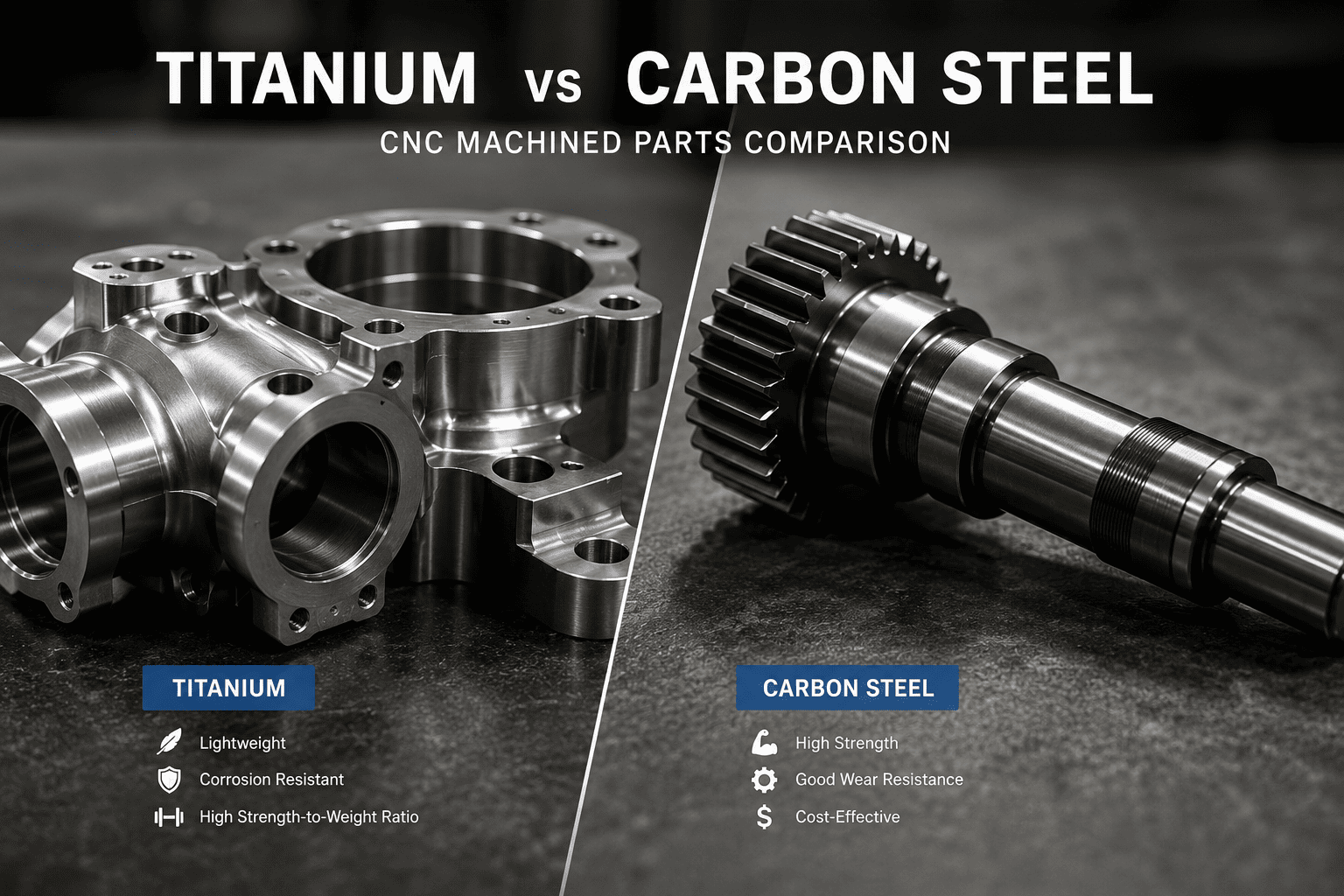
When engineers and product designers compare metals for CNC machining, one of the most common questions asked is: is titanium harder than carbon steel?
The direct answer is: Not always. While titanium is widely recognized as a premium, high-performance material, its hardness depends entirely on the specific titanium grade, the steel grade, and the heat-treatment condition.
In precision CNC machining, simply asking which material is harder isn't enough. The better question is: which material is more suitable for your part’s function, tolerance, weight requirements, corrosive environment, and budget? Let's dive into the details.
Commercially Pure Titanium vs. Medium-Carbon Steel
Commercially pure titanium is not exceptionally hard. For example, Grade 2 titanium is rated at approximately Rockwell B 80 (145 HV Vickers) according to ASM/MatWeb data.
On the other hand, a common medium-carbon steel like AISI 1045 can reach around Rockwell B 84 (170 HV) in certain supplied conditions. This means that some ordinary, untreated carbon steels are actually harder than commercially pure titanium.
Titanium Alloys vs. High-Carbon & Tool Steel
The story changes when we look at titanium alloys. Ti-6Al-4V (Grade 5 titanium) is significantly harder than its commercially pure counterparts. Annealed Ti-6Al-4V has a hardness of about Rockwell C 36 (349 HV). This makes Grade 5 titanium harder than many untreated mild or medium-carbon steels.
However, steel is incredibly versatile. Hardened high-carbon steel and tool steel (which have been quenched and tempered) can easily exceed the hardness of even the toughest titanium alloys. Therefore, titanium is not automatically harder than carbon steel; it is entirely relative to the grades being compared. 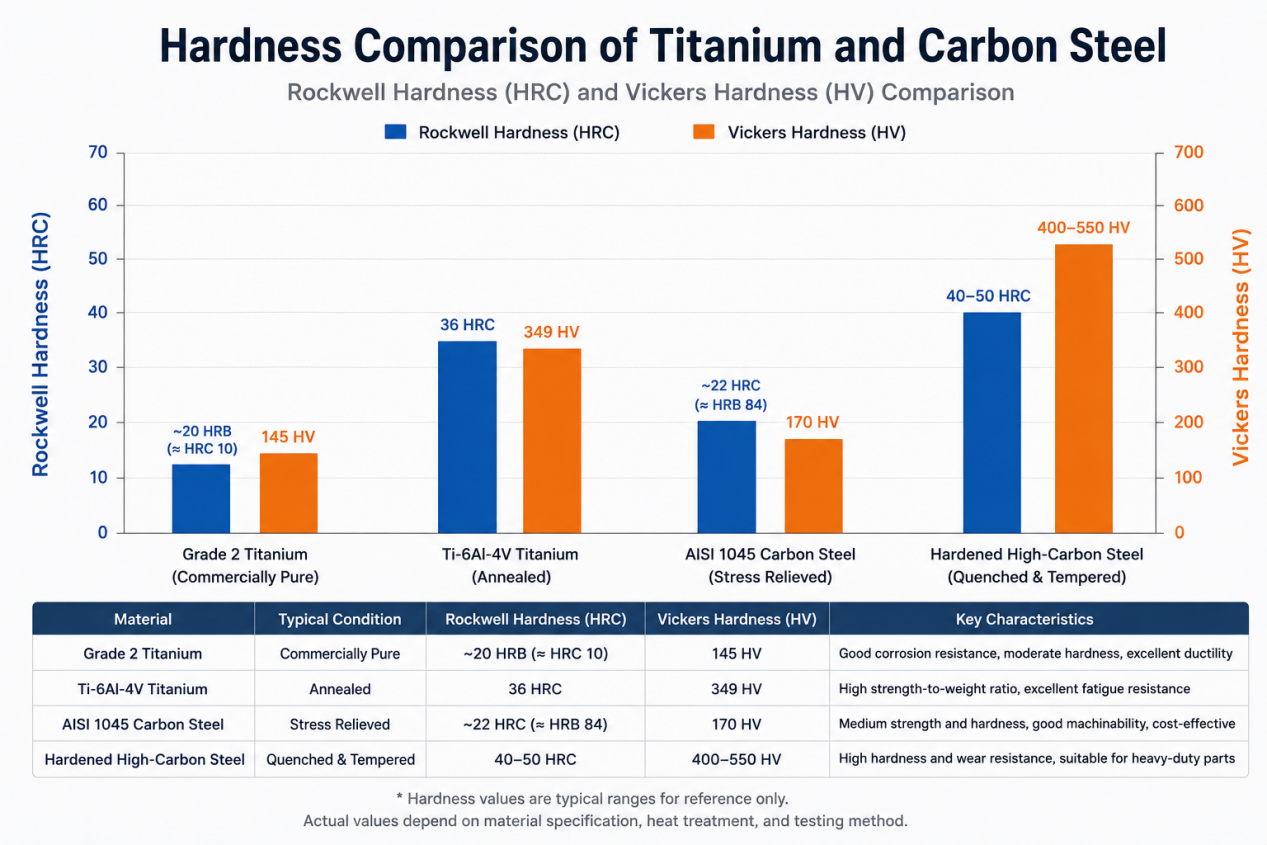
Titanium vs. Carbon Steel Hardness Comparison
Material | Typical Condition | Approx. Hardness | Practical Meaning |
Grade 2 Titanium | Commercially pure | HRB 80 / 145 HV | Good corrosion resistance, moderate hardness |
Ti-6Al-4V (Grade 5) | Annealed alloy | HRC 36 / 349 HV | High strength-to-weight ratio, harder to machine |
AISI 1045 Steel | Hot rolled / stress relieved | HRB 84 / 170 HV | Economical medium-carbon steel |
High-Carbon Steel | Quenched & tempered | Often > Ti-6Al-4V | Better for highly wear-resistant parts |
Tool Steel | Heat treated | Much higher | Used for dies, punches, molds, and tooling |
Why "Hardness" Isn't Everything in Material Selection
The reason "carbon steel" is a tricky category is due to its carbon content and heat treatment variability:
• Low-carbon (mild) steel: Soft, ductile, and highly machinable.
• Medium-carbon steel: Offers a great balance of strength, hardness, and cost.
• High-carbon steel: Can be heat-treated to achieve extreme hardness and wear resistance.
Titanium’s true value does not lie in being the "hardest" metal. Its distinct advantages are its incredible strength-to-weight ratio, excellent corrosion resistance, and biocompatibility. This is why titanium is the go-to choice for aerospace components, medical implants, robotics, marine equipment, and high-performance automotive parts. It provides robust mechanical performance while significantly reducing weight.
CNC Machining Challenges: Why Titanium "Feels" Harder
In CNC machining, titanium can often feel much harder to machine than steel, even if its Rockwell hardness number is lower. Why?
Titanium has low thermal conductivity. This means that during machining, the cutting heat doesn't dissipate through the chip; instead, it stays concentrated near the cutting tool edge. This accelerates tool wear and creates challenges with surface finish, chatter, and dimensional stability.
How to Choose: Titanium or Carbon Steel?
Material selection should always be aligned with your engineering drawings and end-use application.
Choose Titanium when your project requires:
• Significant weight reduction without sacrificing strength.
• Extreme corrosion resistance (e.g., marine or chemical environments).
• Biocompatibility (medical devices).
• High performance in aerospace or robotic applications.
Choose Carbon Steel when your project requires:
• High hardness and wear resistance (achieved via heat treatment).
• Lower material and manufacturing costs.
• Strong structural performance where weight is not a strict limiting factor.
• Components like shafts, gears, fixtures, and general tooling. (Note: Carbon steel requires surface treatments like plating or black oxide to prevent rust). 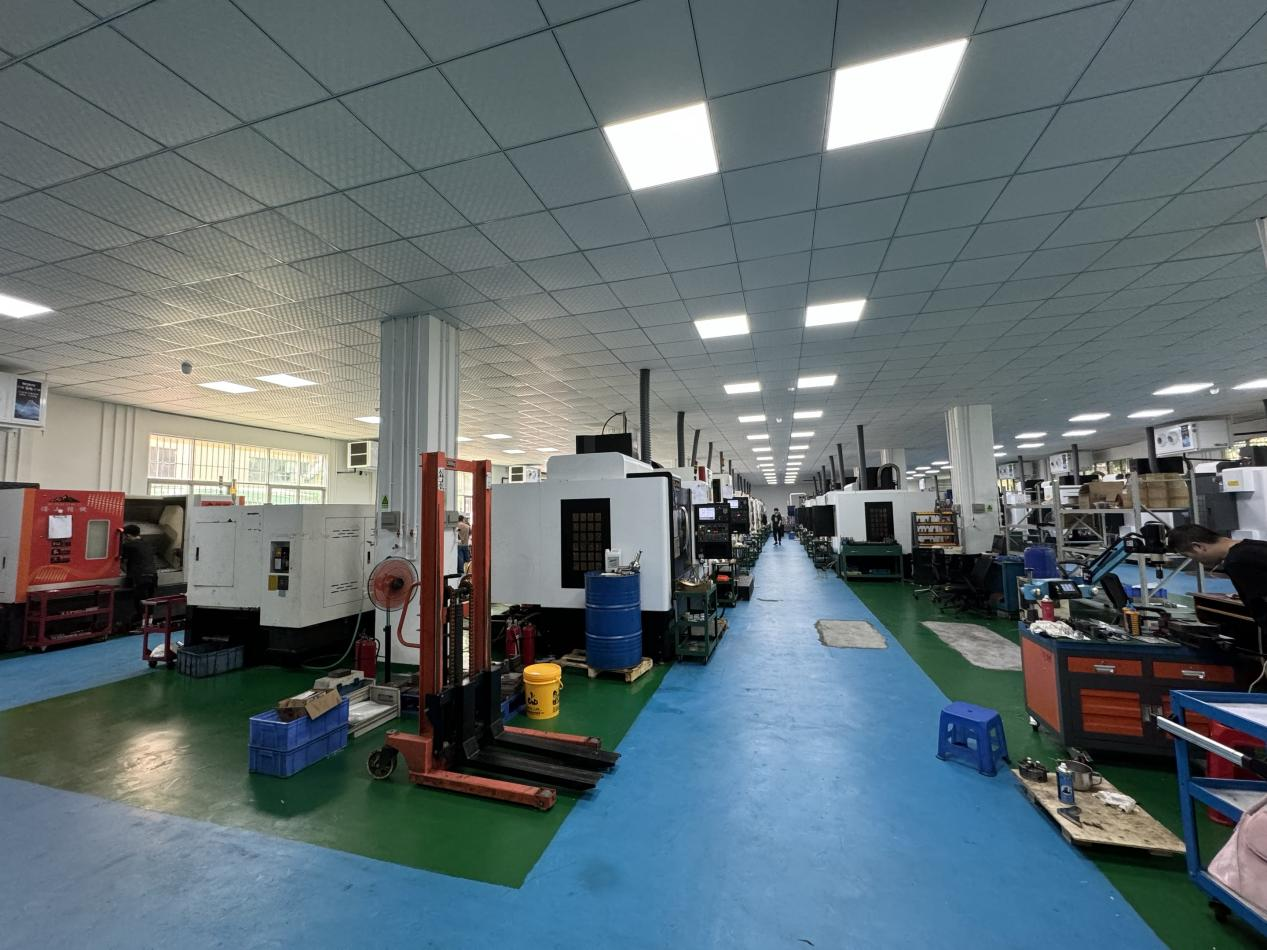
Professional CNC Machining Services at Rapid-Model
A simple statement like "titanium is harder than carbon steel" can be misleading if the grade, condition, and application are not defined. For successful CNC projects, details matter: material grade, tolerance, surface finish, and production volume.
At Rapid-Model, we help our global customers evaluate materials from a practical, manufacturing-first perspective. As a premier Shenzhen-based CNC machining supplier, we provide end-to-end manufacturing solutions. From custom CNC machining, titanium and steel machining, to sheet metal fabrication—we take your project from rapid prototype to large-scale production seamlessly.
Final Verdict
Is titanium harder than carbon steel? Sometimes, but not always. Commercially pure titanium is often softer than medium-carbon steel. Grade 5 Titanium is harder than untreated steel, but hardened tool steel remains superior in pure hardness. Ultimately, hardness is just one factor. The best material is the one that perfectly balances strength, weight, wear, corrosion, precision, and cost for your specific part.