Titanium CNC Machining Cost: 8 Factors That Affect Price & How to Reduce It
1. Article Summary
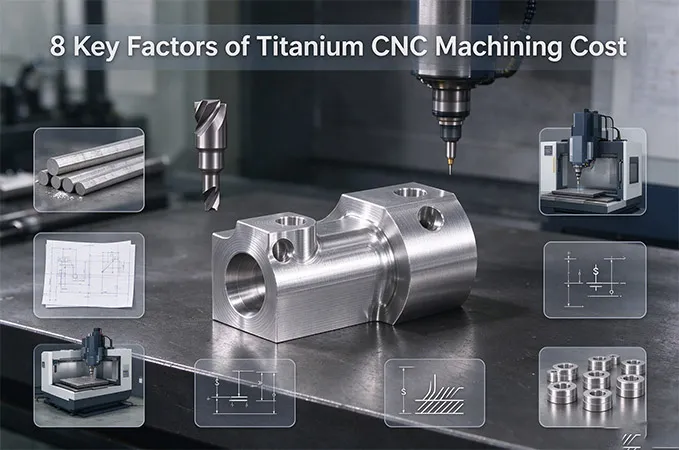
Titanium CNC machining cost depends on more than raw material prices. The titanium grade, material removal rate, part geometry, cutting tool consumption, machine setup, dimensional tolerances, surface finish, inspection requirements, and production quantity all influence the final price.
Titanium alloys such as Ti-6Al-4V (Grade 5) are challenging to machine because of their low thermal conductivity, high strength, chemical reactivity at cutting temperatures, and tendency to cause tool wear. These characteristics affect cutting parameters, cycle time, tooling expenses, and dimensional control.
For engineers, product developers, and procurement managers, the most effective way to reduce titanium machining costs is to optimize the design and manufacturing process without compromising functional requirements. Practical strategies include selecting the appropriate material grade, reducing unnecessary material removal, relaxing noncritical tolerances, simplifying difficult-to-machine features, consolidating setups, and planning production quantities carefully.
There is no universally reliable price per titanium part. A meaningful quotation requires the material specification, CAD model, engineering drawing, order quantity, finishing requirements, and inspection criteria.
Key takeaway: The lowest titanium CNC machining price is not necessarily the lowest total purchasing cost. Evaluate machining efficiency, material traceability, dimensional quality, production repeatability, delivery reliability, and the cost of potential rework alongside the quoted unit price.
3. Full Article
How Much Does Titanium CNC Machining Cost?
Titanium CNC machining cost is determined by the material required, machining time, tooling consumption, part complexity, setup requirements, finishing, inspection, and order quantity. Because these variables differ substantially between components, a universal price per part would be misleading.
A simple titanium turning component and a complex five-axis aerospace component may use the same nominal alloy but require entirely different manufacturing resources. The second part could require more sophisticated fixturing, additional toolpaths, multiple machining orientations, tighter dimensional controls, and more extensive inspection.
A useful framework for evaluating manufacturing cost is:
Total manufacturing cost = material + programming and setup + machining + tooling + finishing + inspection + packaging and logistics + applicable risk allowance.
The cost per component is the total manufacturing cost divided by the number of accepted parts, with any tooling, fixtures, qualification work, or other nonrecurring expenses assigned appropriately to the order.
This is a cost-analysis framework rather than a universal supplier pricing formula. Actual quotations depend on the manufacturing route and commercial terms.
Why an exact price cannot be determined from the material name alone
Consider two components made from Ti-6Al-4V:
- Component A: A simple turned sleeve with accessible external and internal surfaces, moderate tolerances, and a straightforward inspection plan.
- Component B: A complex machined housing with deep pockets, thin walls, multiple angled features, tight positional tolerances, and critical surface-finish requirements.
Although both components use the same alloy, Component B may require substantially more machine time, specialized cutters, more rigid workholding, additional setups, and more inspection.
For purchasing teams, the practical starting point is therefore to request a quotation based on the actual drawing, quantity, and acceptance requirements—not merely the titanium grade.
Why Is Titanium CNC Machining Expensive?
Titanium CNC machining can be expensive because its physical and mechanical characteristics make material removal more demanding than machining many common aluminum alloys.
The most important challenges include heat concentration at the cutting zone, cutting tool wear, workpiece deflection, and the difficulty of maintaining stable machining conditions during complex operations.
Research published by the U.S. National Institute of Standards and Technology (NIST) examined temperature at the tool-chip interface during machining Ti-6Al-4V. The study identifies low thermal conductivity and heat generated during chip formation as important factors in machining titanium alloys.
Source: NIST – Infrared Measurement of the Temperature at the Tool-Chip Interface While Machining Ti-6Al-4V.
1. Low thermal conductivity concentrates heat near the cutting edge
Titanium does not dissipate machining heat as readily as many conventional machining materials. Consequently, the cutting tool can experience significant thermal loading during material removal.
This affects manufacturing economics in several ways:
- Cutting speeds and engagement must be selected for the specific alloy and tooling strategy.
- Cutting tools may require more frequent replacement.
- Effective coolant delivery and chip evacuation become important process controls.
- Tool wear can affect surface integrity and dimensional consistency.
- Aggressive, poorly controlled cutting conditions can increase scrap and rework.
A competent titanium machining process balances material removal rate with tool life and process stability. The fastest cutting condition is not necessarily the least expensive condition when tool changes, rejected parts, and inspection failures are included.
2. Tool wear increases manufacturing costs
Titanium machining can produce rapid cutting-edge wear when tool selection, cutting parameters, or coolant delivery are inappropriate.
Specialized carbide tooling, suitable edge geometry, stable toolholding, and controlled cutting conditions are commonly used to manage these challenges. Kennametal’s titanium milling guidance discusses tool selection, coolant application, tool deflection, and cutting parameter optimization as important process considerations.
Source: Kennametal – 10 Tips for Milling Titanium.
From a cost perspective, tooling expenses include more than the purchase price of an end mill or insert. They also include the labor and machine downtime associated with tool changes, tool-life monitoring, setup adjustments, and potential tool failure.
3. Titanium’s elastic behavior can affect dimensional accuracy
Titanium alloys have a relatively low elastic modulus compared with many steels. This means a thin or poorly supported titanium feature can deflect under cutting forces and may spring back when the tool moves away.
Potential consequences include:
- Dimensional deviations in thin walls.
- Chatter and vibration during milling.
- Poor surface finish.
- Difficulty maintaining parallelism, flatness, or positional tolerances.
- Additional finishing passes and inspection.
Part geometry and workholding therefore influence cost as much as the nominal material grade in some applications.
4. Complex features require slower or more specialized machining
Deep cavities, narrow slots, small internal corner radii, long tool overhangs, and complex curved surfaces can limit tool access and the amount of material that can be removed in each pass.
These features may require longer-reach tools, reduced radial engagement, additional toolpaths, or multiple machining orientations.
For titanium parts, these restrictions can increase cycle time because the process must control both cutting forces and heat generation.
Procurement implication: A higher quote may reflect legitimate engineering requirements rather than simply a higher hourly rate. Ask the supplier which features, tolerances, operations, or inspection steps account for the difference.
Eight Factors That Affect Titanium CNC Machining Cost
The following factors provide a practical framework for understanding quotations and identifying opportunities for cost reduction.
Factor 1: Titanium Grade and Raw Material Cost
The selected titanium grade affects material price, material availability, machinability, and compliance with the part’s engineering requirements.
Common material categories include commercially pure titanium and titanium alloys such as Ti-6Al-4V.
The correct selection depends on required strength, corrosion resistance, operating environment, temperature, fatigue performance, biocompatibility requirements where applicable, and governing material specifications.
Two material orders described informally as titanium may differ in grade, product form, heat treatment, certification, and traceability requirements.
The purchased stock also matters. Bar, plate, block, and near-net-shape blanks have different purchasing and processing implications.
How to control the cost:
- Specify the exact grade and applicable material specification.
- Confirm the required material condition and product form.
- Select stock dimensions appropriate to the component.
- Avoid unnecessary oversizing of the raw material.
- Evaluate alternative material grades only when the responsible engineering team approves them.
A lower-cost grade is not a valid cost-saving substitute when it fails to meet the component’s functional, regulatory, or qualification requirements.
Factor 2: Part Geometry and Material Removal
Part geometry determines how much material must be removed and how difficult that material is to reach.
For titanium, a large amount of machining from a solid billet can be particularly expensive because both material usage and cutting time contribute to the cost.
An important concept is the buy-to-fly ratio: the relationship between the mass of raw material purchased and the mass of the finished component. A high ratio indicates that a substantial amount of the purchased material does not remain in the finished part. The term is especially common in aerospace manufacturing, although the concept is useful for other applications.
Reducing the buy-to-fly ratio can help reduce costs, provided the alternative manufacturing route is technically suitable.
For example, a part with deep pockets machined from a large block may be more economical to produce from a near-net-shape forging or other suitable preform when material savings justify the additional sourcing and processing requirements.
Design recommendations:
- Avoid unnecessarily deep pockets and narrow slots.
- Use larger internal corner radii where the design permits.
- Minimize unnecessary stock allowance.
- Avoid extremely thin walls unless required by weight or functional constraints.
- Consider near-net-shape stock for parts with substantial material removal.
- Simplify features that require unusually long or small-diameter tools.
Factor 3: Machining Time and Cutting Strategy
Machine time is often a major component of titanium machining cost because the process must balance productivity with tool life, temperature control, and dimensional stability.
A supplier estimates cycle time by evaluating the operations required to produce the part. These may include roughing, semi-finishing, finishing, drilling, boring, threading, deburring, tool changes, part repositioning, and in-process measurement.
Cycle time depends on the alloy, starting stock, machine capability, tool geometry, cutting parameters, toolpath strategy, and part geometry.
For example, a deep titanium pocket may require smaller stepdowns or reduced tool engagement to control cutting loads. A similar pocket in an easily machined material may permit a more aggressive strategy.
Reducing titanium machining time should therefore focus on eliminating unnecessary operations and selecting an appropriate cutting strategy rather than simply increasing cutting speeds.
Factor 4: Machine Type and Number of Setups
The selected machine affects programming, tool access, setup time, and process capability.
| Machining approach | Potential advantage | Cost consideration |
|---|---|---|
| CNC turning | Efficient for rotational components | Requires suitable turning geometry and workholding |
| Three-axis CNC milling | Economical for accessible prismatic features | Multiple setups may be necessary for several faces |
| Four-axis CNC machining | Can improve access to indexed or rotational features | Requires suitable rotary equipment and programming |
| Five-axis CNC machining | Can machine multiple orientations with fewer repositioning operations | Machine time, programming, and setup costs may be higher |
| Turn-mill machining | Combines turning and milling operations for suitable parts | May require more capable equipment and specialized programming |
Five-axis machining is not automatically cheaper than three-axis machining. Its advantage depends on whether reduced setups, improved tool access, shorter tool overhang, or more efficient toolpaths offset the cost of the machine and programming.
For parts requiring several angled holes, intersecting features, or complex contours, five-axis machining may reduce the overall manufacturing cost even when the hourly machine rate is higher.
Factor 5: Dimensional Tolerances and Geometric Requirements
Tighter tolerances generally require greater process control, additional finishing operations, more careful inspection, and potentially lower production speeds.
However, not every dimension needs the same degree of precision.
A mounting interface may require strict positional control, while an external nonfunctional surface may be acceptable within a broader dimensional range.
Geometric dimensioning and tolerancing (GD&T) communicates requirements involving form, orientation, location, and relationships between features. These requirements can influence datum selection, workholding, machining sequence, and inspection methods.
For appropriate linear fits and tolerance classes, ISO 286-1 provides a standardized system for tolerances on features of size.
Source: ISO 286-1 – Geometrical Product Specifications: ISO Code System for Tolerances on Linear Sizes.
How to control the cost:
- Tighten tolerances only when function, fit, safety, or performance requires them.
- Identify critical dimensions and datums clearly.
- Avoid applying a single restrictive tolerance to every feature unnecessarily.
- Clarify whether tolerances apply before or after surface treatment when this affects acceptance.
- Align the inspection plan with the actual drawing requirements.
A supplier should not assume that a dimension is noncritical simply because it appears unimportant. Changes to engineering requirements require approval from the responsible design authority.
Factor 6: Surface Finish and Secondary Operations
The required surface finish can affect the number of finishing passes, cutting tools, cycle time, and inspection effort.
A component with ordinary as-machined surfaces may require fewer operations than a component requiring polished sealing surfaces, controlled roughness, cosmetic finishing, or specific post-processing.
Depending on the application, secondary operations may include:
- Deburring and edge breaking.
- Polishing or grinding.
- Bead blasting.
- Specified chemical or surface treatments.
- Surface protection and cleaning.
- Special packaging for contamination-sensitive parts.
The actual finish route depends on the material specification and the part’s functional requirements. Not every titanium component requires every treatment.
Cost-reduction principle: Specify surface finish by feature or surface where appropriate. Requiring an identical fine finish on every surface may increase costs without providing a corresponding functional benefit.
Factor 7: Inspection and Quality Documentation
Inspection costs depend on the number of characteristics being verified, required measurement accuracy, sampling frequency, documentation, and acceptance criteria.
A relatively simple component may require dimensional verification and a material certificate. A safety-critical or highly controlled component may require a more extensive inspection plan.
Depending on the project, requirements can include:
- Material certificates and traceability.
- First-article inspection.
- Coordinate measuring machine (CMM) reports.
- Surface roughness measurement.
- Full dimensional inspection.
- Statistical process monitoring.
- Additional testing or documentation required by the governing specification.
These requirements should be established before production begins.
For example, a drawing that requires detailed reporting of numerous geometric characteristics may lead to more inspection work than one that requires a smaller set of identified critical dimensions.
Inspection should not be removed simply to lower cost when it is required to demonstrate conformity. The better approach is to select documentation and verification methods that match the actual risk and engineering requirements.
Factor 8: Production Quantity and Order Structure
Production quantity changes how fixed manufacturing expenses are distributed across individual parts.
Programming, initial setup, fixture preparation, and first-article inspection are examples of costs that may be incurred largely at the beginning of a production run.
For an order of one component, these expenses are concentrated in a single part. For a larger order, they can be distributed across more accepted components.
However, unit price does not always decline at a constant rate. Tool changes, additional fixtures, capacity constraints, inspection requirements, and material purchasing quantities can affect the cost curve.
When forecasting demand, buyers should compare several order quantities rather than assuming that the largest order always delivers the lowest total purchasing cost.
Titanium Grades and Their Impact on Machining Cost
The appropriate titanium grade depends on the application, and grade selection should not be based on raw material price alone.
Ti-6Al-4V (Grade 5)
Ti-6Al-4V is a widely used alpha-beta titanium alloy containing aluminum and vanadium. It is selected for applications requiring a combination of strength, weight efficiency, and corrosion resistance.
The alloy is commonly associated with demanding aerospace, industrial, and medical applications, subject to the specific grade, product form, and relevant requirements.
Its strength and machining characteristics mean that cutting tool selection, cutting conditions, workholding, and thermal control require careful attention.
Commercially pure titanium
Commercially pure titanium grades are used in applications where corrosion resistance, formability, and other grade-specific properties are important.
The machining behavior of commercially pure titanium should not be assumed to be identical to Ti-6Al-4V. The material grade, condition, and cutting operation all affect process selection.
Titanium Grade 2 versus Grade 5: What should buyers consider?
| Consideration | Grade 2 | Grade 5 (Ti-6Al-4V) |
|---|---|---|
| Material type | Commercially pure titanium | Alpha-beta titanium alloy |
| Selection priorities | Application-dependent corrosion resistance, formability, and strength requirements | Higher-strength applications where its mechanical properties are needed |
| Machining behavior | Depends on material condition and operation | Requires careful tooling and thermal management |
| Cost drivers | Stock price, material form, geometry, cycle time, and finish | Stock price, material form, geometry, cycle time, and finish |
| Selection rule | Choose when its properties meet the engineering requirement | Choose when the alloy’s properties are required |
It is not reliable to claim that one grade will always produce a cheaper finished part. Raw material prices vary, and differences in machining time may offset some of the material-cost difference.
The best purchasing approach is to compare grades only after establishing the mechanical, corrosion, thermal, regulatory, and qualification requirements of the component.
How CNC Machining Processes Affect Titanium Part Pricing
Selecting the right manufacturing process can reduce both cycle time and the number of operations needed to produce an acceptable component.
Titanium CNC milling
CNC milling is suitable for parts requiring flat surfaces, slots, pockets, curved profiles, and complex three-dimensional geometry.
Its cost depends on material removal volume, tool access, cutting strategy, setup count, and surface-finish requirements.
Deep cavities and thin-wall structures may require more conservative cutting conditions or additional finishing passes.
Titanium CNC turning
CNC turning is often suitable for shafts, sleeves, bushings, rings, and other predominantly rotational parts.
A well-designed turned component may require fewer operations than an equivalent part with unnecessary milled features. Internal bores, cross-holes, intersecting features, threads, and tight concentricity or runout requirements can still increase cost.
Titanium five-axis machining
Five-axis machining can be advantageous for complex components with multiple angled surfaces or features that are difficult to access using conventional setups.
The process may reduce repositioning, improve tool approach, and help maintain relationships between features. Nevertheless, programming, machine utilization, and specialized setup requirements must be considered in the total cost.
When should buyers consider an alternative production route?
For parts with a large amount of material removed from the starting billet, it may be worth comparing conventional CNC machining with a suitable forging, casting, or additive-manufacturing route followed by finish machining.
The comparison must consider the full process, including tooling or qualification expenses, material certification, post-processing, dimensional capability, inspection, lead time, and production volume.
A process that appears cheaper per operation may be more expensive across the complete manufacturing route.
How to Reduce Titanium CNC Machining Costs
The most reliable cost reductions come from eliminating unnecessary manufacturing work while preserving required performance.
1. Optimize the design before production
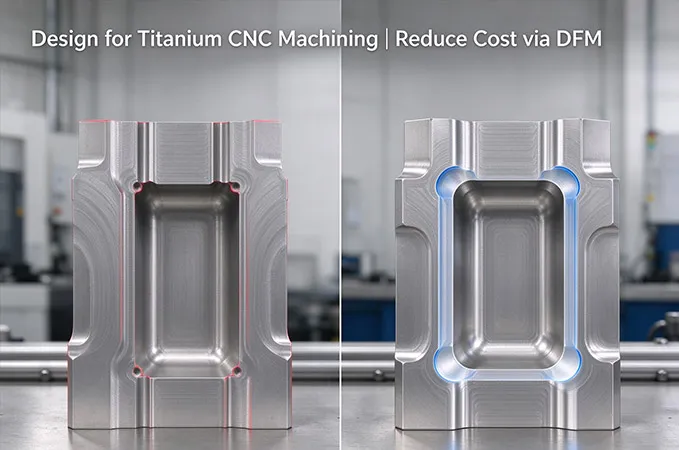
Design-for-manufacturability (DFM) review can identify features that unnecessarily increase tooling complexity, cycle time, or setup count.
Review the following:
- Deep, narrow pockets that restrict tool access.
- Small internal corner radii that require small cutters.
- Thin walls that are difficult to support during machining.
- Features that require repeated repositioning.
- Nonfunctional tight tolerances.
- Surface finishes that exceed functional needs.
An engineering review should distinguish essential design requirements from manufacturing choices that can be revised.
2. Minimize unnecessary material removal
For parts machined from billet, compare the finished geometry with the starting stock.
Potential improvements include selecting more suitable stock dimensions, using near-net-shape blanks, or evaluating a forged preform when technical and commercial conditions support it.
For expensive materials, reducing excess stock can lower both material expenditure and cutting time.
However, material optimization must preserve required grain structure, material condition, traceability, and mechanical performance where these matter to the application.
3. Use appropriate cutting tools and machining parameters
Titanium machining efficiency depends on matching tooling, cutting parameters, machine rigidity, workholding, and coolant delivery to the material and operation.
A supplier experienced with titanium can evaluate whether a different toolpath, cutting engagement, tool geometry, or machining sequence would improve tool life and productivity.
Avoid setting aggressive cutting parameters solely to reduce quoted cycle time. Premature tool failure, vibration, surface damage, and dimensional instability can erase the expected savings.
4. Apply tolerances only where necessary
Review the drawing with the design and manufacturing teams to determine which dimensions, datum relationships, and surface finishes are functionally critical.
Relaxing a genuinely unnecessary tolerance may reduce cycle time and inspection effort. Changing a functional tolerance without engineering approval, however, can create expensive assembly or reliability problems.
A clear drawing often reduces more manufacturing ambiguity than a general instruction to achieve “high precision.”
5. Consolidate machining operations where practical
Where the geometry permits, use a suitable machine and setup strategy to complete multiple features without repeated repositioning.
Depending on the part, this could mean combining milling operations, using a rotary axis, or selecting turn-mill machining.
The decision should be based on total cycle time, setup cost, programming complexity, and inspection requirements—not simply the number of axes on the machine.
6. Plan quantities around actual demand
For repeat-production parts, compare the cost of a prototype order, an initial production batch, and a larger release quantity.
A consolidated order may spread programming and setup costs across more parts. But purchasing too much inventory introduces carrying costs, working-capital requirements, storage needs, and the risk of engineering changes or obsolete stock.
The optimum quantity is therefore a balance between unit price and total purchasing cost.
7. Align inspection with functional risk
Define the required dimensional report, material documentation, sampling plan, and acceptance criteria before placing the order.
Clear inspection requirements reduce ambiguity and help suppliers price the job accurately.
Where full inspection or special documentation is required, retain it in the purchasing specification. Cost optimization should focus on efficient verification rather than removing necessary controls.
8. Compare complete quotations instead of unit prices alone
Ask suppliers to quote against the same revision of the drawing and the same assumptions for quantity, material, finishing, inspection, packaging, and delivery.
A lower unit price may exclude fixtures, material certification, special inspection, or post-processing that appears in another supplier’s quotation.
Comparing equivalent scopes makes it easier to identify genuine manufacturing savings.
How Production Quantity Changes Unit Cost
The unit cost of a titanium CNC component often decreases as quantity increases because fixed setup expenses can be distributed across more accepted parts.
The relationship is not unlimited or perfectly linear.
For low-volume production, programming and setup may be significant relative to the total order value. For repeated production, those costs can be spread over a larger number of components, and process optimization may improve productivity.
At higher quantities, other variables may become more important, including tooling consumption, inspection frequency, production capacity, raw material purchasing terms, and the cost of maintaining consistent quality.
A useful quotation comparison should separate:
| Cost category | Typical behavior as quantity increases |
|---|---|
| Initial programming | Often largely fixed for an unchanged design and process |
| Setup and fixtures | May be distributed across more parts |
| Raw material | Depends on stock dimensions, supplier terms, and quantity breaks |
| Machining | Increases with production volume, although process optimization may improve efficiency |
| Tooling | Usually grows with production volume as tools are consumed |
| Inspection | Depends on the required plan and number of characteristics to verify |
| Packaging and logistics | Depends on shipment size, packaging specification, and delivery arrangement |
When planning repeat orders, discuss annual demand, release schedules, drawing stability, and inventory constraints with suppliers. A stable production forecast may support better process planning without requiring the buyer to accept excessive inventory.
Tolerances, Surface Finish, and Inspection Costs
Tolerances and surface finish should be treated as functional requirements rather than aesthetic preferences.
A bearing interface, sealing face, or precision mounting feature may need specific geometric and surface characteristics. An external nonfunctional surface may not require the same level of control.
The cost impact arises because tighter requirements may require additional finishing, more controlled workholding, in-process measurement, or more detailed final inspection.
Questions to resolve before requesting a quote
- Which dimensions are critical to fit, alignment, sealing, or performance?
- Which features require explicit GD&T controls?
- Which surfaces require specified roughness or cosmetic finishing?
- Does inspection require a CMM or another dedicated measurement method?
- Are material certificates or traceability records required?
- Is a first-article report required before production release?
- Does the specification require full inspection or sampling for particular characteristics?
Resolving these questions early helps avoid price adjustments after production begins.
For regulated applications, such as certain medical or aerospace components, applicable standards, qualification requirements, and traceability controls should be defined by the engineering and quality teams. The exact requirements depend on the component and its intended use.
How to Compare Titanium CNC Machining Suppliers
Supplier selection affects more than the initial manufacturing price. The supplier’s process planning, equipment suitability, material purchasing controls, inspection capability, and production management can influence total cost.
Evaluate technical capability
Ask whether the supplier regularly machines the specified titanium grade and has experience with comparable part geometry.
Review the proposed machining route, workholding strategy, finishing operations, and control of challenging features such as thin walls, deep bores, or tight positional relationships.
Review quality controls
Ask how the supplier will verify critical dimensions and material conformity.
Relevant evidence may include material certificates, calibration controls, inspection reports, process records, and traceability documentation, depending on the project.
Do not assume that a particular certification is necessary for every part. Determine the requirement from the customer, applicable industry standards, and purchasing specification.
Review production repeatability
For recurring orders, assess how the supplier controls tool wear, setup changes, process drift, rejected components, and drawing revisions.
A quotation should be supported by a credible manufacturing plan, especially when dimensional consistency across batches is important.
Compare commercial terms
Normalize quotations against:
- The same material grade and material condition.
- The same drawing revision and order quantities.
- Equivalent tolerances and finish requirements.
- The same inspection and documentation scope.
- Comparable packaging and delivery terms.
- Clearly defined treatment of fixtures, tooling, and nonrecurring costs.
The objective is not to select the supplier with the highest advertised capability or the lowest price. It is to select a supplier whose proposed process can satisfy the actual technical, commercial, and delivery requirements.
What to Include in a Titanium CNC Machining RFQ
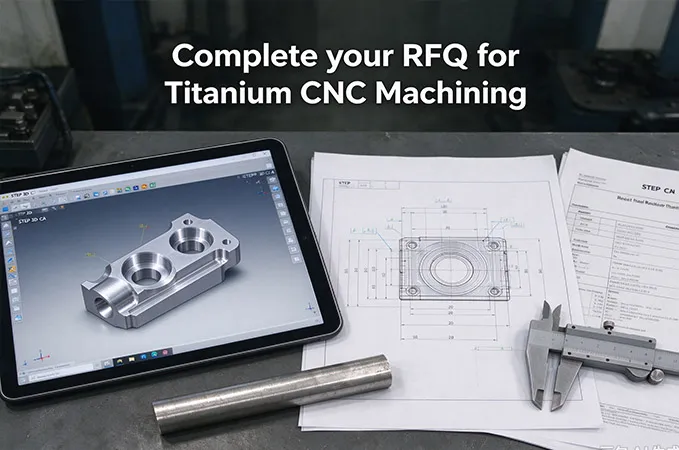
A complete request for quotation (RFQ) allows suppliers to assess manufacturing difficulty, estimate material consumption, plan inspection, and identify risks before pricing the order.
Prepare the following information.
| RFQ item | Information to provide |
|---|---|
| CAD model | A suitable 3D model in STEP or another mutually agreed format |
| Engineering drawing | A controlled 2D drawing with dimensions, datums, GD&T, and revision information |
| Material | Exact titanium grade, applicable specification, and required material condition |
| Quantity | Prototype quantity, initial batch, and forecast repeat-order volume where available |
| Tolerances | General tolerances plus explicitly identified critical characteristics |
| Surface finish | Roughness requirements and any specified treatments |
| Quality documents | Material certificates, traceability, first-article inspection, or other required records |
| Special requirements | Cleaning, marking, packaging, testing, or regulatory requirements where applicable |
| Delivery | Required delivery date and delivery destination |
| Commercial terms | Required quotation breakdown, shipping terms, and any agreed purchasing conditions |
How to request a useful quotation
Ask suppliers to identify material assumptions, nonrecurring costs, production lead time, inspection scope, and any design features that could increase cost.
For complex components, a DFM review before order placement can help clarify tool access, stock selection, critical dimensions, and possible manufacturing alternatives.
Providing complete information at the beginning is usually more useful than asking suppliers to quote an incomplete drawing and then comparing prices that were based on different assumptions.
Common Mistakes That Increase Titanium Machining Costs
Several purchasing and design decisions can increase cost without improving the finished component.
- Over-specifying tolerances: Applying restrictive tolerances to noncritical features may create additional finishing and inspection work.
- Starting with oversized stock: Excess stock can increase material consumption and machining time, particularly for expensive titanium alloys.
- Ignoring difficult geometry: Deep cavities, thin walls, and very small internal radii can force slower cutting strategies or specialized tooling.
- Comparing incomplete quotations: A quote excluding certification, inspection, surface treatment, or packaging is not directly comparable with a fully scoped quotation.
- Changing the material without engineering approval: A less expensive grade may not satisfy required strength, corrosion resistance, fatigue performance, or qualification requirements.
- Optimizing only for cutting speed: Higher cutting speed does not guarantee lower total cost if it reduces tool life or increases rejected parts.
- Ignoring order structure: A very small repeat order may repeatedly incur setup costs, while an unnecessarily large order may tie up working capital and increase inventory risk.
- Leaving inspection requirements unclear: Unspecified reports or acceptance criteria can create disagreements, delays, and additional costs after manufacturing begins.
The practical solution is to review design, materials, process planning, quality requirements, and purchasing assumptions together before production starts.
Frequently Asked Questions
Why is titanium CNC machining more expensive than aluminum machining?
Titanium alloys generally require more demanding cutting conditions than common aluminum alloys. Low thermal conductivity contributes to high temperatures at the tool-chip interface, while tool wear, cutting forces, workholding, and dimensional-control requirements can increase cycle time and process costs. Raw material cost and material waste also affect the comparison. The actual cost difference depends on the titanium grade, part geometry, production quantity, machine capability, and required finish.
What is the most expensive part of titanium CNC machining?
There is no single cost category that dominates every titanium part. Material, machining time, tooling, setup, secondary operations, and inspection can each be significant. A part with complex geometry and high material removal may be dominated by machining and material costs. A low-quantity precision component may carry a substantial setup and inspection burden relative to its production volume. A supplier quotation based on the actual design is needed to determine the largest cost drivers for a specific component.
Is Ti-6Al-4V more expensive to machine than Grade 2 titanium?
The answer depends on the material condition, geometry, operation, tooling strategy, and raw stock price. Ti-6Al-4V has different mechanical properties and machining behavior from commercially pure Grade 2, but it is not possible to establish a universal finished-part cost difference without considering the entire manufacturing process. Select the grade based on the functional requirements first, then optimize the machining process.
How can I reduce titanium CNC machining costs without sacrificing quality?
Start by reviewing the material specification, stock dimensions, part geometry, tolerances, and finish requirements. Reduce unnecessary material removal, use accessible feature geometry where possible, and identify which surfaces truly require tight tolerances or special finishing. Select an appropriate machining strategy and define inspection requirements clearly. For repeat production, compare alternative quantities and verify that suppliers are quoting the same scope.
Does five-axis CNC machining reduce titanium machining cost?
It can, particularly for parts with multiple angled surfaces, complex contours, or features that otherwise require repeated setups. However, five-axis machining may involve higher equipment and programming costs. It reduces total cost only when the time saved, setup reduction, improved access, or other process benefits outweigh those additional expenses.
Does increasing production quantity always reduce the unit price?
Not always. Larger quantities can spread fixed setup and programming costs across more parts, but tooling consumption, inspection requirements, capacity constraints, and material purchasing conditions also affect price. The lowest unit price may not correspond to the lowest total purchasing cost if the order creates excessive inventory or unnecessary financial commitment.
What tolerances should I specify for titanium CNC machined parts?
Specify tolerances based on function, assembly, and performance requirements rather than using unnecessarily tight tolerances throughout the drawing. Use explicit controls for critical dimensions and geometric relationships. Discuss difficult features with the manufacturing supplier and confirm that the measurement method can verify the specified requirement. The appropriate tolerances depend on the part geometry, manufacturing process, and application; there is no single tolerance that is suitable for every titanium component.
What information is needed for a titanium CNC machining quotation?
Provide the 3D CAD model, controlled engineering drawing, titanium grade, material condition, order quantity, tolerances, surface finish, inspection requirements, documentation needs, and delivery information. For repeat production, provide expected demand and release quantities when possible. Complete specifications help suppliers evaluate process requirements and generate more comparable quotations.
Is CNC machining always the best way to manufacture titanium components?
No. CNC machining is suitable for many precision parts and low- to medium-volume production requirements, but the best process depends on geometry, quantity, material requirements, and lifecycle cost. For parts that require removing large amounts of material, a suitable forged or near-net-shape blank may reduce waste. Other production routes may also be worth evaluating for specific geometries and volumes, provided they meet the required material, qualification, and dimensional requirements.
How should I compare titanium CNC machining quotations from different countries?
Compare equivalent material specifications, drawing revisions, quantities, tolerances, finishes, inspection documentation, and delivery terms. Include shipping, duties where applicable, packaging, communication, qualification, and the potential cost of rejected or delayed parts. A lower quoted manufacturing price does not necessarily mean a lower total landed cost or lower supply-chain risk.
Conclusion
Titanium CNC machining cost is the result of interconnected material, engineering, manufacturing, quality, and procurement decisions. The titanium grade matters, but part geometry, material removal, tooling life, machine strategy, tolerances, inspection, and production quantity can be equally important.
For engineers, the priority is to preserve functional performance while eliminating unnecessary machining work. For procurement teams, the priority is to obtain complete, comparable quotations from suppliers capable of consistently meeting the part requirements.
Before placing an order, prepare a controlled drawing and CAD model, confirm the material specification, identify critical characteristics, define surface and inspection requirements, and provide realistic production quantities. Then ask suppliers to review manufacturability and explain the major cost drivers.
This approach provides a sound basis for reducing titanium CNC machining costs without transferring avoidable expenses into rework, quality failures, or production delays.