Grade 2 vs Grade 5 vs Grade 23 Titanium: Properties, CNC Machining & Selection Guide
Quick answer: Choose Grade 2 when corrosion performance, weldability, and formability are more important than high structural strength. Choose Grade 5 (Ti-6Al-4V) when a strong, lightweight structural part is required. Choose Grade 23 (Ti-6Al-4V ELI) when the design benefits from tighter control of interstitial elements for improved ductility or fracture toughness—particularly for medical implants and fracture-critical components. Grade 5 and Grade 23 are both challenging to CNC machine; the best choice depends on the application, certified material condition, and required regulatory documentation.
1. What are Grade 2, Grade 5, and Grade 23 titanium?
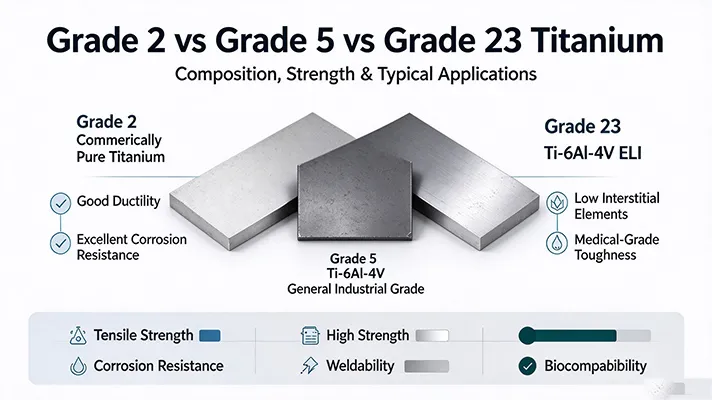
These designations describe two different material families: commercially pure (CP) titanium and the alpha-beta alloy Ti-6Al-4V. Their selection is not simply a ranking from low to high performance. Each grade balances strength, corrosion behavior, ductility, manufacturing needs, and specification requirements differently.
Grade 2 is a commercially pure titanium grade. It is commonly selected for chemical-processing equipment, heat exchangers, marine hardware, and other applications where corrosion resistance, weldability, and forming behavior are important. Its strength is substantially lower than that of Ti-6Al-4V grades.
Grade 5 is Ti-6Al-4V, an alpha-beta titanium alloy containing aluminum and vanadium within specified ranges. It is widely used where high strength-to-weight performance is essential, including aerospace structures and demanding mechanical components.
Grade 23 is Ti-6Al-4V ELI, where ELI means “extra low interstitial.” Lower limits for interstitial elements such as oxygen, as well as controlled impurity limits, improve ductility and fracture-toughness compared with standard Grade 5. Grade 23 is commonly specified for medical implant stock and selected cryogenic or fracture-critical applications. It is not automatically a drop-in substitute for every Grade 5 specification.
Grade names alone are not a complete purchasing specification. Product form, applicable ASTM or aerospace specification, heat-treatment condition, testing, traceability, and the mill certificate must match the end-use requirements.
2. Grade 2 vs. Grade 5 vs. Grade 23: property comparison
The figures below are representative specified minimum values for annealed material under commonly referenced product specifications[1]. Always verify the exact specification and material test certificate before using values for design calculations.
| Property | Grade 2 (CP titanium) | Grade 5 (Ti-6Al-4V) | Grade 23 (Ti-6Al-4V ELI) |
|---|---|---|---|
| Material family | Commercially pure titanium | Alpha-beta titanium alloy | Extra-low-interstitial alpha-beta titanium alloy |
| UNS designation | R50400 | R56400 | Verify against product form; implant specification designations may differ |
| Minimum tensile strength | 345 MPa (50 ksi) | 895 MPa (130 ksi) | 828 MPa (120 ksi) * |
| Minimum yield strength | 275 MPa (40 ksi) | 828 MPa (120 ksi) | 759 MPa (110 ksi) * |
| Minimum elongation | 20% | 10% | 10% |
| Typical density | ~ 4.51 g/cm³ | ~ 4.43 g/cm³ | ~ 4.43 g/cm³ |
| Relative strength | Moderate | High | High |
| Corrosion behavior | Excellent in oxidizing environments | Excellent in many environments | Excellent in many environments |
| CNC machining difficulty | Moderate; gummy material forms built-up edge and stringy chips | Challenging; heat concentration and tool wear need active control | Challenging; highly similar to Grade 5 |
| Typical application | Chemical equipment, marine, heat exchangers | High-strength aerospace and structural parts | Medical implants, fracture-critical components |
*Important Note on Grade 23 Strength: While 828 MPa (UTS) and 759 MPa (Yield) are the minimums for general industrial stock under ASTM B348, the medical implant specification ASTM F136[3] generally requires higher minimums of 860 MPa (125 ksi) UTS and 795 MPa (115 ksi) Yield for common section sizes. Never combine values from different product standards.
3. Grade 2 titanium: corrosion resistance and fabrication flexibility
Grade 2 is often a strong candidate when a part needs commercially pure titanium's corrosion performance, weldability, and useful ductility but does not require the structural strength of Ti-6Al-4V. Titanium's passive oxide film supports corrosion resistance in many oxidizing environments.
Common Grade 2 applications
- Chemical-processing vessels and wetted piping components.
- Heat exchangers and surface condensers.
- Marine hardware and selected seawater-service components.
- Welded or formed components relying on Grade 2's fabrication traits.
Strengths and limitations
Because Grade 2 has much lower specified tensile and yield strengths, it may need a different design to carry the same load as Grade 5. Its comparatively high ductility is beneficial in forming, but in CNC machining, this ductility causes long, stringy chips and material adhesion (built-up edge) on the cutting tool. “Softer” does not mean “effortless to machine.”
4. Grade 5 titanium: high strength-to-weight performance
Grade 5 Ti-6Al-4V is the most widely used titanium alloy globally. It is chosen when high strength, low density, fatigue performance, and corrosion resistance must be balanced in a single material.
Common Grade 5 applications
- Aerospace brackets, bulkheads, and structural fittings.
- Lightweight, high-load mechanical components in robotics and automotive.
- Motorsport, marine, and energy parts where performance justifies the cost.
Engineering considerations
Higher strength alone does not guarantee a safer part. Surface finish, notch sensitivity, residual stress, and loading spectrum profoundly affect fatigue life. Furthermore, Grade 5 is difficult to machine efficiently. Because titanium has low thermal conductivity, cutting heat remains concentrated at the tool-chip interface[5]. Stable fixturing, sharp carbide tooling, and high-pressure coolant are mandatory.
5. Grade 23 titanium: Ti-6Al-4V ELI
Grade 23 retains the principal Ti-6Al-4V alloy system but applies strict upper limits to interstitial elements—particularly oxygen (capped at 0.13% vs 0.20% in Grade 5). These chemistry controls significantly improve ductility and fracture-toughness behavior[4].
Typical applications
- Wrought stock for orthopedic, spinal, and dental surgical implants (when conforming to ASTM F136).
- Aerospace fracture-critical or cryogenic components where ELI chemistry is specified.
Do not treat “ELI” as the entire medical specification
For medical applications, a Grade 23 label alone does not guarantee compliance with FDA or MDR requirements. ASTM F136 covers wrought Ti-6Al-4V ELI intended explicitly for surgical implants. Medical device approval requires rigorous device-level biocompatibility testing, documented lot traceability back to the sponge source, and manufacturing governed by a certified Quality Management System (such as ISO 13485).
6. CNC machinability: how the three grades behave
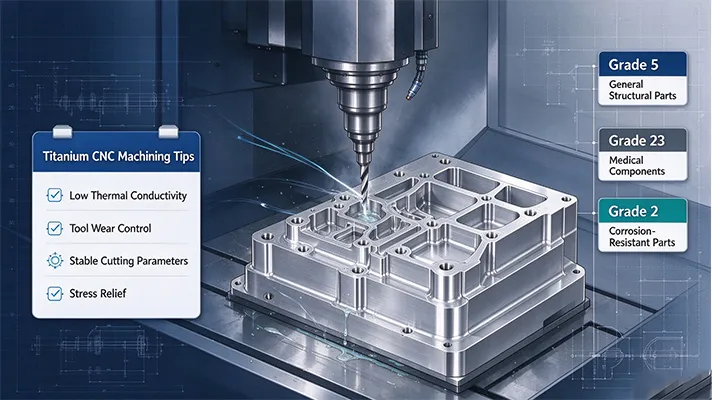
All three grades can be CNC machined, but their specific challenges differ. Titanium’s relatively low thermal conductivity means heat does not easily escape through the chip. Alloys may also chemically interact with cutting tools at elevated temperatures, requiring active control of tool wear and vibration.
| Machining factor | Grade 2 | Grade 5 | Grade 23 |
|---|---|---|---|
| Primary challenge | Ductility, built-up edge (BUE), and stringy chips | Heat concentration, high cutting loads, and tool wear | Similar to Grade 5; must manage heat and preserve material traceability |
| Workholding | Rigid support; avoid distortion on thin walls | Rigid clamping and short tool overhang | Rigid, repeatable setup with documented process controls |
| Tooling approach | Sharp, positive-rake tools suited for gummy metals; tune chip evacuation | Carbide tooling optimized for titanium; stable engagement | Use validated Grade 5 strategies unless trials indicate otherwise |
| Coolant strategy | High pressure to prevent adhesion and clear chips | Prioritize heat management and lubricity at the cutting edge | Prioritize heat management without introducing prohibited contaminants |
Practical CNC machining recommendations
- Start from a validated process window:Cutting speed, feed per tooth, and toolpath must match the alloy condition. Never apply generic steel or aluminum feeds and speeds to titanium.
- Cut consistently rather than rubbing:Dwelling in the cut accelerates heat and work-hardening. Maintain stable tool engagement.
- Support thin walls:Titanium's elastic modulus is roughly half that of steel, meaning thin sections will deflect and spring back away from the tool. Plan your roughing sequence accordingly.
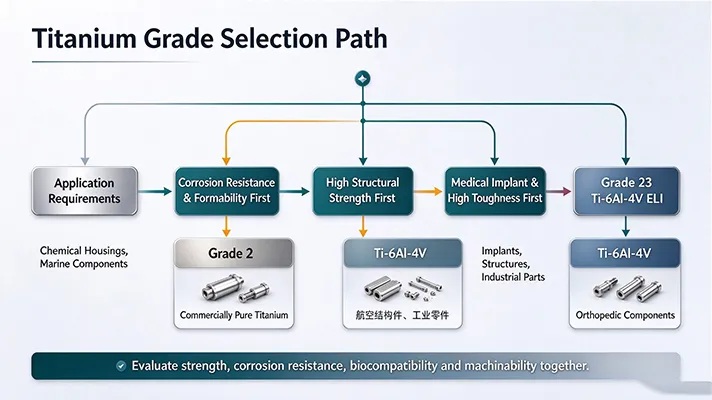
7. How to select the right grade for your part
Starting with the cheapest raw material or the highest-strength alloy can lead to unnecessary costs or unsuitable designs. Let the part's functional requirements lead.
8. Procurement checklist for titanium CNC parts
When requesting a quotation for titanium machining, provide complete technical information so your manufacturing partner can accurately estimate tooling, time, and certification requirements.
- Provide comprehensive CAD:Include 2D drawings and 3D models with critical GD&T and surface finish requirements.
- Specify exact material:Detail the material designation, applicable specification (e.g., ASTM B348 vs. ASTM F136), and required heat-treatment condition.
- Define the environment:Note the operating load case, fatigue requirements, or chemical exposures.
- Require documentation upfront:Clearly request material test certificates (MTRs), lot traceability, and specific inspection reports.
- Note post-processing:Detail any required surface treatments, passivation, or clean-room packaging.
9. Frequently asked questions
Is Grade 5 titanium stronger than Grade 2?
Yes. Grade 5 (Ti-6Al-4V) has specified minimum tensile and yield strengths that are more than double those of commercially pure Grade 2 titanium.
Is Grade 23 stronger than Grade 5?
Which titanium grade is easiest to CNC machine?
Why is Grade 23 used for medical implants?
10. Technical references
The following references support the grade definitions and property comparisons in this guide. Verify the current edition of the applicable standard before engineering release.
- Laube Technology — Titanium grades chart: specified minimum properties for annealed Grade 2, 5, and 23.
- Titanium Industries — Titanium sheet grades: typical application context.
- ASTM International — ASTM F136: wrought Ti-6Al-4V ELI alloy requirements for surgical implants.
- ATI — 6-4 ELI technical data sheet: chemistry, physical characteristics, and formability constraints.
- Ezugwu and Wang, Journal of Materials Processing Technology: research review of titanium machining challenges and tool wear.