Is Titanium Stronger Than Steel? Strength Comparison
Is Titanium Stronger Than Steel? Tensile Strength, Yield Strength & Strength-to-Weight Ratio
⏱️ The Quick Answer (TL;DR)
Is titanium stronger than steel? It depends on the specific grade and metric. Grade 5 Titanium (Ti-6Al-4V) is stronger than standard structural steel and weighs about 44% less, giving it an unbeatable strength-to-weight ratio. However, heat-treated alloy steels (like quenched AISI 1045 or 4140) can achieve significantly higher absolute ultimate tensile and yield strengths than titanium.
For CNC Machining: Choose titanium for lightweight, corrosion-resistant aerospace or medical parts. Choose steel for high-stiffness, wear-resistant, and cost-effective industrial tooling.
When engineers and product designers compare titanium and steel for custom CNC components, the exact mechanical properties—tensile strength, yield strength, and specific strength—dictate the final material choice.
In this guide, we dive deep into the metallurgical data to compare titanium and steel, helping you select the perfect material for your next precision CNC machining project.
1. What Does "Stronger" Mean in Material Selection?
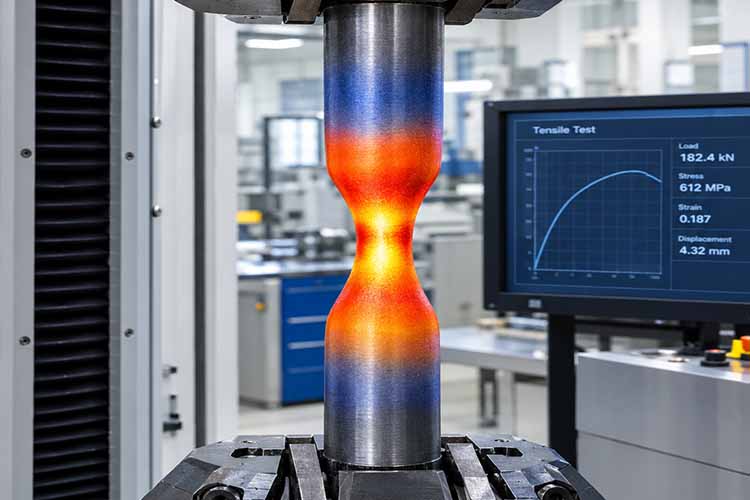
Before putting these two metal giants head-to-head, it’s vital to clarify that "strength" is not a single, universal property. In mechanical engineering, strength is broken down into three primary categories:
- Ultimate Tensile Strength (UTS): The maximum stretching or pulling stress a material can withstand before catastrophic failure (breaking). Measured in MPa or PSI.
- Yield Strength: The maximum stress a material can handle before it permanently bends or deforms (plastic deformation). For CNC-machined parts that require strict dimensional accuracy, yield strength is often the most critical metric.
- Specific Strength (Strength-to-Weight Ratio): The material's strength divided by its density. This metric is the holy grail for aerospace engineers, robotics designers, and automotive manufacturers.
Engineering Takeaway: You cannot compare "titanium" to "steel" broadly. You must compare specific alloys (e.g., Grade 5 Titanium vs. AISI 1045 Steel) across the exact type of load your part will endure.
2. Titanium vs Steel: Mechanical Properties Compared
To provide a realistic comparison, we’ve sourced representative published data for highly common CNC machining materials. Note: Values can vary based on heat treatment and form.
| Material & Condition | Density (g/cm³) | Tensile Strength (MPa) | Yield Strength (MPa) | Best Application |
|---|---|---|---|---|
| Grade 2 Titanium (Commercially Pure) | 4.51 | ≥ 345 | ≥ 275 | Chemical processing, medical devices (high corrosion resistance) |
| Grade 5 Titanium (Ti-6Al-4V) | 4.43 | ≥ 895 | ≥ 830 | Aerospace, high-performance structural components |
| AISI 1045 Steel (Normalized) | ~7.85 | ~ 565 | ~ 310 | Economical general engineering parts, gears, shafts |
| AISI 1045 Steel (Quenched & Tempered) | 7.85 | 1,825 | 1,259 | Heavy-duty, wear-resistant tooling |
| 304 Stainless Steel (Annealed) | 7.90 | ≥ 515 | ≥ 205 | General-purpose corrosion-resistant fixtures |
Analyzing the Data
The table reveals three crucial engineering realities:
- Grade 5 Titanium crushes basic steel: Ti-6Al-4V is vastly stronger than normalized 1045 carbon steel and 304 stainless steel in both tensile and yield metrics.
- Heat treatment changes everything: When AISI 1045 steel is quenched and tempered, its absolute strength skyrockets, easily surpassing Grade 5 titanium.
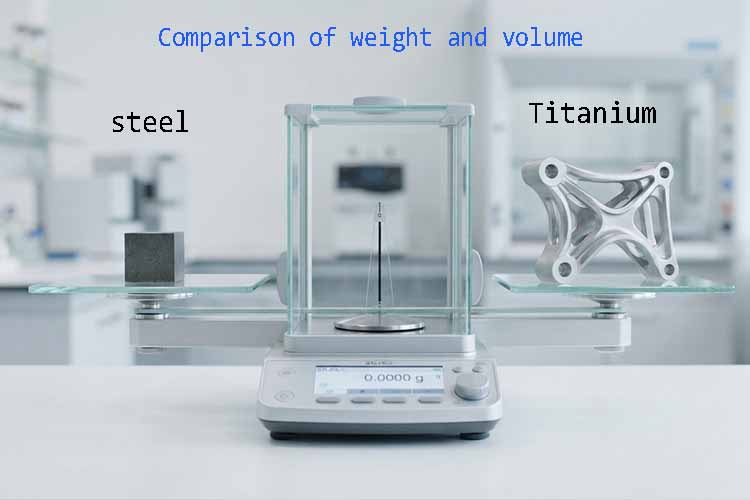
- Titanium is remarkably light: Notice the density column. Titanium is nearly half the weight of steel.
3. Tensile Strength: Withstanding Pulling Forces
Tensile strength matters most when designing tie rods, suspension links, fasteners, and load-bearing connectors.
The Titanium Advantage:
Ti-6Al-4V (Grade 5) is an alpha-beta alloy containing aluminum and vanadium. Boasting a minimum tensile strength of 895 MPa, it is incredibly resilient under tension. However, commercially pure Grade 2 Titanium is quite soft (345 MPa) and should not be used for high-tension structural loads.
The Steel Advantage:
Steel’s tensile strength is highly malleable. While normalized medium-carbon steel sits around 565 MPa, heat-treated alloy steels can push past 1,800 MPa. If a component requires the maximum possible pulling resistance and weight is not an issue, heat-treated steel is the definitive winner.
4. Yield Strength: Resisting Permanent Deformation
If your CNC-machined part bends and stays bent, it has failed. Yield strength dictates exactly when that permanent plastic deformation occurs.
- Grade 5 Titanium: ~830 MPa
- Normalized 1045 Steel: ~310 MPa
- Heat-Treated 1045 Steel: ~1,259 MPa
Why this matters for CNC Machining: Imagine a robotic arm linkage moving at high speeds. If the linkage yields under the stress of rapid acceleration, the robot loses its calibration. For un-heat-treated components, Grade 5 titanium offers a massive safety margin against yielding compared to standard carbon and stainless steels.
5. Strength-to-Weight Ratio: Titanium's Superpower
If you take only one concept away from this guide, it should be this: Titanium's true dominance lies in specific strength.
With a density of roughly 4.43 g/cm³, titanium is about 43.6% lighter than steel (7.85 g/cm³). To calculate the strength-to-weight ratio, engineers use the formula: Specific Strength = Strength ÷ Density.
| Material | Tensile-to-Density Index | Verdict |
|---|---|---|
| Grade 5 Titanium | 202.0 | Exceptional for lightweight applications |
| AISI 1045 Steel (Normalized) | 72.0 | Heavy and moderately strong |
| 304 Stainless Steel | 65.2 | Lowest strength-to-weight ratio |
In aerospace (like Boeing or NASA components), motorsport, and lightweight robotics, minimizing inertia and fuel consumption is paramount. Titanium allows engineers to maintain high structural integrity while shedding nearly half the weight of a steel equivalent.
6. When High-Strength Steel Outperforms Titanium
Despite titanium's premium reputation, steel remains the backbone of global manufacturing for several critical reasons:
- Extreme Hardness & Wear Resistance: Titanium is susceptible to galling (adhesive wear) and is relatively soft on its surface. For gears, drive shafts, tooling dies, and sliding-contact components, hardened steels (like 4140, D2, or hardened 1045) vastly outperform titanium.
- Absolute Strength Limit: As proven by our data tables, certain high-carbon and alloy steels, when quenched and tempered, can achieve yield strengths that titanium simply cannot reach physically.
- Economics: Raw steel is vastly cheaper, and processing it requires less specialized machinery.
7. Stiffness, Fatigue, and Corrosion Resistance
Mechanical design is about more than just breaking points. You must consider stiffness and environmental survival.
Stiffness (Young’s Modulus): Steel Wins
Stiffness is measured by Elastic Modulus. Steel has a modulus of roughly 200 GPa, while titanium sits at about 114 GPa. This means that if you have a steel rod and a titanium rod of the exact same dimensions, the titanium rod will bend (elastically) almost twice as much under the same load. If your part requires absolute rigidity with zero deflection, steel is superior.
Corrosion Resistance: Titanium Wins
Titanium instantly forms a stable, highly protective oxide layer upon exposure to oxygen. It is virtually immune to saltwater, chlorides, and many industrial acids. While stainless steels (like 316) are excellent, titanium remains the gold standard for long-term marine and biomedical implants.
8. CNC Machining: Manufacturability & Costs
Material selection drastically impacts your CNC manufacturing costs, lead times, and tolerancing.
| Machining Factor | Titanium Alloys (Ti-6Al-4V) | Carbon & Alloy Steels |
|---|---|---|
| Thermal Conductivity | Low. Heat concentrates on the cutting tool, leading to rapid tool wear. | High. Heat dissipates effectively through the chips. |
| Deflection & Chatter | Lower modulus causes thin walls to push away from the tool (springback). | Highly rigid; easier to hold ultra-tight tolerances on thin walls. |
| Tooling Costs | Requires specialized carbide tools, high-pressure coolant, and strict feeds/speeds. | Standard tooling works well; highly optimized across the industry. |
The Machining Reality: Titanium has a tendency to work-harden and gall during machining. To successfully mill or turn titanium, your CNC partner must have rigid machine setups and optimized toolpaths. Steel, generally speaking, is much easier and cheaper to machine.
9. Checklist: When to Choose Titanium vs. Steel
✅ Choose Titanium When:
- Weight is critical: Aerospace components, drones, high-end bicycles, and racing parts.
- Corrosion is severe: Marine hardware, medical implants, or chemical processing plants.
- Inertia must be reduced: Fast-moving robotic arms where lower mass equals faster movement.
- Budget allows for premium manufacturing.
✅ Choose Steel When:
- Maximum stiffness is required: Machine frames, long shafts, and heavy-duty fixtures.
- Wear resistance is paramount: Gears, sliding rails, stamping dies, and punches.
- Absolute maximum yield strength is needed: High-load industrial applications where weight doesn't matter.
- Cost reduction is the primary goal.
10. Frequently Asked Questions (FAQ)
Is titanium stronger than steel?
Not universally. Grade 5 titanium is stronger than basic structural carbon steel and has a vastly superior strength-to-weight ratio. However, heat-treated high-carbon and alloy steels can reach much higher absolute tensile and yield strengths than titanium.
Is titanium stiffer than steel?
No. Steel has an elastic modulus of around 200 GPa, compared to titanium's 114 GPa. Given the same dimensions, steel will deflect less under load than titanium.
Why is titanium harder to machine than steel?
Titanium has poor thermal conductivity, meaning the heat generated during cutting transfers into the cutting tool rather than the chips. It also has a lower elastic modulus, making it prone to "springback" and tool chatter, requiring specialized CNC strategies.
11. Expert Titanium & Steel CNC Machining Services
Choosing between titanium and steel goes beyond reading a datasheet. It requires evaluating toolpath strategies, material costs, and dimensional stability.
At Rapid Model, our engineering team specializes in high-precision Titanium CNC Machining and advanced steel manufacturing. We optimize feeds, speeds, and tool geometries to prevent galling, limit thermal expansion, and deliver parts with pristine surface finishes.
Ready to optimize your next component? Prepare your CAD drawings, required tolerances, and material specifications, and our engineers will help you make the most cost-effective and structurally sound choice.