Types of Rivets: A Guide to 8 Common Rivet Types
Rivets are permanent mechanical fasteners widely used to join sheet metal, structural components, enclosures, machinery, vehicles, and many other assemblies. Unlike screws and bolts, most rivets are not intended to be removed after installation.
However, not all rivets work in the same way. Different types of rivets are designed for different joint strengths, materials, installation methods, and accessibility conditions.
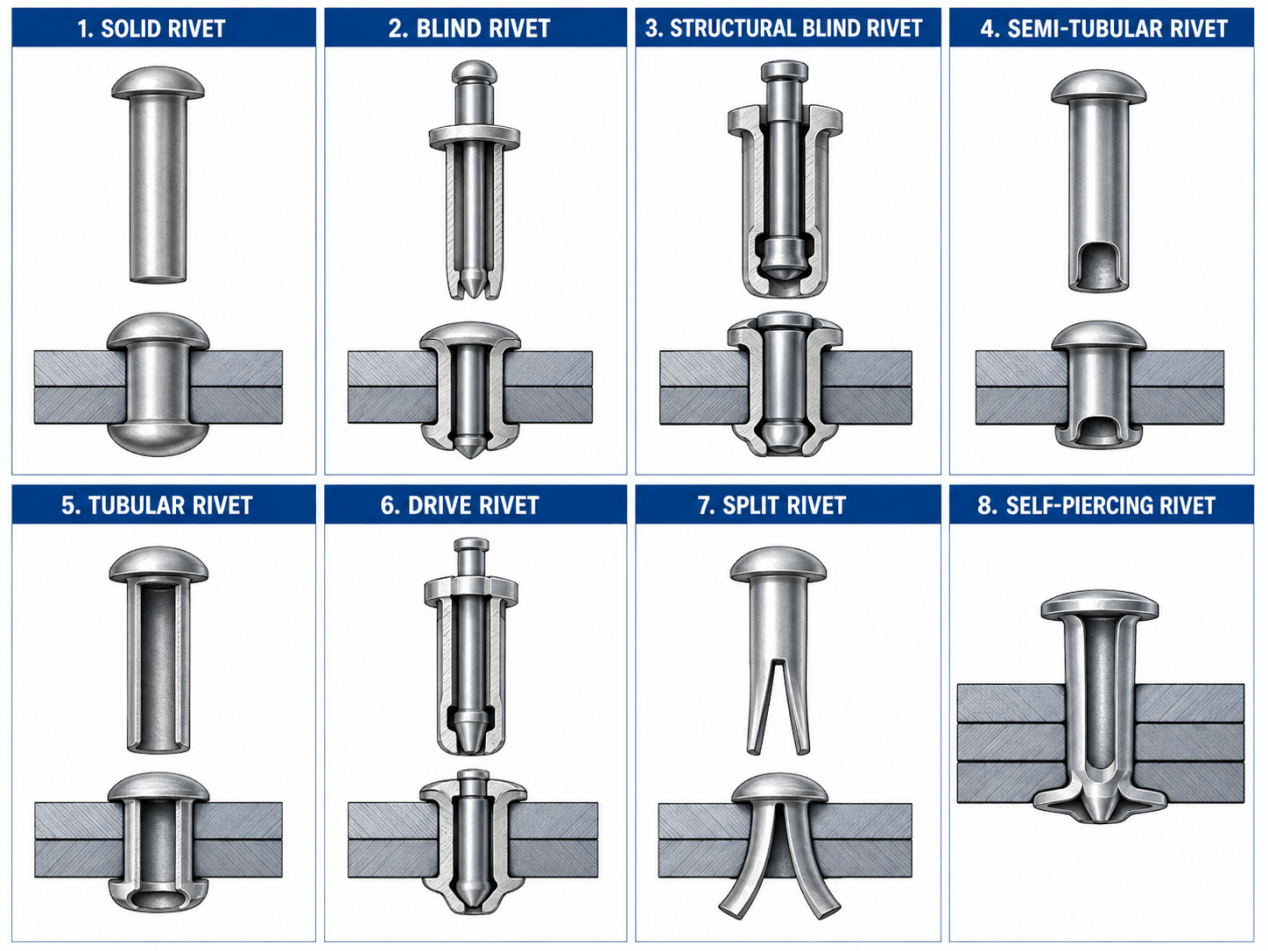
The most common rivet types include solid rivets, blind rivets, structural blind rivets, semi-tubular rivets, tubular rivets, drive rivets, split rivets, and self-piercing rivets.
This guide explains how each type works, where it is commonly used, and what engineers should consider when selecting rivets for manufactured parts.
What Is a Rivet?
A rivet is a permanent mechanical fastener consisting primarily of a head and shank. It is inserted through the parts being joined and then deformed or expanded so that a second retaining head or locking feature is formed on the opposite side.
This deformation prevents the rivet from being pulled back through the hole and clamps the materials together.
The exact installation method depends on the rivet design. Some rivets require access to both sides of the assembly, while blind rivets can be installed when only one side is accessible.
1. Solid Rivets
Asolid rivet is one of the simplest and strongest traditional rivet designs. It consists of a solid cylindrical shank with a manufactured head on one end.
During installation, the rivet is placed through aligned holes and the tail is mechanically deformed to form a second head.
Because the tail normally needs to be supported or formed from the opposite side, solid riveting generally requires access to both sides of the joint.
Solid rivets are commonly associated with applications where joint strength, fatigue resistance, and reliability are important, including aircraft structures and heavy mechanical assemblies.
Typical applications:
>aircraft structures;
>structural metal assemblies;
>heavy equipment;
->bridges and steel structures;
>high-strength sheet metal joints.
Main advantage: high mechanical strength and reliability.
Main limitation: access is generally required to both sides during installation.
2. Blind Rivets
Blind rivets are among the most common rivets used in modern sheet metal fabrication.
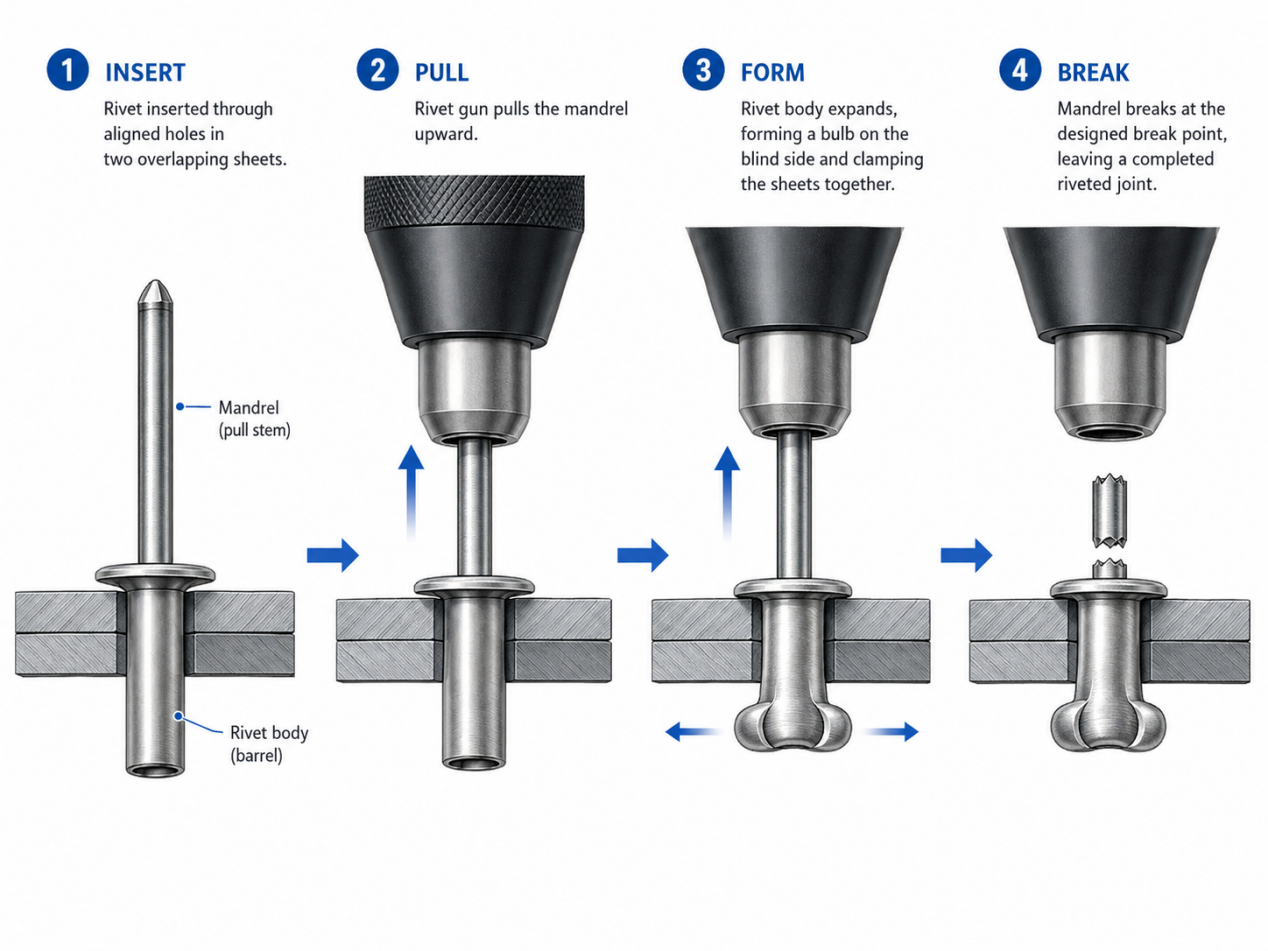
A blind rivet consists of a hollow rivet body and an internal mandrel. The rivet is inserted into a prepared hole from one side of the assembly. A rivet tool then pulls the mandrel, causing the rivet body on the blind side to expand and clamp the materials together. The mandrel eventually breaks at a designed point.
Their main advantage is obvious:
Blind rivets can be installed with access to only one side of the assembly.
They are therefore particularly useful for closed sections, housings, sheet metal enclosures, ducts, and assemblies where the rear surface cannot easily be reached.
Blind rivets are also frequently called pop rivets, although POP® originated as a brand name rather than the generic technical term.
Typical applications:
>sheet metal enclosures;
>electronics housings;
>HVAC components;
>automotive panels;
>cabinets;
>lightweight structures.
3. Structural Blind Rivets
Astructural blind rivet operates on the same general principle as a conventional blind rivet but is engineered for higher mechanical loads and more demanding assemblies.
Certain structural blind rivets mechanically lock the mandrel into the rivet body, improving shear and tensile performance and providing greater resistance to vibration than standard open blind rivets.
They are commonly considered when one-sided installation is necessary but a stronger joint is required.
Typical applications:
>transportation equipment;
>truck bodies;
>industrial structures;
>heavy sheet metal assemblies;
>vibration-resistant joints.
When specifying structural blind rivets, engineers should use manufacturer load data rather than assuming that all blind rivets provide the same strength.
4. Semi-Tubular Rivets
Asemi-tubular rivet resembles a solid rivet but has a partial axial hole in the tail end.
Because the tail is hollow for part of its length, less force is required to deform it during installation compared with a completely solid rivet. The hollow section expands or rolls outward to secure the joint.
Semi-tubular rivets can also be useful for joints where limited rotational movement is required.
典型的なアプリケーションには以下のものが含まれます:
>hinges;
>brake components;
>ladders;
>lighting products;
>electronic products;
>mechanical assemblies.
They are often installed using presses, squeezers, impact riveting equipment, or automated riveting machines.
5. Tubular Rivets
Atubular rivet has a hollow shank extending much farther into the rivet body than a semi-tubular design.
The hollow end is flared or rolled during installation to create the retaining feature.
Because relatively little material needs to be deformed, tubular rivets can be installed with lower forming forces. They are generally better suited to light- and medium-duty fastening than highly loaded structural joints.
Typical applications:
>electrical components;
>consumer products;
>light sheet metal assemblies;
>leather products;
>plastic assemblies;
>lightweight mechanical components.
Semi-tubular and fully tubular rivets look similar, so they should be specified clearly on engineering documentation rather than relying only on visual appearance.
6. Drive Rivets
Adrive rivet is installed by driving a pin or mandrel into the rivet body rather than pulling a mandrel with a conventional blind-rivet tool.
As the pin is driven inward, the rivet body expands and locks into the hole. Some drive-rivet designs can therefore be installed with relatively simple tools and with access from one side.
Typical applications:
>nameplates;
>identification plates;
>signs;
>panels;
>plastic components;
>light-duty assemblies.
Drive rivets are convenient for fast installation, but they are generally not selected as substitutes for high-strength structural fasteners without appropriate engineering verification.
7. Split Rivets
Asplit rivet has a shank divided into two or more legs.
During installation, these legs spread apart or bend outward, creating a mechanical lock behind the material.
This design works particularly well with softer materials because the expanded legs provide a relatively large retaining area.
Typical applications:
>leather;
>plastics;
>fiberboard;
>soft materials;
>lightweight products.
Split rivets are generally more appropriate for light-duty fastening than structural metal joints. Different rivet manufacturers offer split and bifurcated designs for specialized assembly requirements.
8. Self-Piercing Rivets
Self-piercing riveting (SPR) differs from conventional riveting because the sheets do not necessarily require a pre-drilled hole.
During installation, a specially shaped rivet is driven through the upper sheet or sheets while a die supports the material underneath. The rivet penetrates the upper material and flares into the lower sheet, producing a mechanical interlock without completely penetrating the bottom layer.
This makes self-piercing riveting particularly useful in automated sheet metal assembly.
Typical applications:
>automotive body structures;
>aluminum sheet assemblies;
>mixed-material joints;
>high-volume sheet metal manufacturing.
SPR equipment and joint design are more specialized than conventional hand-installed riveting, so the process is normally engineered as part of the production system.
Comparison of Common Rivet Types
Rivet Type | Access Required | 標準強度 | Common Application |
Solid | Both sides | 高い | Aircraft and structural assemblies |
盲目 | One side | Low–Medium | Sheet metal enclosures |
Structural Blind | One side | Medium–High | Transportation and industrial assemblies |
Semi-Tubular | Usually both sides | 中くらい | Hinges and mechanical products |
Tubular | Usually both sides | Low–Medium | Lightweight assemblies |
Drive | One side | Low–Medium | Panels and nameplates |
Split | One side / simple assembly | 低い | Soft materials |
Self-Piercing | Automated die access | Medium–High | Automotive sheet metal |
Actual joint performance depends on rivet diameter, geometry, material, grip range, installation quality, and the materials being joined. Manufacturer specifications should therefore be used when structural load capacity is important.
Common Rivet Materials
Rivets are manufactured from several metals, including:
>アルミニウム;
>鋼鉄;
>ステンレス鋼;
>copper;
>brass;
>specialty alloys.
Blind rivets, for example, are commonly available in aluminum, steel, and stainless steel combinations. Material choice affects strength, corrosion resistance, weight, cost, and compatibility with the parts being joined.
For outdoor or corrosive environments, stainless steel may provide better corrosion resistance, while aluminum is often preferred when low weight and ease of installation are priorities.
Engineers should also consider galvanic corrosion when dissimilar metals will be exposed to moisture.
Common Rivet Head Types
Rivet type and rivet head style should not be confused.
For example, a blind rivet may be supplied with several different head configurations. Common head styles include:
>dome or standard heads;
>countersunk heads;
>large-flange heads.
Head selection affects load distribution, surface profile, appearance, and the preparation required in the mating material.
A countersunk rivet may be preferred when a flush surface is required, while a large-flange design can distribute load over a wider area.
How to Choose the Right Type of Rivet
Selecting the correct rivet requires more than choosing a diameter.
Important engineering considerations include:
>accessibility — can both sides of the assembly be reached?
>joint strength — what shear and tensile loads must the joint withstand?
>material thickness — is the rivet grip range suitable?
>base materials — are you joining aluminum, steel, plastic, composites, or mixed materials?
>耐食性 — will the joint operate outdoors or in a corrosive environment?
>surface requirement — is a flush head necessary?
>production volume — will riveting be manual or automated?
>service environment — will vibration, temperature, or moisture affect the joint?
For blind riveting in particular, rivet diameter and grip range should match the prepared hole and the combined thickness of the materials being joined.
Rivets in Sheet Metal Fabrication
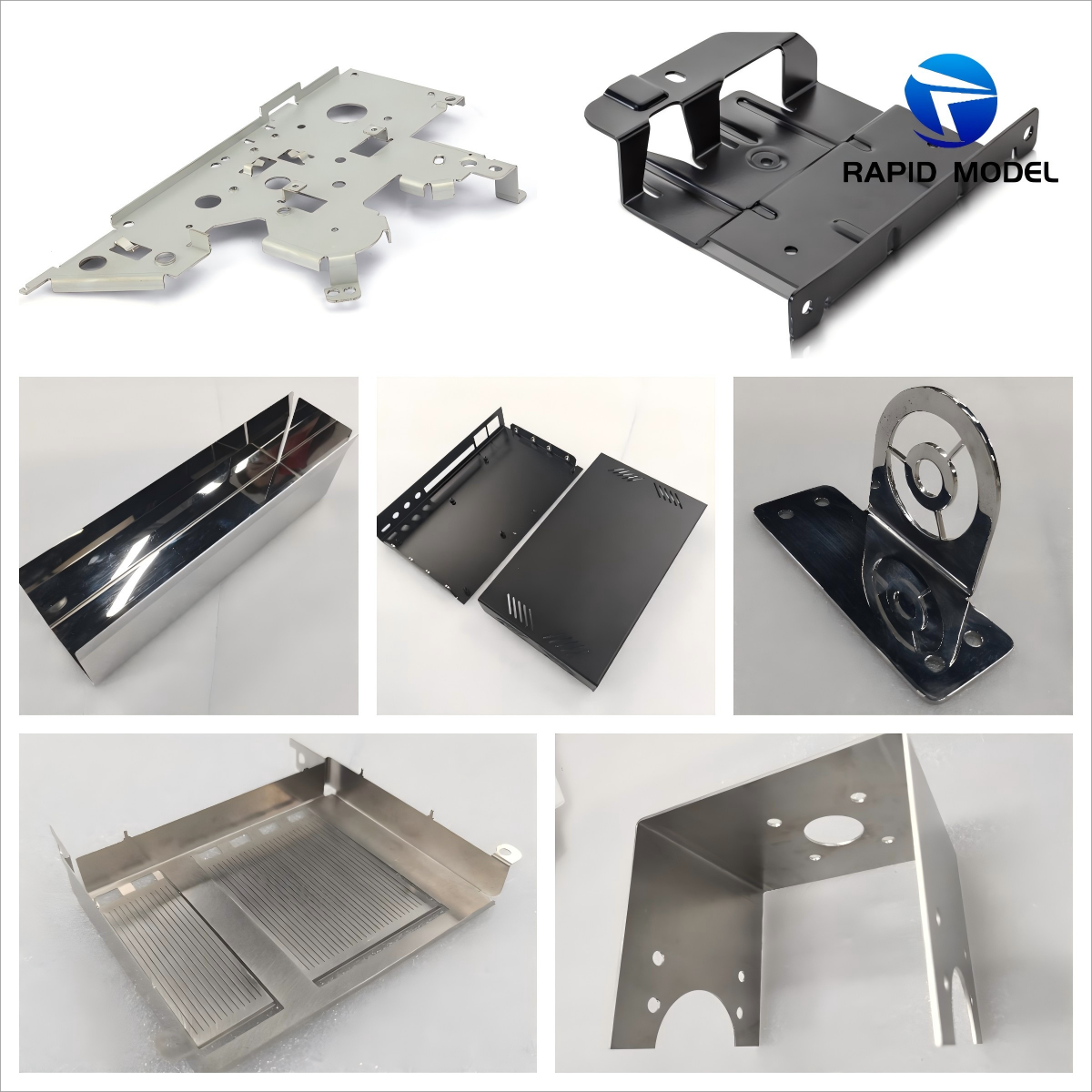
Riveting remains useful in sheet metal fabrication because it can permanently join thin materials without requiring access for a nut and, in many cases, without applying the heat associated with welding.
The appropriate joining method ultimately depends on product requirements. A fabricated enclosure, for example, may use a combination of bending, welding, threaded inserts, rivets, and mechanical fasteners.

For custom sheet metal parts, engineers should define critical joining requirements on the drawing, including hole diameter, rivet type, material, head style, and any cosmetic or structural requirements.
Rapid-Model provides custom sheet metal fabrication and CNC machining for prototypes and low-volume production. Providing complete CAD files, drawings, material specifications, finishes, and assembly requirements helps the manufacturing team evaluate the appropriate fabrication and joining process.
結論
There are many types of rivets, and each is designed for a different combination of installation access, material, load, and production requirements.
Solid rivets provide excellent strength when both sides are accessible, while blind rivets are ideal when installation is possible from only one side. Semi-tubular and tubular rivets reduce forming force, drive and split rivets provide simple fastening solutions, and self-piercing rivets are particularly useful in automated sheet metal production.
Choosing the right rivet requires consideration of joint loads, material compatibility, grip range, hole size, corrosion resistance, installation method, and service environment—not simply the external appearance of the fastener