Ist Titan härter als Kohlenstoffstahl? Ein umfassender Engineering Guide
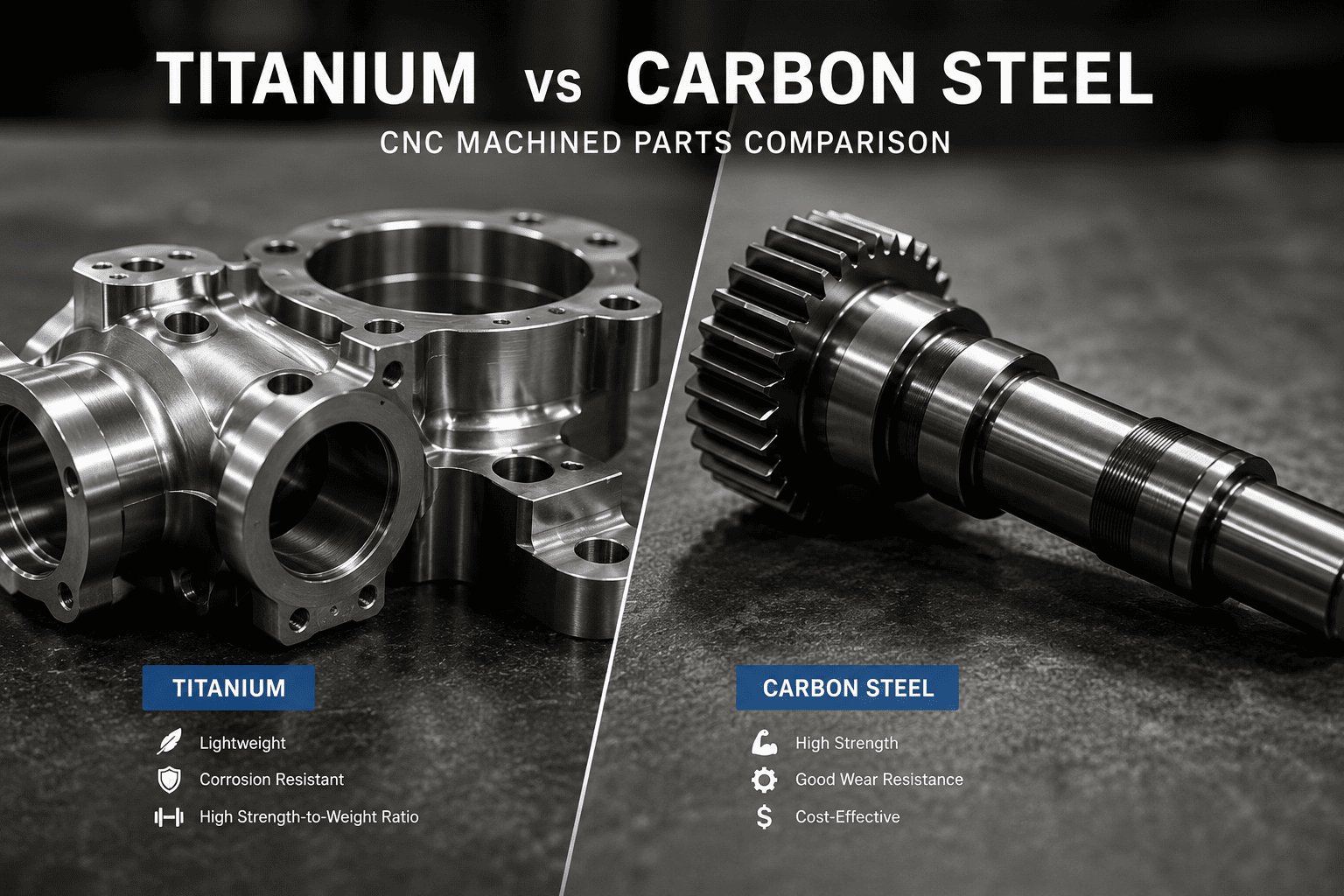
Wenn Ingenieure und Produktdesigner Metalle für die CNC-Bearbeitung vergleichen, lautet eine der häufigsten Fragen: Ist Titan härter als Kohlenstoffstahl?
Die direkte Antwort lautet: Nicht immer. Während Titan weithin als Premium-Hochleistungsmaterial anerkannt wird, hängt seine Härte ausschließlich von der spezifischen Titanqualität, der Stahlqualität und dem Wärmebehandlungszustand ab.
Bei der PräzisionsCNC-Bearbeitung reicht es nicht aus, einfach zu fragen, welches Material härter ist. Die bessere Frage ist: Welches Material eignet sich besser für die Funktion, Toleranz, Gewichtsanforderungen, korrosive Umgebung und Budget Ihres Teils? Tauchen wir in die Details ein.
Kommerziell reines Titan vs. mittlerer Kohlenstoffstahl
Kommerziell reines Titan ist nicht außergewöhnlich hart. Zum Beispiel wird Titan der Klasse 2 auf etwa Rockwell B 80 (145 HV Vickers) nach ASM/MatWeb Daten.
Andererseits kann ein üblicher mittlerer Kohlenstoffstahl wie AISI 1045 unter bestimmten gelieferten Bedingungen rund um Rockwell B 84 (170 HV) erreichen. Dies bedeutet, dass einige gewöhnliche, unbehandelte Kohlenstoffstahl tatsächlich härter sind als kommerziell reines Titan.
Titanlegierungen vs. Kohlenstoffreiche & Werkzeugstahl
Die Geschichte ändert sich, wenn wir uns Titanlegierungen ansehen. Ti-6Al-4V (Grad 5 Titan) ist deutlich härter als seine kommerziell reinen Gegenstücke. Geglühtes Ti-6Al-4V hat eine Härte von etwa Rockwell C 36 (349 HV). Dies macht Titan der Klasse 5 härter als viele unbehandelte milde oder mittlere Kohlenstoffstahl.
Doch Stahl ist unglaublich vielseitig. Gehärteter kohlenstoffroher Stahl und Werkzeugstahl (der gelöscht und gehärtet wurde) können die Härte selbst der härtesten Titanlegierungen leicht übertreffen. Daher ist Titan nicht automatisch härter als Kohlenstoffstahl; es ist ganz relativ zu den verglichen Graden. 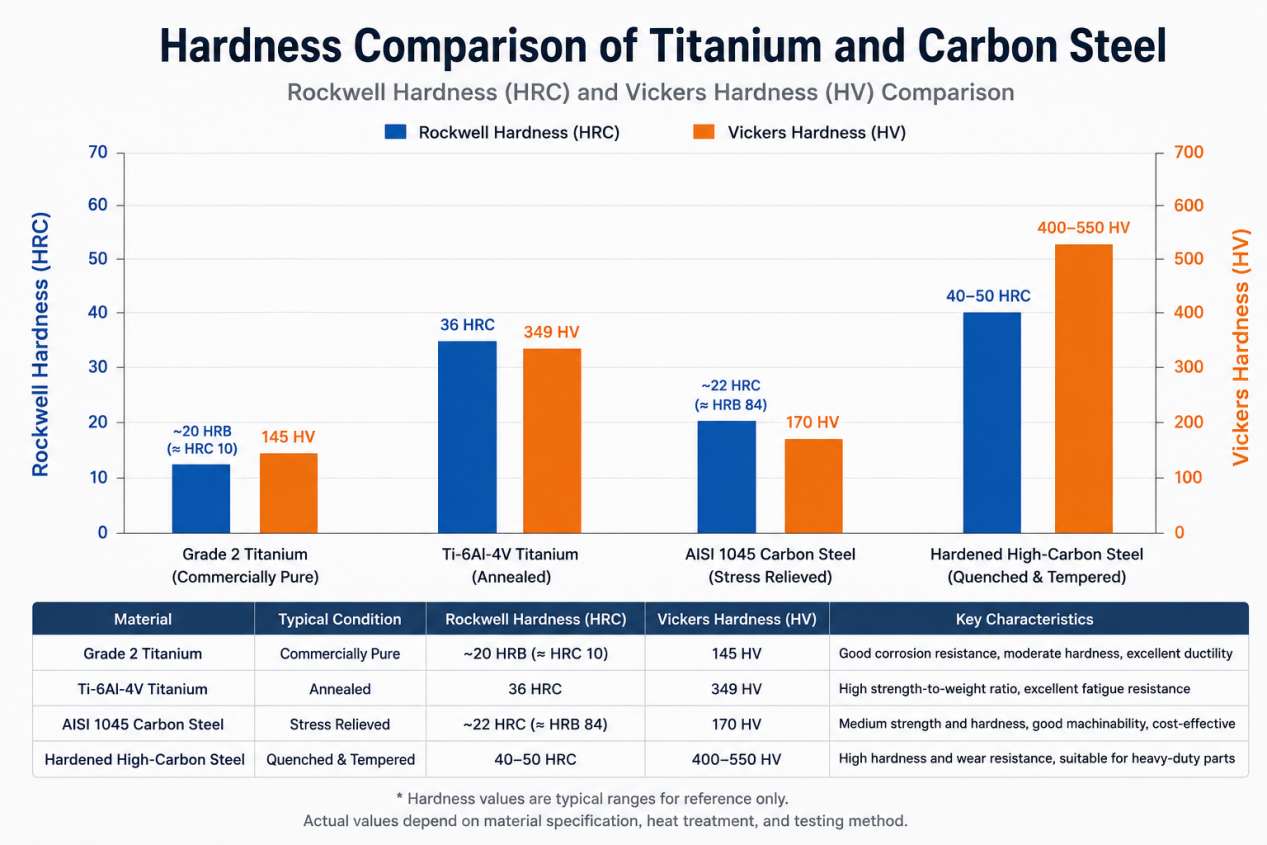
Titan vs. Kohlenstoffstahl Härte Vergleich
Material | Typischer Zustand | ca. Härte | Praktische Bedeutung |
Klasse 2 Titan | Kommerziell rein | HRB 80 / 145 HV | Gute Korrosionsbeständigkeit, moderate Härte |
Ti-6Al-4V (Klasse 5) | Geglühte Legierung | HRC 36 / 349 HV | High strength-to-weight ratio, harder to machine |
AISI 1045 Steel | Hot rolled / stress relieved | HRB 84 / 170 HV | Economical medium-carbon steel |
High-Carbon Steel | Quenched & tempered | Often > Ti-6Al-4V | Better for highly wear-resistant parts |
Tool Steel | Heat treated | Much higher | Used for dies, punches, molds, and tooling |
Why "Hardness" Isn't Everything in Material Selection
The reason "carbon steel" is a tricky category is due to its carbon content and heat treatment variability:
• Low-carbon (mild) steel: Soft, ductile, and highly machinable.
• Medium-carbon steel: Offers a great balance of strength, hardness, and cost.
• High-carbon steel: Can be heat-treated to achieve extreme hardness and wear resistance.
Titanium’s true value does not lie in being the "hardest" metal. Its distinct advantages are its incredible strength-to-weight ratio, excellent corrosion resistance, and biocompatibility. This is why titanium is the go-to choice for aerospace components, medical implants, robotics, marine equipment, and high-performance automotive parts. It provides robust mechanical performance while significantly reducing weight.
CNC-Bearbeitung Challenges: Why Titanium "Feels" Harder
In CNC machining, titanium can often feel much harder to machine than steel, even if its Rockwell hardness number is lower. Why?
Titanium has low thermal conductivity. This means that during machining, the cutting heat doesn't dissipate through the chip; instead, it stays concentrated near the cutting tool edge. This accelerates tool wear and creates challenges with surface finish, chatter, and dimensional stability.
How to Choose: Titanium or Carbon Steel?
Material selection should always be aligned with your engineering drawings and end-use application.
Choose Titanium when your project requires:
• Significant weight reduction without sacrificing strength.
• Extreme corrosion resistance (e.g., marine or chemical environments).
• Biocompatibility (medical devices).
• High performance in aerospace or robotic applications.
Choose Carbon Steel when your project requires:
• High hardness and wear resistance (achieved via heat treatment).
• Lower material and manufacturing costs.
• Strong structural performance where weight is not a strict limiting factor.
• Components like shafts, gears, fixtures, and general tooling. (Note: Carbon steel requires surface treatments like plating or black oxide to prevent rust). 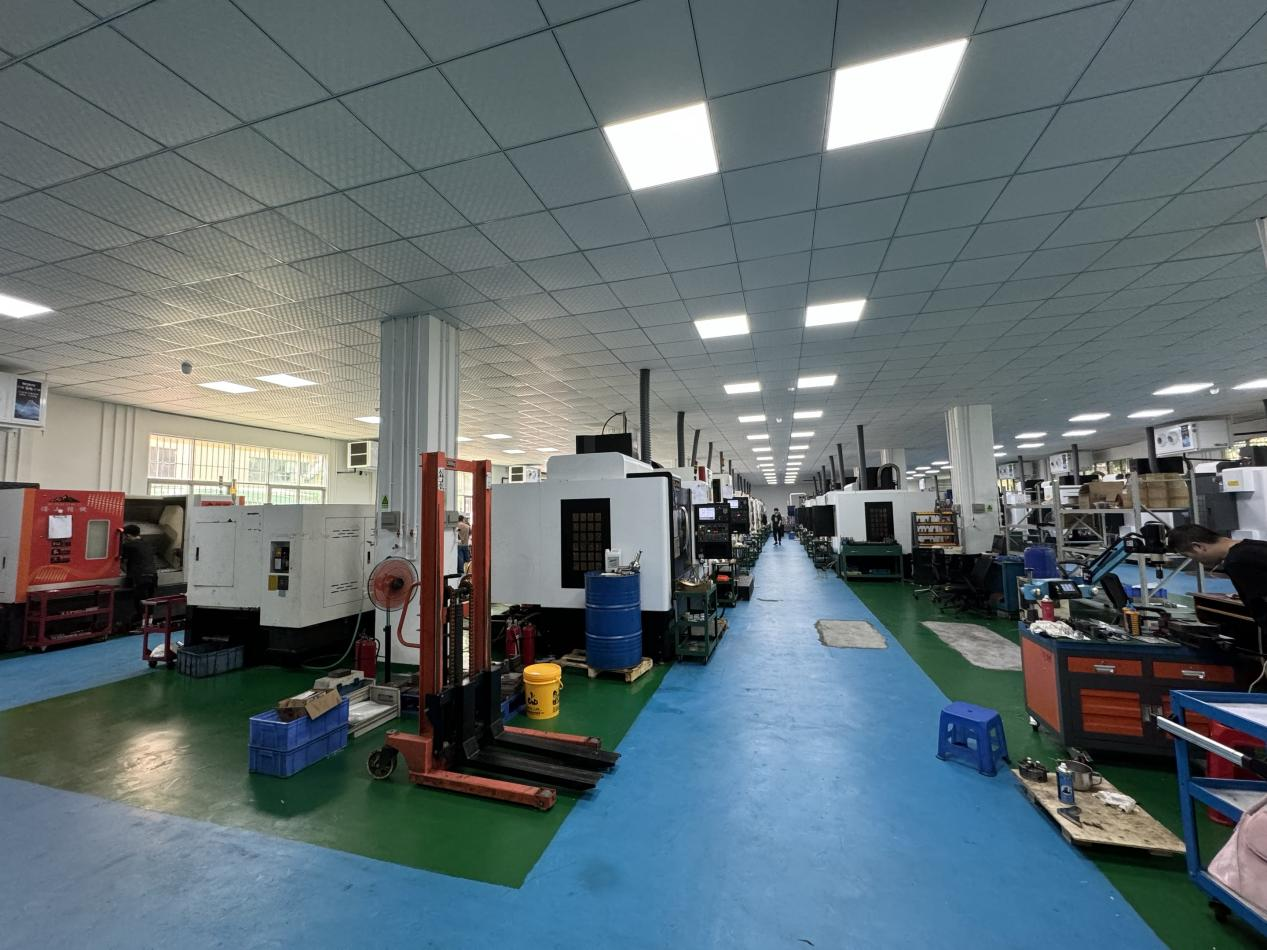
Professional CNC Machining Services at Rapid-Modell
A simple statement like "titanium is harder than carbon steel" can be misleading if the grade, condition, and application are not defined. For successful CNC projects, details matter: material grade, tolerance, surface finish, and production volume.
At Rapid-Model, we help our global customers evaluate materials from a practical, manufacturing-first perspective. As a premier Shenzhen-based CNC machining supplier, we provide end-to-end manufacturing solutions. From custom CNC machining, titanium and steel machining, to sheet metal fabrication—we take your project from rapid prototype to large-scale production seamlessly.
Final Verdict
Is titanium harder than carbon steel? Sometimes, but not always. Commercially pure titanium is often softer than medium-carbon steel. Grade 5 Titanium is harder than untreated steel, but hardened tool steel remains superior in pure hardness. Ultimately, hardness is just one factor. The best material is the one that perfectly balances strength, weight, wear, corrosion, precision, and cost for your specific part.