What is CNC Turning? A Complete Guide to Precision Cylindrical Machining
In the world of manufacturing, few processes balance speed, precision, and versatility quite like CNC turning. If your project relies on shafts, bushings, threaded connectors, or any component with rotational symmetry, you are looking at a part that likely requires a lathe.
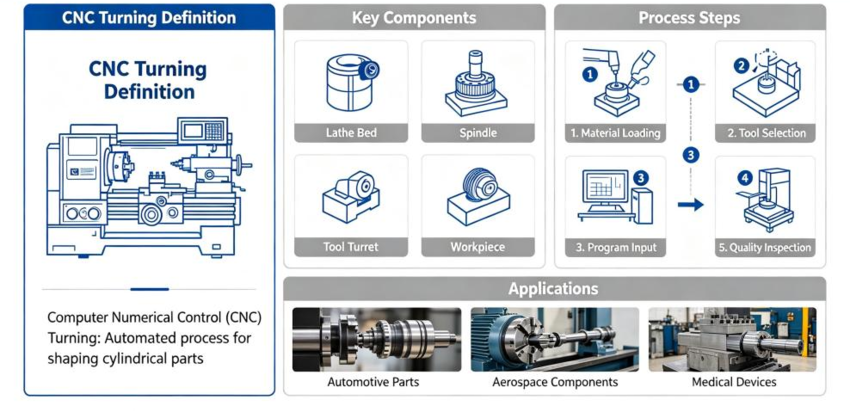
At Rapid Model, we have spent over 16 years perfecting this craft. Whether you are an engineer prototyping an electric vehicle motor or a medical device buyer understanding CNC turning is critical for your supply chain.
What is CNC Turning?
CNC turning is a subtractive manufacturing process where a cylindrical bar of material is rotated at high speed while a stationary cutting tool moves along its surface to remove material.
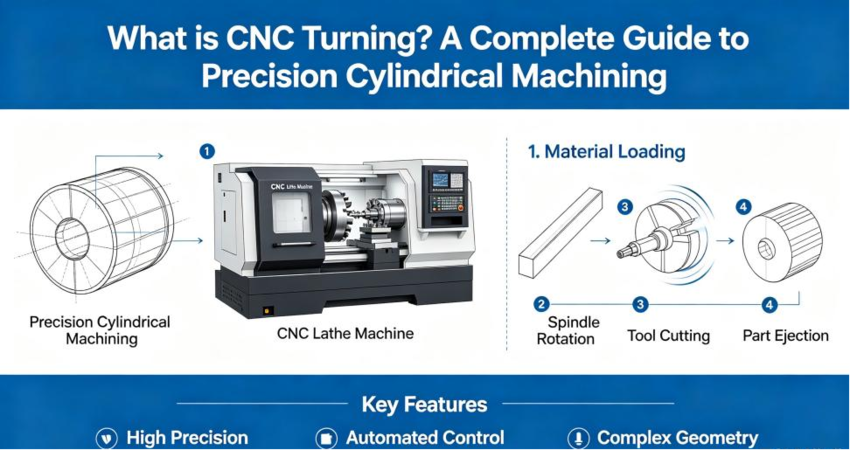
Unlike a milling machine where the tool spins and the part stays still, in turning, the part spins and the tool stays still (relative to the workpiece). This method is specifically designed to create parts with perfect concentricity—meaning the outer diameter remains perfectly round relative to the center axis.
At Rapid Model, our advanced CNC lathes (or "turning centers") are capable of holding tolerances as tight as ±0.01mm and can produce complex geometries including tapers, threads, and internal bores in a single setup.
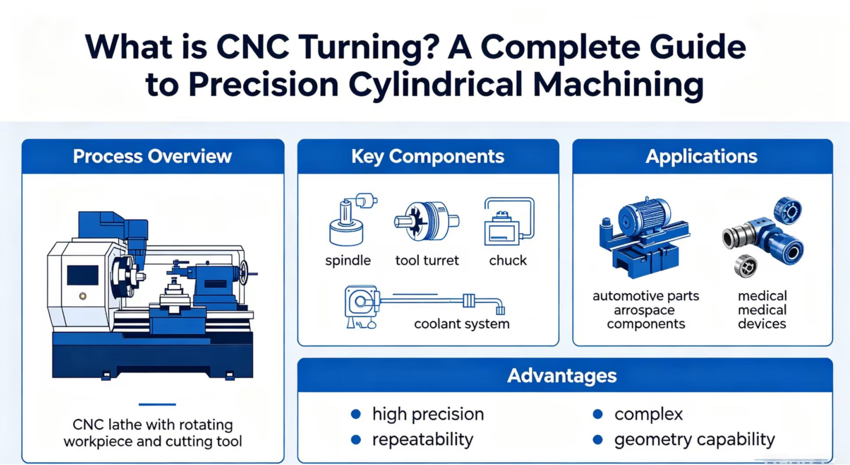
The Key Advantages of CNC Turning
Why do US manufacturers turn to Rapid Model for their turning needs? It comes down to four major competitive advantages:
1. Speed and Efficiency
For cylindrical parts, turning is the fastest game in town. Because the material is constantly rotating, we can remove large amounts of material quickly. For high-volume orders—such as automotive components—we utilize Swiss-type lathes with bar feeders that run lights-out production, drastically reducing your unit cost.
2. Exceptional Surface Finish
If your assembly requires a smooth finish for bearing seats or hydraulic seals, turning delivers. The continuous cutting action produces a superior surface finish (low Ra values) often eliminating the need for secondary grinding operations.
3. Material Versatility
From 6061 aluminum and 303 stainless steel to engineering plastics like PEEK and Delrin, our machines at Rapid Model handle it all. We also work with exotic alloys used in aerospace and defense.
4. High Repeatability
Once we program your G-code, the machine runs exactly the same cycle for the 1st part, the 100th, and the 10,000th. This is vital for ISO and IATF-certified production runs where consistency is mandatory.
The Limitations: When Turning Isn't the Answer
As a sales manager, I believe in radical honesty. CNC turning is not a "magic bullet." It has specific limitations that your design team should know about.
1. Geometry Restrictions
CNC turning is generally limited to rotationally symmetric parts. If you need a square box or a part with deep, complex pockets on the side, a CNC mill (or machining center) is likely a better fit.
2. Secondary Operations
While we use "live tooling" (milling attachments on a lathe) to add flats or cross-holes, highly complex, multi-faceted parts still require secondary milling operations. This can add setup time and cost.
3. Material Waste
Turning is subtractive; we start with a bar that is larger than the finished part and chip away the rest. For very large parts, the cost of the raw billet can sometimes be higher than casting, though the precision justifies it.
Turning vs. Milling: A Quick Comparison
Because we get this question daily at our [Get a Quote] page, here is the simple difference:
CNC Turning: The part spins. Best for cylindrical shapes (Shafts, Pins, Threads).
CNC Milling: The tool spins. Best for prismatic shapes (Blocks, Brackets, Gearboxes).
Why Rapid Model for Your Turning Projects?
Whether you need rapid prototyping for a medical device or batch production for automotive steering components, the execution matters.
At Rapid Model, we bridge the gap between US quality expectations and efficient manufacturing. We offer:
Certified Quality: ISO 9001 certified processes.
Speed: As fast as 3-day delivery on critical turned parts.
Expert DFM: Our engineers review your CAD file to minimize tooling wear and cycle time.