Project Specifications
Client Engagement & Discovery
A leading European robotics startup reached out to Rapid Model after discovering our precision machining showcases on LinkedIn. Following a series of technical consultations and a highly competitive proposal that demonstrated our value, they entrusted us with the project.
Design Objective: Zero-Play Motion
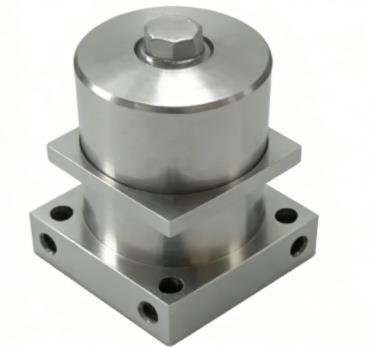
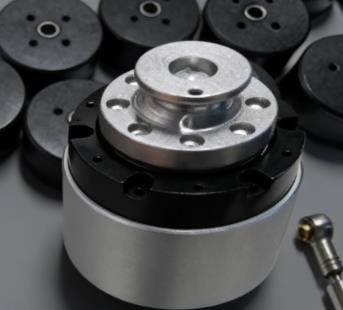
The assembly serves as the "spine" of a collaborative robot (cobot). The primary engineering goal was to house high-torque brushless motors within a chassis that remains rigid under eccentric loads. This required a hybrid material approach: SUS304 for high-wear threaded interfaces and AL6061-T6 for the main body to minimize inertia.
The Engineering Roadmap: Overcoming Material Stress
Machining stainless steel and aluminum to micron-level precision requires more than just fast spindles; it requires thermal discipline.
- Thermal Stabilization: We implemented staged machining. After roughing the SUS304 components, we performed vacuum stress-relieving heat treatment to prevent dimensional "creep" during the final finishing pass.
- Tolerance Synchronicity: To ensure the ±0.01mm fit for the high-speed bearings, our shop used in-situ probing on our 5-axis centers. This allowed us to adjust tool offsets in real-time based on the ambient temperature of the workpiece.
- Clamping Integrity: Custom soft-jaw fixtures were machined to match the outer profile of the aluminum housing, ensuring no surface deformation occurred during the high-torque milling of the internal pockets.
Difficulties & Economic Optimization
The main technical hurdle was the deep-hole drilling and threading within the SUS304 base, where tool breakage is common. To improve efficiency, we switched to thread milling instead of traditional tapping. This not only eliminated the risk of scrapped parts due to broken taps but also allowed for precise control over the thread pitch diameter, ensuring a perfect "Class 3" fit for the assembly bolts.
Final Validation & Delivery
Post-machining, all parts underwent a rigorous secondary processing phase, including fine grinding and surface hardening.
- Cycle Time: Prototype validation to final batch delivery was achieved in 14 days.
- Metrology: 100% inspection was performed using our Zeiss CMM. We provided the client with a digital map of all critical bores to assist in their assembly-side matching.
- Client Feedback: The precision of the interface resulted in a significantly lower motor operating temperature, as the perfect alignment reduced internal friction losses.
Long-Term Outlook: Material Evolution
Following the success of this batch, we have suggested moving toward Stainless Steel 440C for the high-wear internal tracks in the next version. By utilizing our localized heat treatment expertise, we can increase surface hardness to HRC 58-60, potentially doubling the operational lifespan of the robot's primary joints.
“Despite our initial reservations regarding their quality-on-delivery, their competitive pricing convinced us to give them a chance. They exceeded our expectations. We are currently moving toward a long-term partnership. Well done!”
— Head of Hardware Engineering
Bring Your Complex Assemblies to Life
Our expertise in multi-material integration and high-tolerance 5-axis machining ensures your robotic components perform exactly as designed.
Start a Technical Consultation