PEEK CNC Machining China Shenzhen para la precisión Fabricación por lotes
Mecanizado CNC de precisión de componentes PEEK para prototipos, producción en bajo volumen y fabricación por lotes. Desde dibujos de ingeniería y archivos CAD hasta piezas mecanizadas PEEK terminadas, apoyamos a los fabricantes originales globales con procesos de fabricación controlados y calidad constante.
- Precisión PEEK CNC mecanizado
- Prototipo a producción por lotes
- China Fabricación OEM directa de fábrica
Aceptado: PASO / STP / SLDPRT / IGES / X_T / STL / ZIP, dibujos 2D y GD& T dibujos.
- Fabricación CNC de precisión
- Prototipo a producción por lotes
- Expertía en ingeniería PEEK
- OEM / ODM Fabricación
- Producción Controlada de Calidad
- Shenzhen China fábrica
¿Qué es el mecanizado CNC PEEK?
El mecanizado CNC de PEEK es el proceso de retirar material del stock de polímeros de ingeniería PEEK utilizando fresado CNC, torneado u otros métodos de mecanizado de precisión. En comparación con los metales, el PEEK requiere una cuidadosa gestión térmica, selección de herramientas, fijación y control de virutas porque el calor excesivo y la carga mecánica pueden afectar a la estabilidad dimensional.
La cetona de poliéter éter (PEEK) es un termoplástico semicristalino de alto rendimiento. Se mecaniza bien de varilla, placa y tubo de stock, pero no es perdonante en la forma en que es una aleación de aluminio de corte libre. Baja conductividad térmica significa que el calor permanece en el borde de corte y en la pieza; La tensión interna liberada durante el corte puede cambiar la geometría después de desmontar. En Proceso de mecanizado CNC PEEK En la planificación, tratamos el calor, la fuerza de sujeción y la evacuación de virutas como insumos de diseño en lugar de reflexiones posteriores.
La fresadora CNC se adapta a piezas prismáticas, bolsillos, ranuras y características contornadas. Tornado CNC se adapta a cojinetes, manguitos, anillos y ejes. La ruta correcta depende de la geometría, el esquema de tolerancia y el tamaño del lote. Ver nuestro Directrices de mecanizado de PEEK y fabricación de piezas PEEK personalizadas páginas para detalles, o Piezas CNC PEEK para aplicaciones industriales visión general.
Expertía en ingeniería
El mecanizado de PEEK requiere más que simplemente programar una máquina CNC. La geometría de la herramienta, la gestión del calor, la retención del trabajo, el grado del material, las tolerancias y la estrategia de inspección influyen en el rendimiento de la pieza final.
Revisado por: [Ingeniero de fabricación CNC] · [AÑOS DE EXPERIENCIA]
Servicios de mecanizado CNC PEEK en China Shenzhen
Ofrecemos Servicios de mecanizado CNC PEEK de una fábrica de Shenzhen, que cubre fresado, torneado, prototipos, producción por lotes y programas OEM, construidos alrededor de sus dibujos y requisitos de producción.
Mecanizado CNC PEEK personalizado
Piezas hechas a sus requisitos de dibujo, grado e inspección.
fresado CNC PEEK
Fresado de 3 ejes, 4 ejes y, cuando esté disponible, de 5 ejes para geometrías complejas.
Tornado CNC PEEK
Casquillos, manguitos, anillos y ejes con concentración controlada.
Mecanizado PEEK de alta precisión
Características de tolerancia estrecha verificadas contra su GD& Esquema T.
Prototipo y bajo volumen
La validación del diseño se ejecuta antes de comprometerse con las herramientas de producción.
Producción por lotes / en masa
Procesos repetibles para pedidos OEM recurrentes.
PEEK CNC piezas de fabricación
Fabricación de extremo a extremo desde el stock hasta el envío envasado.
Fabricación OEM PEEK
Suministro a largo plazo para programas globales de OEM.
Proceso de mecanizado CNC PEEK
Un proceso de PEEK controlado comienza antes del corte: la revisión del dibujo, la retroalimentación del DFM, la confirmación del grado y la planificación del mantenimiento del trabajo deciden si se pueden mantener las tolerancias en la producción, no solo en la primera parte.
- CAD / revisión de dibujos
- Revisión de ingeniería DFM
- Confirmación de material y grado
- Herramientas y mantenimiento
- fresado CNC / torneado
- Debarrado y acabado
- Inspección dimensional
- Revisión final de calidad
- Embalaje y envío
| Desafío técnico | Para lo que planeamos |
|---|---|
| Generación de calor y expansión térmica | Herramientas afiladas, condiciones de corte controladas, temperatura de inspección estable |
| Deformación del soporte de trabajo | Ajuste de baja distorsión, soporte de secciones delgadas, estrategia de dato |
| Burras, chatter, desgaste de herramientas | Intervalos de selección e inspección de herramientas, pasos de acabado, método de desbarbado |
| Paredes delgadas, agujeros profundos, roscas | Roughing y acabado secuenciado, evacuación de virutas, estrategia de rosca por diseño |
| Deriva dimensional en lotes | Aprobación de primera pieza y controles en curso |
Relacionado: Directrices de mecanizado de PEEK, Control de calidad de mecanizado CNC PEEK, Acabado de superficie de mecanizado CNC PEEK.
Subir archivos CADGuías de mecanizado CNC PEEK
Los parámetros de corte para PEEK no son universales. Deben validarse para el grado PEEK, el material de la herramienta, la geometría de la pieza, la rigidez de la máquina, la capacidad de trabajo, el tamaño del lote y el acabado superficial requerido. La tabla enumera qué evaluar, no valores fijos.
| Parámetro | Consideración de ingeniería | Por qué importa |
|---|---|---|
| Geometría y nitidez de la herramienta | Rake positivo, borde afilado, material de herramienta adecuado para el grado | Las herramientas aburridas frotan y calientan la superficie, dañando el acabado y el tamaño |
| Velocidad de corte, alimentación, profundidad de corte | Validado por grado y geometría | Equilibra el calor, la formación de virutas y la calidad de la superficie |
| Refrigerante / refrigeración por aire | Método compatible con la limpieza del material y la aplicación | Gestiona el calor y la eliminación de virutas; puede afectar la limpieza de la parte |
| Evacuación del chip | Caminos limpios en bolsillos y agujeros profundos | Los chips de nuevo corte dañan las superficies y aumentan la temperatura |
| Empleo | Ajuste uniforme y moderado; soporte para características delgadas | El exceso de sujeción causa la distorsión que aparece después de la liberación |
| Espesor de pared, costillas, agujeros profundos, roscas | Revisión en la etapa DFM | Características débiles desvían, deforman o chatear |
| Planificación y gestión térmica | Secuencia de rugosidad y acabado consciente del estrés | El estrés residual puede relajarse después del mecanizado |
Los parámetros de corte, las tolerancias alcanzables, la selección de herramientas y las puntas de mecanizado se cubren en el Directrices de mecanizado de PEEK.
Piezas mecanizadas PEEK personalizadas
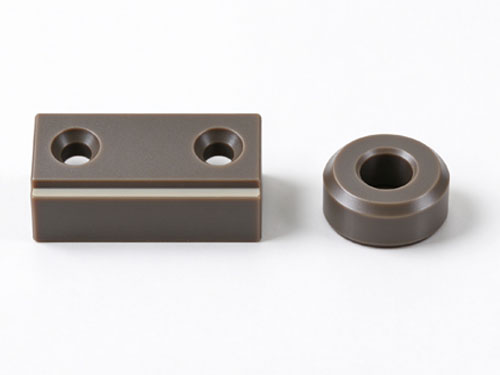
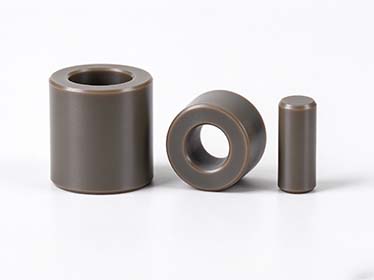
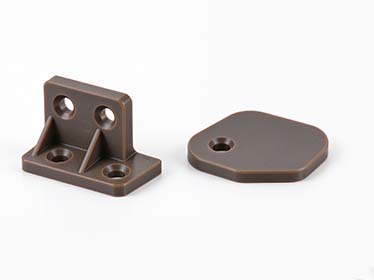
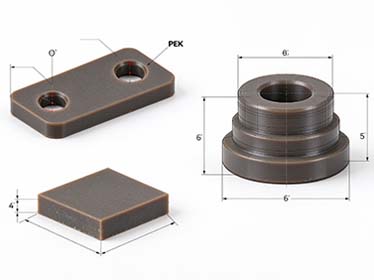
Nosotros fabricamos piezas mecanizadas PEEK personalizadas a partir de sus dibujos, incluyendo casquillos, manguitos, anillos, ejes, aislantes, espaciadores, soportes de precisión, componentes estructurales, semiconductores, de automatización, médicos y aeroespaciales.
Not every PEEK part suits every application. Load, temperature, chemical exposure, cleanliness and regulatory requirements must be validated by the design team; we support that through DFM feedback and fabricación de piezas PEEK personalizadas planning. Seals and wear components are accepted where PEEK is appropriate for the duty.
PEEK CNC Milling & Turning Services
Milling suits prismatic and contoured PEEK parts; turning suits rotational parts such as bushings and shafts. The right process follows geometry, tolerance scheme and volume.
| Aplicación | Recommended CNC process | Typical engineering considerations |
|---|---|---|
| Pockets, slots, thin-wall housings | Precision PEEK CNC milling (3/4/5-axis where available) | Wall stiffness, chip evacuation, clamping distortion |
| Bushings, sleeves, rings | Precision PEEK turning | Concentricity, roundness, bore size control |
| Shafts and pins | CNC turning, with milled features as needed | Runout, slenderness, support during cutting |
| Complex parts with turned and milled features | Combined turning and milling | Datum consistency across setups |
Turned parts typically achieve rotational accuracy efficiently; milled parts allow more complex geometry but may need more setups and fixturing. Tolerances are confirmed from your drawing.
High Precision PEEK CNC Machining
PEEK CNC Machining Tolerances
Achievable PEEK tolerance depends on part dimensions, geometry, grade, machining process, thermal conditions, workholding and inspection method. We do not quote a blanket standard tolerance; we review each drawing against ISO or ASME GD&T principles and confirm what can be held and verified.
| Características | Key risk | Control method |
|---|---|---|
| Hole diameter | Elastic recovery, thermal change | Finishing strategy and measurement after stabilization |
| Flatness, parallelism | Residual stress, clamping distortion | Stress-aware sequence, low-distortion fixturing |
| Concentricity, runout | Setup changes, part flex | Single-setup machining where possible, defined datums |
| Position, perpendicularity | Datum shift between operations | Consistent datum scheme, CMM verification |
| Surface finish (Ra) | Tool wear, heat smearing | Sharp tooling, finishing pass, inspection interval |
See PEEK CNC machining tolerances y PEEK surface finish and dimensional accuracy.
PEEK Material for CNC Machining
PEEK (polyether ether ketone) is a high-performance engineering thermoplastic known for heat resistance, chemical resistance, wear resistance and dimensional stability. Exact properties vary by grade and manufacturer, so confirm against the supplier datasheet. See what is PEEK material y PEEK material properties and grades.
| PEEK grade | General characteristics | Typical CNC applications | Engineering considerations |
|---|---|---|---|
| PEEK natural | Unfilled base grade | Insulators, bushings, general components | Reference grade for machining behavior |
| PEEK black | Pigmented grade | Visual or process-specific parts | Confirm properties with the supplier datasheet |
| Glass-filled PEEK | Filled for stiffness and dimensional stability | Structural and stable components | Filler can increase tool wear and change finish |
| Carbon-filled PEEK | Filled for stiffness and wear behavior | Wear and load-bearing parts | Machining behavior differs from unfilled |
| Reinforced PEEK | Grade-specific reinforcement | Application-specific | Validate per datasheet and application |
Learn more in PEEK material grades for CNC machining.
PEEK Machining Feasibility & DFM Self-Checker
Get an immediate preliminary assessment of your PEEK part design, recommended process, material grade and key DFM points — based on our Shenzhen factory machining standards.
PEEK CNC Machining Design Guidelines
Good PEEK part design limits unsupported walls, avoids sharp internal corners, defines clear datums and allows inspection access. Early design for CNC machining PEEK review reduces warping, cost and rework.
Walls and ribs
Avoid tall unsupported walls; thin sections deflect under the tool and warp after release.
Holes and threads
Limit hole depth-to-diameter where possible; specify thread type and check fit needs for a plastic thread.
Corners and radii
Use internal radii matched to standard tool sizes rather than sharp corners.
Clamping and datums
Design flat, stable clamping surfaces and datums that match your inspection plan.
Warping control
Balance material removal and avoid asymmetric geometry that releases stress unevenly.
Inspection access
Ensure critical features can be reached and measured.
PEEK CNC Machining Drawing Requirements
A complete RFQ package speeds up review: a 2D drawing, a 3D CAD file, material grade, tolerances, surface finish and critical features. See what should be included in a PEEK CNC drawing.
| Required information | Examples | Por qué importa |
|---|---|---|
| 2D drawing and 3D CAD | PDF/DWG; STEP, STP, SLDPRT, IGES, X_T, STL | Drawing governs tolerances; CAD supports programming |
| Material specification and grade | PEEK natural, glass-filled, carbon-filled | Affects machining, cost and performance |
| Dimensions, GD&T, tolerances | Datums, flatness, position, runout | Defines inspection and process planning |
| Surface finish and critical features | Ra requirement, sealing faces | Focuses control where function needs it |
| Special inspection and revision number | CMM report, first article, Rev B | Prevents wrong-revision production |
From PEEK Prototype to Batch Manufacturing
A prototype confirms design; production needs a repeatable process. We support PEEK prototype and low volume machining and scale to PEEK CNC machining for mass production through process optimization and scheduling.
- Prototype
- Design validation
- Low volume
- Pilot production
- Batch production
- High volume
Learn more: PEEK prototypes and small batch parts y high volume PEEK manufacturing. Repeatability comes from fixed fixtures, documented programs and first-piece approval.
PEEK CNC Machining Cost
PEEK part cost depends on stock price, grade, complexity, machining time, tooling, setup, tolerance, finish, quantity, lead time, inspection and shipping. Batch quantities often lower unit cost by spreading setup and programming. We do not publish per-part prices without a drawing. See how much does PEEK CNC machining cost y Factores de costo de mecanizado de PEEK.
Cost drivers (illustrative, not proportional)
Relative weighting varies by part. Bars show which factors to review, not real cost shares. Also see PEEK parts CNC machining price.
PEEK CNC Machining Applications
PEEK is used where heat, chemicals, wear or insulation matter. See PEEK CNC machining applications y PEEK parts for aerospace, medical and semiconductor applications. Regulated sectors may require added material traceability, cleanliness and qualification.
PEEK Medical CNC Machining
Precision components for medical equipment. We make no medical-grade, FDA or implant claim without documented evidence; see CNC machined PEEK medical components.
PEEK Aerospace CNC Machining
Lightweight, high-temperature parts. See PEEK components for aerospace applications.
PEEK Semiconductor CNC Machining
Chemical-resistant, vacuum-compatible parts where validated. Cleanroom status: [CERTIFICATIONS]. See PEEK parts for semiconductor equipment.
Electrical & Electronics
Insulating components: PEEK insulating components.
Industrial Equipment & Automation
Wear-resistant, low-friction bushings and machine parts: PEEK components for automation and machinery.
Machinery & Robotics
Precision spacers, bushings and structural parts for moving assemblies.
PEEK CNC Machining Supplier in Shenzhen, China
Shenzhen offers a dense manufacturing ecosystem: CNC machining, electronics and industrial supply chains, supporting processes and international logistics. As a PEEK CNC machining supplier in Shenzhen, [rapid-model] works factory-direct with global OEMs.
See PEEK CNC machining factory in China, PEEK CNC machining manufacturer in China y factory direct PEEK CNC machining. Factory details: [MACHINE CAPACITY], [MONTHLY CAPACITY], [INSPECTION EQUIPMENT], [CERTIFICATIONS].
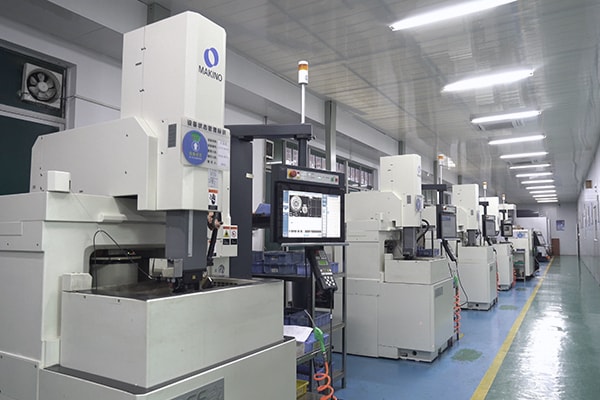
Custom PEEK CNC Machining for OEMs
We work as a long-term manufacturing partner for OEM programs: engineering collaboration, prototypes, production planning, batch manufacturing, inspection, documentation, packaging and export logistics. See PEEK OEM machining services y custom PEEK CNC machining for OEMs.
Built for engineering teams, procurement departments and global OEM programs.
PEEK vs Other Engineering Plastics for CNC Machining
No plastic is universally best. Selection should follow temperature, chemical, wear, friction, stiffness and cost requirements. Qualitative comparison only; verify with datasheets. See the PEEK CNC machining material selection guide y PEEK and other CNC engineering plastics.
| Material | Where it is typically chosen | Compared with PEEK |
|---|---|---|
| PEEK vs PTFE | Chemical resistance, low friction, sealing | PTFE is softer and lower friction; PEEK is stiffer and stronger. Which to machine? |
| PEEK vs UHMW-PE | Wear and impact, low cost | UHMW-PE has a much lower temperature range. Compare |
| PEEK vs HDPE | General-purpose, chemical exposure | HDPE is economical with lower heat resistance. Compare |
| PEEK vs ULTEM / PEI | Stiff, high-temperature parts | Both are high-performance; chemical and wear needs differ. Compare |
| PEEK vs Delrin / POM | Precision parts, good machinability | POM is easier and cheaper; PEEK has higher temperature capability. Compare |
PEEK CNC Machining Near Me or in China?
Local and overseas suppliers each fit different projects. Compare engineering communication, logistics, volume, quality control and total landed cost. See PEEK CNC machining near me y how to choose a PEEK CNC machining supplier.
Local sourcing can suit urgent, low-volume or on-site needs. A Shenzhen supplier can suit recurring batch programs where drawings are stable and lead-time planning is possible.
Online PEEK CNC Machining Services
Our online PEEK CNC machining RFQ workflow is engineer-reviewed: upload CAD, receive DFM feedback and a quotation. See get a quote for custom PEEK parts. We do not offer automated instant pricing.
- Upload CAD
- Engineering review
- DFM feedback
- cotización
- Producción
- Inspection
- Entrega
PEEK CNC Machining Lead Time
Lead time depends on material availability, complexity, quantity, tooling, programming, inspection, finishing, scheduling and logistics. Prototype lead time is not batch lead time. Typical lead time: [LEAD TIME]. See how long does PEEK CNC machining take.
PEEK CNC Machining Quality Control
Quality control is a workflow, not one final check. We define inspection requirements per drawing: material verification, first-piece, in-process and final inspection, documentation and packaging checks. See PEEK CNC inspection and quality control.
- Incoming material verification
- First-piece inspection
- In-process inspection
- Final dimensional inspection
- Documentation review
- Packaging inspection
Available methods: CMM and dimensional inspection, GD&T verification, first article inspection and inspection reports, as specified: [INSPECTION EQUIPMENT], [CERTIFICATIONS].
Request Inspection RequirementsPEEK CNC Machining Surface Finishing
PEEK finishing is mostly deburring, edge finishing and machining-mark control, and polishing where applicable. Metal finishes such as anodizing do not apply to PEEK. Finishing can affect dimensions, so it is planned with tolerances. See PEEK surface finishing options.
PEEK CNC Machining FAQ
Answers to common PEEK CNC machining frequently asked questions.
What is PEEK CNC machining?
Removing material from PEEK stock with CNC milling or turning, with controlled heat, tooling, fixturing and chip evacuation.
Why is PEEK suitable for CNC machining?
It is a rigid engineering thermoplastic that holds shape and machines from rod, plate and tube, when heat and clamping stress are managed.
Can PEEK be CNC milled and turned?
Yes. Milling suits prismatic parts; turning suits bushings, shafts, rings and sleeves.
Can you machine glass-filled or carbon-filled PEEK?
Filled grades can be machined but behave differently, often with more tool wear. Confirm the grade and datasheet with us.
What tolerances are possible with CNC machined PEEK?
It depends on size, geometry, grade, thermal conditions, workholding and inspection method. We confirm against your drawing.
How much does PEEK CNC machining cost?
It depends on stock, complexity, time, tolerance, finish, quantity and inspection. Send a drawing and quantity for a quote.
How long does PEEK CNC machining take?
Prototype and batch lead times differ. Typical lead time: [LEAD TIME], confirmed per order.
How should PEEK parts be designed for CNC machining?
Avoid tall unsupported walls and sharp internal corners, define datums and allow inspection access.
What files are needed for a quote?
2D drawing, 3D CAD (STEP, STP, SLDPRT, IGES, X_T, STL, ZIP), grade, quantity, tolerances and finish.
Can you make prototypes, batches and OEM parts?
Yes: prototypes, low-volume, batch and OEM production, planned around your requirements.
How do I choose between PEEK, PTFE, UHMW, HDPE, PEI and Delrin?
Start from temperature, chemicals, wear, friction, stiffness and cost. See the comparison table above.