Aluminum 6061 t6 cnc milling prototype service cost
A 6061-T6 CNC milling prototype costs $85-$250 for one part and $10-$15 at 1,000 units. See the 2026 cost formula, regional rates, and quantity discounts.
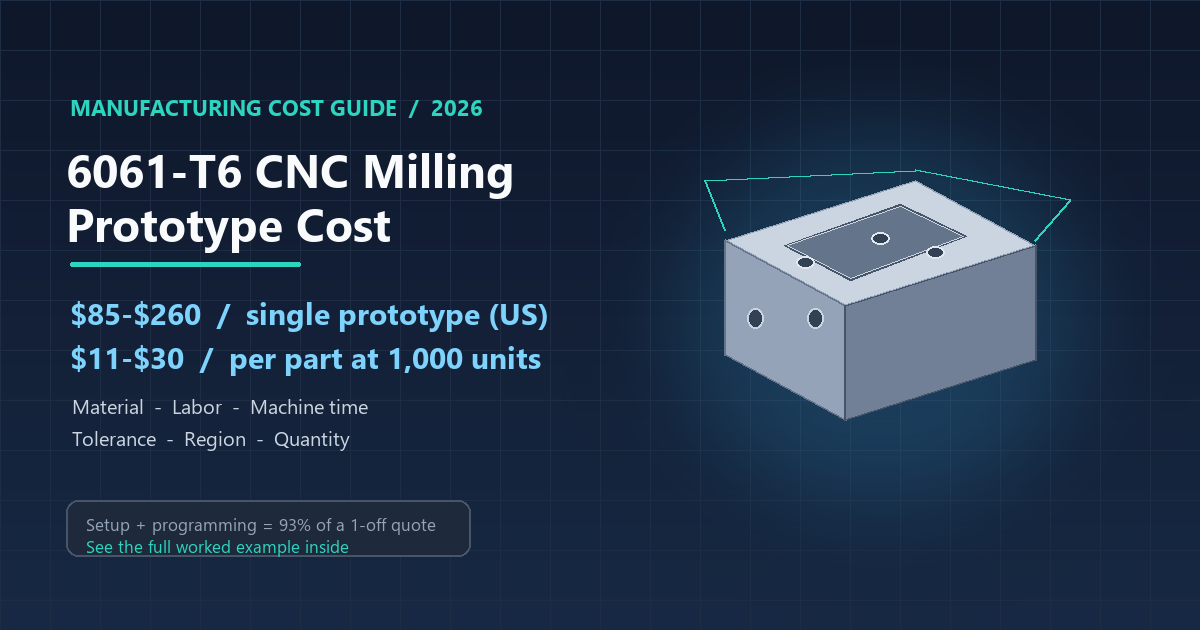
A single 6061-T6 CNC milling prototype typically costs $85–$250 in the United States, depending on complexity: a simple 3-axis bracket starts near $85 (The Machine Daily, 2026) while a medium-complexity part runs $180–$250 (Lewei Precision, 2026). At 1,000 units those benchmarks converge to $10–$15 per part, because setup and programming spread across the batch. Region shifts the number too — 3-axis shop rates run $35–$50/hour in China against $80–$150/hour in the US (Lewei Precision, 2026). The price is not driven by aluminum alone: machine time, setup, tolerance, drawing quality, region, and quantity together decide the quote.
This guide breaks down every cost input with 2026 benchmark data and a worked example you can reproduce.
Key Takeaways - A single 6061-T6 prototype runs $85–$250 (US): about $85 for a simple bracket (The Machine Daily, 2026) and $180–$250 for a medium-complexity part (Lewei Precision, 2026); at 1,000 pieces it drops to $10–$15 per part. - Setup and programming dominate prototypes — in the worked example they make up $165 of a $177 single-part price, while raw material is only about $3. - 6061-T6 stock costs $4–$9 per kg, but buy-to-fly ratios of 1.5–2.0 mean you pay for roughly twice the finished part's weight. - Tolerance is the biggest lever you control: moving from ±0.1 mm to ±0.025 mm adds roughly 40–80% to affected features. - Region and quantity compound: China 3-axis rates near $35–$50/hour sit far below US rates near $80–$150/hour, and setup amortization cuts unit cost by 60–75% from 1 to 50 pieces.
Table of Contents
- What Does a 6061-T6 CNC Milling Prototype Cost?
- The 6061-T6 Prototype Cost Formula
- Material Cost: Stock, Density and Buy-to-Fly
- Machine Cost: Shop Rates and Removal Rate
- Labor, Programming and Setup Cost
- Part Difficulty and Tolerance Multipliers
- Drawing and Design Factors
- Regional Cost Differences
- How Quantity Changes Unit Cost
- Worked Example: Pricing One Bracket
- Hidden Costs: Finishing, Inspection, Shipping
- How to Reduce Your Prototype Cost
- Frequently Asked Questions
- Conclusion
What Does a 6061-T6 CNC Milling Prototype Cost?
A 6061-T6 CNC milling prototype is a one-off or low-volume aluminum part machined from stock on a computer-controlled mill, usually within days. For a small to medium part (roughly a 100 × 60 × 20 mm bracket) with standard ±0.1 mm tolerances and an as-machined finish, expect $85–$250 per piece in the US for a single unit: about $85 for a simple 3-axis bracket (The Machine Daily, 2026) and $180–$250 for a medium-complexity part (Lewei Precision, 2026). At 1,000 pieces those same benchmarks converge to $10–$15 each (The Machine Daily, 2026; Lewei Precision, 2026).
Three facts explain almost every quote:
- Fixed costs dominate prototypes. CAM programming, fixturing, and first-article setup are charged once per design; in the worked example below they are $165 of a $177 single-part price (YC PrimePrecision, 2026).
- Aluminum is the cheap part. 6061-T6 stock runs $4–$9 per kg, and a small bracket consumes only a few dollars' worth.
- Tolerance and geometry set the machine hours. Tight tolerances, deep pockets, thin walls, and extra setups multiply cycle time.
Because these inputs vary, a serious estimate builds the quote from the bottom up. That is what the next sections do. If you want the short version for a specific geometry, our CNC aluminum machining service applies the same model to a real CAD file.
The 6061-T6 Prototype Cost Formula
The industry-standard formula is:
Unit price = (fixed block ÷ quantity) + variable cost per part
The fixed block covers CAM programming, fixture design, machine setup, and first-article inspection. Variable cost covers raw material, machine time, tooling, and routine inspection. A published 2026 example uses a $165 fixed block plus $12 of variable cost per part, producing these unit prices (YC PrimePrecision, 2026):
| Quantity | Fixed cost per part | Variable cost | Unit price |
|---|---|---|---|
| 1 | $165.00 | $12.00 | $177.00 |
| 10 | $16.50 | $12.00 | $28.50 |
| 100 | $1.65 | $12.00 | $13.65 |
| 1,000 | $0.17 | $12.00 | $12.17 |
Only the fixed block moves in that table. This is why the first quote you receive can look shocking and the 100-piece quote looks reasonable — nothing about the part changed except how many times the setup was divided. Repeat orders are cheaper again: many shops cut setup time 50–80% on a proven program with the fixture already on the shelf (Yeyuan CNC, 2026).
Material Cost: Stock, Density and Buy-to-Fly
6061-T6 aluminum costs $4–$9 per kg in distributor quantities, with a density of 2.70 g/cm³ (GLOBID material table, Q1 2026; Lewei Precision, 2026). Raw LME aluminum settled around $3,150 per tonne in mid-November 2026, and 6061 stock adds alloying and processing premiums on top of that benchmark (London Metal Exchange official prices, 13 Nov 2026).
The number that matters is buy-to-fly: the ratio of blank weight to finished part weight. Plate stock runs 1.3–2.0 and bar or near-net stock 3–4, so a 450 g bracket often starts as a 0.9 kg blank (YC PrimePrecision, 2026). You buy two kilos to ship one.
Worked material cost for a 100 × 60 × 20 mm bracket:
- Blank envelope 105 × 65 × 25 mm = 170.6 cm³.
- Mass = 170.6 cm³ × 2.70 g/cm³ = 461 g = 0.461 kg.
- Cost at $6/kg = $2.77, rounded to about $3.00 after saw-cut charges.
That $3 is roughly 1.7% of a $177 single-part price. Chasing a cheaper aluminum grade rarely pays; choosing stock close to the part envelope does. Cutting a 25 mm part from a 26 mm billet instead of a 30 mm billet drops waste from about 17% to near zero (Lewei Precision, 2026).
Machine Cost: Shop Rates and Removal Rate
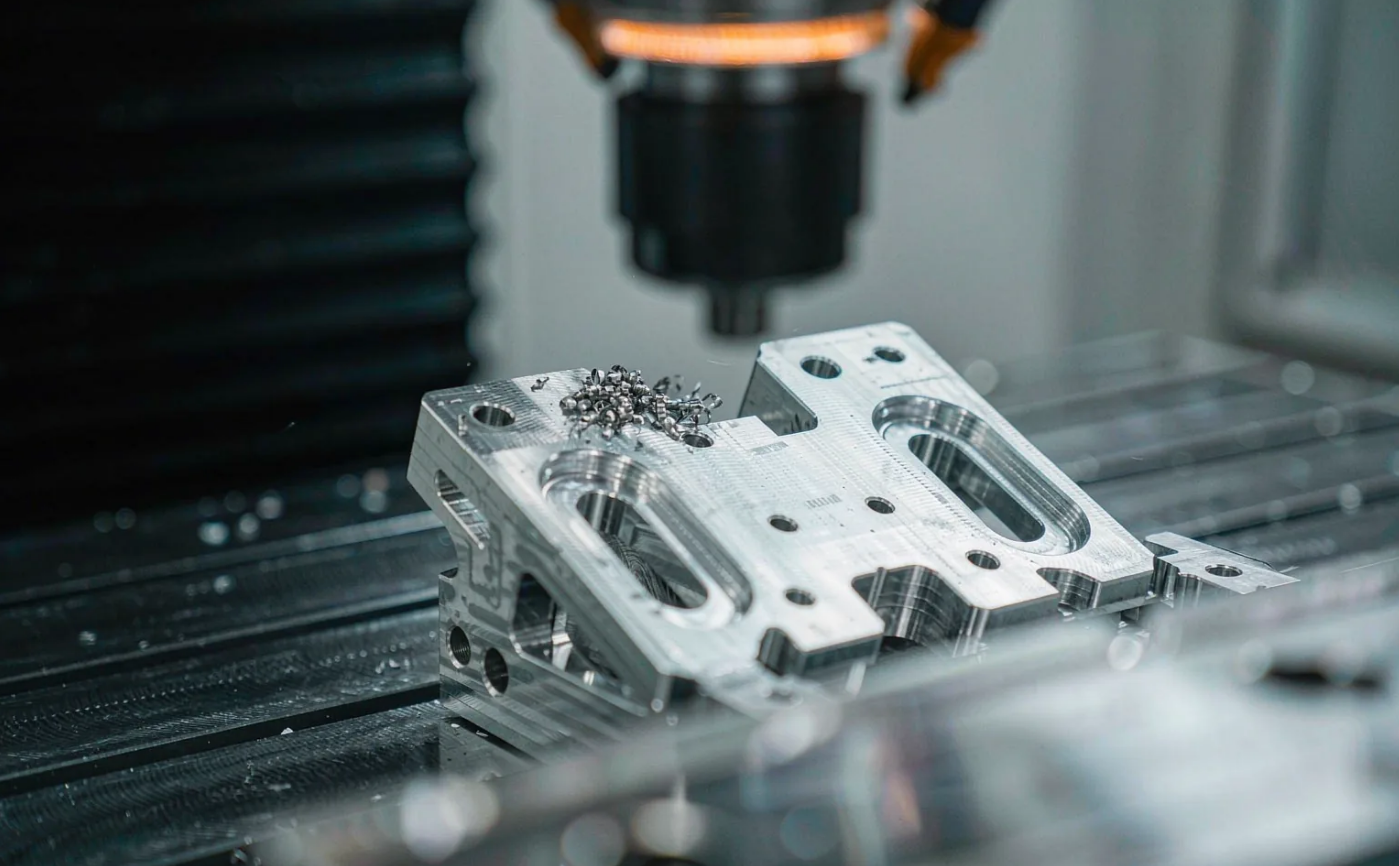
Machine time is usually 30–60% of total cost on production runs, and it is priced as cycle time multiplied by the shop's hourly rate. A 40-taper vertical mill roughs 6061 at roughly 20–100 cm³ per minute, with 55 cm³/min a typical 3-axis planning value (YC PrimePrecision, 2026; GLOBID, Q1 2026).
Cycle time depends on four things:
- Chip volume — driven by buy-to-fly and how much material must leave.
- Feature count — every pocket, hole, and thread adds a tool and a move.
- Finish passes — they remove almost nothing but run at a fraction of roughing feed.
- Non-cutting time — a part using 14 tools spends close to a minute just changing them (YC PrimePrecision, 2026).
Face milling a 100 × 100 mm 6061 surface takes 24–40 seconds with a high-feed cutter, but a fine Ra 0.8 finish on the same area can take 12–30 minutes. Specifying a fine finish everywhere is one of the fastest ways to inflate a quote (Precision CNC Solutions, 2026).
For the bracket, removing about 110 cm³ at 55 cm³/min takes roughly 2 minutes of roughing; adding finishing, tool changes, and approach/retract brings the cycle to about 5.5 minutes. At a $100/hour US 3-axis rate, machine cost is $9.
Labor, Programming and Setup Cost
Programming and setup are the fixed block that dominates prototype pricing. A simple 3-axis part needs 0.5–2 hours of CAM at $60–$120/hour plus 0.5–2 hours of machine setup; a contoured 5-axis part can need 3–8 hours of programming, 2–8 hours of setup, and a $200–$2,000 fixture (YC PrimePrecision, 2026).
For a single prototype, setup can add $80–$150 per part. Spread over 100 pieces, the same setup adds only $1–$2 each (Lewei Precision, 2026). Standard end mills, drills, and inserts are absorbed into the hourly rate; custom form cutters or EDM electrodes are quoted separately.
Our bracket's fixed block is built from two lines:
- CAM programming: 1.5 hours × $70/hour = $105.
- Setup and first article: 1.0 hour × $60/hour = $60.
- Total fixed block = $165.
Part Difficulty and Tolerance Multipliers
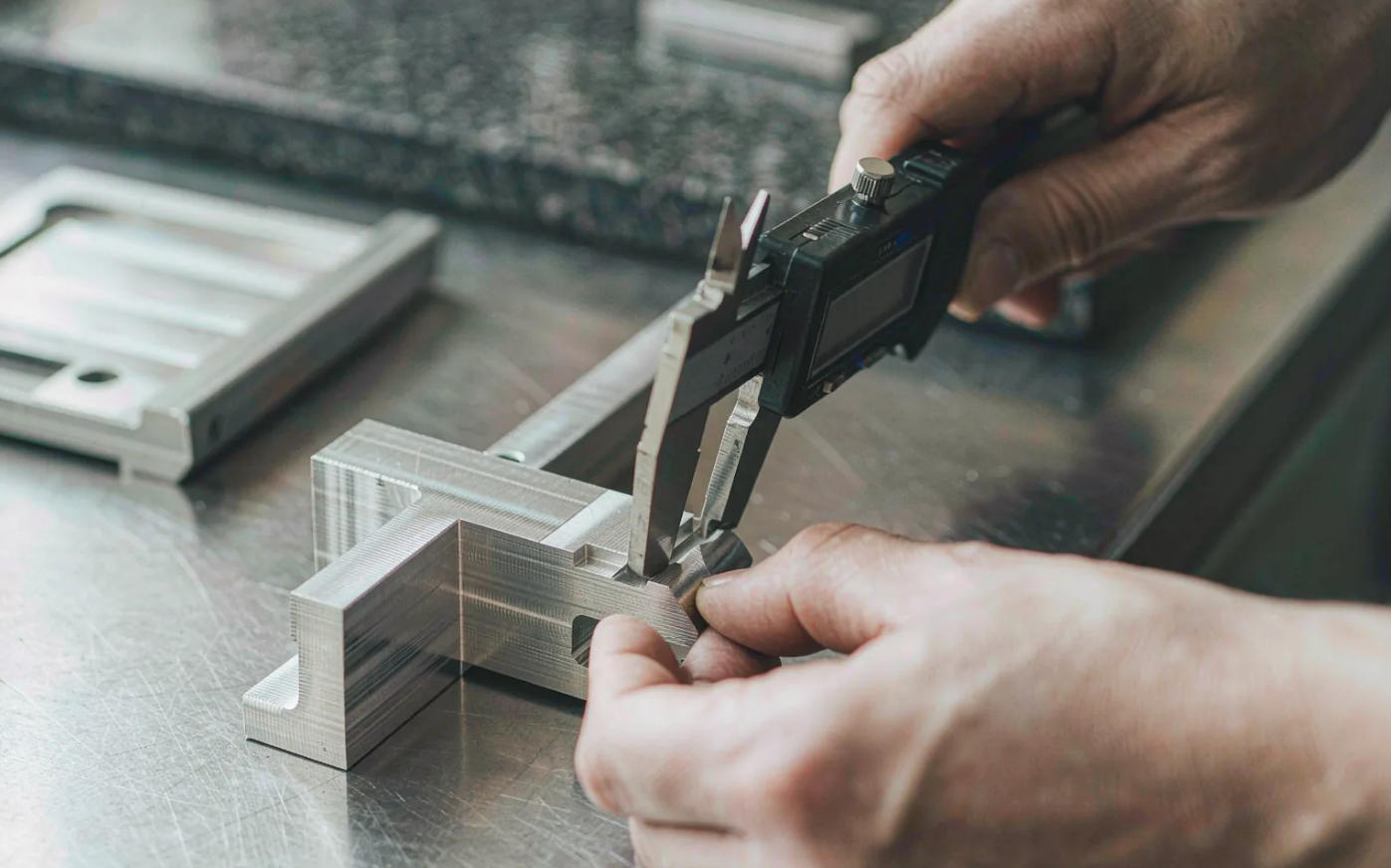
Tolerance is the largest cost lever you control at the drawing stage. Moving from ±0.1 mm to ±0.025 mm adds 40–80% to the affected features; ±0.005 mm multiplies cost three to five times through extra finish passes, temperature control, and 100% CMM inspection (YC PrimePrecision, 2026).
| Feature spec | Indexed cost | Typical consequence |
|---|---|---|
| ±0.1 mm general tolerance | 1.0× | Standard setup, sample inspection |
| ±0.025 mm tight tolerance | ~1.6× | Extra finish pass, in-process checks |
| ±0.005 mm precision | ~4.0× | Thermal control, 100% CMM, slower feeds |
Material choice also carries a machinability multiplier: 6061-T6 is the 1.0× baseline, 7075-T6 about 1.4×, 304 stainless about 2.2×, and Ti-6Al-4V 4.5–6× (The Machine Daily, 2026). Aluminum machines roughly three times faster than steel, so picking steel to save on raw material often costs more overall (Precision CNC Solutions, 2026).
Geometry adds cost in its own way: deep pockets force slower feeds and longer tools, thin walls need lighter cuts and supports, and any feature that cannot be reached in one setup adds a second fixturing operation. Consolidating features onto fewer faces cut cost 22% at 200 pieces in one documented redesign (Yeyuan CNC, 2026).
Drawing and Design Factors
The fastest way to inflate a quote is to leave information out. Without tolerances, a shop must price the tightest reading of the drawing; without a firm quantity, it must price the risk of a one-off setup. Both push the number up — and neither is the shop being greedy.
A complete RFQ package includes:
- A STEP or IGES 3D model for geometry, wall thickness, and tool access.
- A 2D PDF with tolerances, datum references, and surface finish callouts.
- The exact alloy and temper — "aluminum" and "6061-T6" quote differently.
- Firm quantity and target lead time.
- Surface finish and inspection requirements.
A design-for-manufacturability (DFM) review before cutting metal can cut quotes 15–30% by flagging unreachable pockets, adding draft, or relaxing tolerances that do not affect function (TEAM MFG, 2026). Our CNC milling service treats DFM feedback as part of quoting, so design changes happen on screen rather than on the machine.
Regional Cost Differences
Geography is the single biggest price lever after quantity. Mid-range 2026 3-axis shop rates run about $35–$50/hour in China, $30–$45/hour in India, $50–$75/hour in Eastern Europe, and $80–$150/hour in the United States, with Germany and Switzerland at $100–$160/hour for ultra-precision work (Lewei Precision, 2026; Yeyuan CNC, 2026).
| Region | Typical 3-axis rate | Typical 5-axis rate | Best for |
|---|---|---|---|
| China | $35–$50/hr | $60–$90/hr | Cost-sensitive prototypes and scale-up |
| India | $30–$45/hr | $55–$80/hr | Simple, high-volume parts |
| Eastern Europe | $50–$75/hr | $90–$130/hr | EU-regulation projects |
| United Kingdom | $80–$110/hr | $140–$180/hr | Aerospace and regulated work |
| United States | $80–$150/hr | $150–$250/hr | ITAR, AS9100, fast domestic delivery |
| Germany / Switzerland | $100–$160/hr | $180–$300/hr | Ultra-precision, micron-level work |
The hourly rate is a rate, not a total. A $45/hour shop that needs four setups and 90 minutes of cycle time can cost more than a $60/hour shop finishing the same part in two setups and 60 minutes. Optimize total landed cost — machining, finishing, freight, duties, and rework risk — not the headline rate (Gnee Steel market report, Aug 2026).
How Production Quantity Changes Unit Cost
Quantity changes price because fixed costs amortize. Published 2026 benchmarks for a medium-complexity aluminum bracket show the curve clearly (Lewei Precision, 2026):
| Quantity | Indicative cost per part | Main driver |
|---|---|---|
| 1 | $180–$250 | Setup dominates |
| 10 | $45–$70 | Setup splits across batch |
| 100 | $18–$28 | Cycle time dominates |
| 1,000 | $10–$15 | Optimized fixtures and feeds |
| 10,000 | $6–$10 | Dedicated cell, tooling amortized |
Going from 1 to 50 pieces typically cuts per-part cost 60–75%, and from 50 to 1,000 another 40–55%. Beyond roughly 1,000 pieces the curve flattens because material and cycle time dominate and no fixed cost is left to spread (Yeyuan CNC, 2026).
The practical lesson: order the quantity you will actually consume. The 1,000-piece price looks attractive until a design revision obsolesces half the batch.
Worked Example: Pricing One Bracket
Here is the full build-up for one 6061-T6 bracket, 100 × 60 × 20 mm, 3-axis, ±0.1 mm tolerance, as-machined finish, ordered as a single piece from a US shop:
| Cost element | Calculation | Amount |
|---|---|---|
| Material | 0.461 kg blank × $6/kg, plus cut charge | $3.00 |
| Machine time | 5.5 min × $100/hr | $9.00 |
| CAM programming | 1.5 hr × $70/hr | $105.00 |
| Setup and first article | 1.0 hr × $60/hr | $60.00 |
| Total | Fixed $165 + variable $12 | $177.00 |
Two observations follow directly. First, material is under 2% of the price — a 20% swing in aluminum cost changes this quote by less than 60 cents. Second, programming and setup are 93% of it. That is the entire story of prototype pricing in one table.
Now change only the quantity to 10 pieces: fixed cost per part becomes $16.50, and the unit price becomes $28.50. Change the region to China at $45/hour: machine time drops to about $4, material stays near $3, and a comparable domestic quote starts lower still. The physics of the part never changed; only fixed-cost allocation and local rates did.
For a firm price on your own geometry, request a quote through our aluminum CNC machining page with a STEP file and a toleranced drawing attached.
Hidden Costs: Finishing, Inspection, Shipping
Finishing, inspection, and logistics are easy to overlook when comparing quotes:
- Surface finishing — Type II clear anodize runs about $0.50–$3 per part for small aluminum parts; hard Type III anodize, electroless nickel, or PTFE finishes can double part cost (Lewei Precision, 2026).
- Inspection and documentation — standard 2D checks are usually included, but full CMM dimensional reports, material test reports, and AS9102 first-article packages add $30–$200 per project (Lewei Precision, 2026).
- Shipping and duties — overseas sourcing adds freight and potential tariffs that can erase the hourly-rate advantage on small orders.
- Scrap risk — realistic shops build in 2–8% scrap; a quote assuming 100% yield is optimistic (TEAM MFG, 2026).
Our quality assurance process makes inspection scope explicit up front, so these line items do not appear as surprises on an invoice.
How to Reduce Your 6061-T6 Prototype Cost
Start with the levers that change fixed cost and cycle time, not the ones that shave cents off material:
- Relax tolerances wherever function allows. Moving a non-critical feature from ±0.025 mm to ±0.1 mm can remove 40–80% from that feature's cost.
- Consolidate setups. Put features on fewer faces; every extra fixturing operation adds time and stack-up error.
- Match stock to the part envelope. A blank cut close to final size cuts waste and roughing time together.
- Order the quantity you need. Going from 1 to 50 pieces typically cuts unit cost 60–75%.
- Specify finish only where it is seen or functions. Bead blast before anodizing often reaches a cosmetic target cheaper than a finer machining pass.
- Send a complete package. STEP file, toleranced 2D drawing, alloy and temper, firm quantity, and finish spec shorten quoting and remove risk pricing.
- Plan for repeat orders. Proven programs and stored fixtures cut setup 50–80% on re-runs.
Frequently Asked Questions
How much does a 6061-T6 CNC milling prototype cost?
For a small to medium part with standard tolerances, $85–$250 per piece in the US at quantity 1 — about $85 for a simple bracket (The Machine Daily, 2026) and $180–$250 for medium complexity (Lewei Precision, 2026). At 1,000 pieces, expect $10–$15 each. Material is a small share; setup and programming dominate single-piece pricing.
Is 6061-T6 cheaper than 7075-T6 to machine?
Yes. 6061-T6 stock costs $4–$9/kg versus roughly $10–$22/kg for 7075-T6 (YC PrimePrecision, 2026), and 6061 machines about 30% faster than 7075 with a 1.0× machinability baseline against about 1.4× for 7075 (Lewei Precision, 2026; The Machine Daily, 2026). The saving compounds in both material and cycle time.
Why is one prototype so much more expensive than ten?
Setup, CAM programming, and fixturing are fixed per design. On one part they can be $165 of a $177 price; across ten pieces the same $165 becomes $16.50 each, dropping the unit price from $177 to $28.50.
Does a lower hourly rate always mean a cheaper part?
No. Rate × hours is what matters. A shop at $45/hour needing four setups and 90 minutes can cost more than a $60/hour shop finishing in two setups and 60 minutes. Ask for setup count and estimated cycle time, not just the rate.
How much do tight tolerances add?
Moving from ±0.1 mm to ±0.025 mm adds about 40–80% to the affected features; ±0.005 mm can multiply cost three to five times because of extra finish passes, thermal control, and full inspection.
What files do I need for an accurate quote?
A STEP or IGES 3D model, a 2D PDF with tolerances and surface finishes, the exact alloy and temper, firm quantity, and target lead time. Missing tolerances or quantity make a shop price the worst case.
Conclusion
A 6061-T6 CNC milling prototype costs $85–$250 in the US for a single small part (The Machine Daily, 2026; Lewei Precision, 2026) and $10–$15 at 1,000 pieces. Raw aluminum is only a few dollars of that; the price is set by setup, programming, machine time, tolerance, region, and quantity. To pay less, simplify geometry, relax tolerances that do not matter, match stock size to the part, and order a realistic batch.
Ready to price your part? Send a STEP file and a toleranced drawing through our CNC aluminum machining service for a quote built on the same cost model, or review our quality assurance standards before you commit.
Sources
- London Metal Exchange, Official Prices, 13 Nov 2026.
- YC PrimePrecision, "CNC Machining Cost: How Custom Part Quotes Are Calculated," 2026.
- TEAM MFG, "How Much Does CNC Machining Cost Per Part?," 2026.
- The Machine Daily, "How Much Does CNC Machining Cost? 2026 Pricing & Alternatives," 2026.
- Yeyuan CNC, "CNC machining cost per hour: what you actually pay in 2026."
- Lewei Precision, "CNC Machining Cost Guide 2026."
- GLOBID, material reference table, Q1 2026.
- Precision CNC Solutions, "CNC Machining Cost Calculator 2026."
- Gnee Steel, "CNC Machining Prices August 2026."