CNC Meaning Explained: What Is CNC and How Does It Work?
If you work with manufacturing, engineering, or product development, you will frequently see the term CNC. But what exactly does CNC mean?
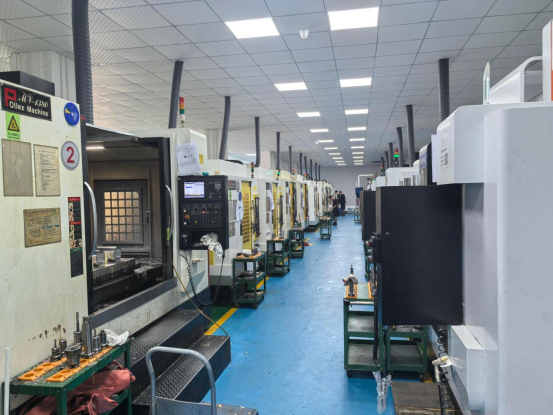
CNC stands for Computer Numerical Control. It refers to the automated control of machine tools using computer-programmed instructions. Instead of an operator manually controlling every machine movement, a CNC system follows programmed commands to control operations such as tool position, feed rate, spindle speed, and cutting paths. Autodesk similarly defines CNC as Computer Numerical Control and describes CNC systems as computer-controlled machine tools.
CNC technology is widely used to manufacture precise metal and plastic parts through processes such as milling, turning, drilling, and other machining operations.
What Does CNC Stand For?
The full meaning of CNC is:
Computer Numerical Control
Each part of the term describes how the system works:
<!--[if !supportLists]-->· <!--[endif]-->Computer — a controller processes the machining program.
<!--[if !supportLists]-->· <!--[endif]-->Numerical — machining instructions are represented by coded numerical commands.
<!--[if !supportLists]-->· <!--[endif]-->Control — those commands control the movements and functions of the machine.
In practical manufacturing, CNC allows a machine tool to perform a programmed sequence automatically rather than relying entirely on manual movement by a machinist.
Modern CNC systems can control spindle speed, feed rate, cutting-tool position, axis movement, coolant functions, and other machine operations.
What Is a CNC Machine?
A CNC machine is a manufacturing machine equipped with a computerized control system.
Depending on the machine type, the CNC controller may move:
<!--[if !supportLists]-->· <!--[endif]-->the cutting tool;
<!--[if !supportLists]-->· <!--[endif]-->the workpiece;
<!--[if !supportLists]-->· <!--[endif]-->the machine table;
<!--[if !supportLists]-->· <!--[endif]-->the spindle;
<!--[if !supportLists]-->· <!--[endif]-->or several axes simultaneously.
CNC machines commonly operate along three or more axes. More advanced machining centers may use five-axis motion to machine multiple surfaces or complex geometries with fewer setups. Autodesk describes CNC machines as electromechanical devices that move tools along multiple axes according to computer instructions, while Haas notes that five-axis machining can reduce setups when producing multi-sided and complex parts.
The key idea is simple:
The machine follows a programmed toolpath rather than depending on continuous manual control.
How Does CNC Machining Work?
CNC machining usually begins with a digital design of the required component.
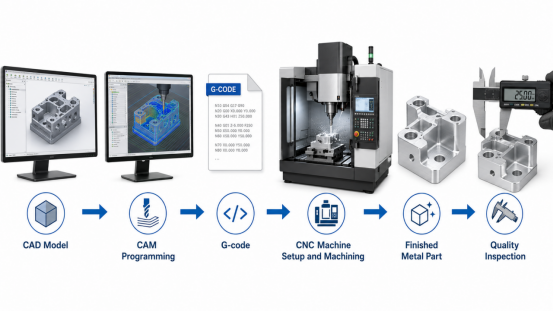
A typical workflow can be summarized as:
CAD Model → CAM Programming → CNC Code → Machine Setup → Machining → Inspection
1. Create the CAD Model
The part is first designed using CAD, or Computer-Aided Design, software.
The CAD model defines features such as:
<!--[if !supportLists]-->· <!--[endif]-->dimensions;
<!--[if !supportLists]-->· <!--[endif]-->holes;
<!--[if !supportLists]-->· <!--[endif]-->pockets;
<!--[if !supportLists]-->· <!--[endif]-->threads;
<!--[if !supportLists]-->· <!--[endif]-->contours;
<!--[if !supportLists]-->· <!--[endif]-->surfaces.
2. Create the CNC Toolpath
CAM, or Computer-Aided Manufacturing, software is then used to determine how the cutting tool will machine the component.
The programmer selects machining operations, cutting tools, stock material, cutting parameters, and toolpaths.
Autodesk explains that CAM software can take CAD geometry and generate toolpaths and instructions for CNC equipment.
3. Generate CNC Code
The CAM toolpaths are converted into machine-readable instructions, commonly called G-code.
These commands tell the CNC machine how and where to move.
G-code remains a commonly used programming language for CNC machine tools, and machine builders such as Haas publish dedicated G-code references for their CNC controls.
4. Set Up the Machine
Before machining begins, the operator typically prepares:
<!--[if !supportLists]-->· <!--[endif]-->raw material;
<!--[if !supportLists]-->· <!--[endif]-->workholding;
<!--[if !supportLists]-->· <!--[endif]-->cutting tools;
<!--[if !supportLists]-->· <!--[endif]-->work coordinates;
<!--[if !supportLists]-->· <!--[endif]-->tool offsets;
<!--[if !supportLists]-->· <!--[endif]-->machining program.
Correct setup is critical because even an accurate CNC program cannot compensate for incorrectly positioned stock or tooling.
5. Machine the Part
Once the setup and program are verified, the CNC machine follows the programmed toolpaths to remove material.
Depending on the machine, operations may include:
milling, turning, drilling, boring, threading, facing, contouring, and engraving.
6. Inspect the Finished Part
After machining, critical dimensions and features are inspected using appropriate measuring equipment.
For precision components, inspection requirements should be defined according to the drawing, tolerances, and intended function of the part.
Common Types of CNC Machines
CNC is not a single machining process. It is a control technology used across many different manufacturing machines.
CNC Milling Machines
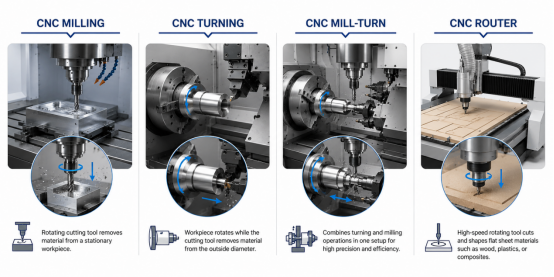
A CNC mill uses rotating cutting tools to remove material from a stationary or moving workpiece.
Typical milling operations include:
<!--[if !supportLists]-->· <!--[endif]-->pockets;
<!--[if !supportLists]-->· <!--[endif]-->slots;
<!--[if !supportLists]-->· <!--[endif]-->holes;
<!--[if !supportLists]-->· <!--[endif]-->flat surfaces;
<!--[if !supportLists]-->· <!--[endif]-->contours;
<!--[if !supportLists]-->· <!--[endif]-->complex 3D surfaces.
Three-axis CNC milling is common for relatively straightforward parts, while four-axis and five-axis machines provide additional positioning and machining flexibility.
CNC Lathes
A CNC lathe primarily rotates the workpiece while cutting tools remove material.
Turning is particularly suitable for cylindrical or rotational components such as:
<!--[if !supportLists]-->· <!--[endif]-->shafts;
<!--[if !supportLists]-->· <!--[endif]-->bushings;
<!--[if !supportLists]-->· <!--[endif]-->pins;
<!--[if !supportLists]-->· <!--[endif]-->threaded components;
<!--[if !supportLists]-->· <!--[endif]-->round housings.
CNC turning centers can also include additional tooling and machining capabilities beyond conventional turning.
CNC Mill-Turn Machines
Mill-turn equipment combines turning and milling functions within a single machine platform.
With live tooling, additional axes, and synchronized machine functions, these machines can produce complex components while reducing the need to move a part between multiple machines.
CNC Routers
CNC routers operate on similar computer-controlled principles but are commonly used for materials such as:
<!--[if !supportLists]-->· <!--[endif]-->wood;
<!--[if !supportLists]-->· <!--[endif]-->plastics;
<!--[if !supportLists]-->· <!--[endif]-->composites;
<!--[if !supportLists]-->· <!--[endif]-->foam;
<!--[if !supportLists]-->· <!--[endif]-->some aluminum applications.
The appropriate CNC equipment depends on the material, part geometry, tolerance, production quantity, and required surface finish.
CNC vs. Manual Machining
Both CNC and conventional machines remove material using cutting tools, but the method of machine control is different.
In manual machining, an operator directly controls much of the tool or workpiece movement.
With CNC machining, these movements are defined by the machining program and executed through the CNC control.
This makes CNC especially useful when producing:
<!--[if !supportLists]-->· <!--[endif]-->complex geometry;
<!--[if !supportLists]-->· <!--[endif]-->repeated components;
<!--[if !supportLists]-->· <!--[endif]-->parts requiring controlled toolpaths;
<!--[if !supportLists]-->· <!--[endif]-->multi-operation components;
<!--[if !supportLists]-->· <!--[endif]-->production batches.
However, CNC machining still requires skilled people. Programmers and machinists must understand tooling, materials, workholding, cutting conditions, tolerances, and machine behavior.
CNC should therefore be understood as automated machine control, not manufacturing without human expertise.
What Are the Advantages of CNC Machining?
Precision
Programmed axis movement allows CNC machines to follow controlled machining paths for precision manufacturing.
Repeatability
Once a process has been properly established, the same CNC program can be used to manufacture multiple components with consistent machining operations.
Complex Geometry
Multi-axis CNC machines can produce features and surfaces that would be difficult or inefficient to manufacture through conventional manual methods.
Automation
After machine setup and program verification, many machining operations can proceed automatically, reducing the need for continuous manual control.
Production Flexibility
A CNC machine can manufacture many different parts by changing the program, tools, fixtures, and raw material rather than requiring a dedicated machine for every component.
These capabilities explain why CNC machining is widely used for precision and complex manufacturing applications.
What Materials Can CNC Machines Cut?
CNC machining can be used with a wide variety of engineering materials.
Common metals include:
<!--[if !supportLists]-->· <!--[endif]-->aluminum;
<!--[if !supportLists]-->· <!--[endif]-->stainless steel;
<!--[if !supportLists]-->· <!--[endif]-->carbon steel;
<!--[if !supportLists]-->· <!--[endif]-->tool steel;
<!--[if !supportLists]-->· <!--[endif]-->brass;
<!--[if !supportLists]-->· <!--[endif]-->copper;
<!--[if !supportLists]-->· <!--[endif]-->titanium.
Engineering plastics can include materials such as:
<!--[if !supportLists]-->· <!--[endif]-->ABS;
<!--[if !supportLists]-->· <!--[endif]-->POM / acetal;
<!--[if !supportLists]-->· <!--[endif]-->nylon;
<!--[if !supportLists]-->· <!--[endif]-->polycarbonate;
<!--[if !supportLists]-->· <!--[endif]-->PEEK;
<!--[if !supportLists]-->· <!--[endif]-->PTFE.
However, machinability varies significantly between materials. Cutting tools, spindle speed, feed rate, coolant strategy, workholding, and machining parameters should therefore be selected for the specific material.
Where Is CNC Machining Used?
CNC machining is used across industries that require functional and dimensionally controlled components, including:
Aerospace, automotive, robotics, electronics, medical equipment, industrial machinery, automation equipment, and product development.
It is particularly useful for prototypes and production parts where geometry, material properties, dimensional requirements, and surface quality are important.
CNC Meaning in Modern Manufacturing
Although CNC literally means Computer Numerical Control, the term is often used more broadly in manufacturing.
For example:
<!--[if !supportLists]-->· <!--[endif]-->CNC machining — manufacturing parts using CNC-controlled machine tools;
<!--[if !supportLists]-->· <!--[endif]-->CNC milling — milling performed on a CNC machine;
<!--[if !supportLists]-->· <!--[endif]-->CNC turning — turning performed on a CNC lathe;
<!--[if !supportLists]-->· <!--[endif]-->CNC machine — a machine tool controlled by a computerized numerical control system;
<!--[if !supportLists]-->· <!--[endif]-->CNC programming — creating the instructions used to control CNC equipment.
So when an engineer says a component is a “CNC part,” they generally mean that the component was manufactured using CNC-controlled machining equipment.
From CNC Design to Finished Custom Parts
Understanding what CNC means is useful, but successful CNC manufacturing also depends on the complete production process.
Important considerations include:
<!--[if !supportLists]-->· <!--[endif]-->material selection;
<!--[if !supportLists]-->· <!--[endif]-->part geometry;
<!--[if !supportLists]-->· <!--[endif]-->achievable tolerances;
<!--[if !supportLists]-->· <!--[endif]-->tool access;
<!--[if !supportLists]-->· <!--[endif]-->hole depth;
<!--[if !supportLists]-->· <!--[endif]-->internal corner radii;
<!--[if !supportLists]-->· <!--[endif]-->surface finish;
<!--[if !supportLists]-->· <!--[endif]-->threading;
<!--[if !supportLists]-->· <!--[endif]-->inspection requirements.
A well-designed CNC part considers both functional requirements and manufacturability.
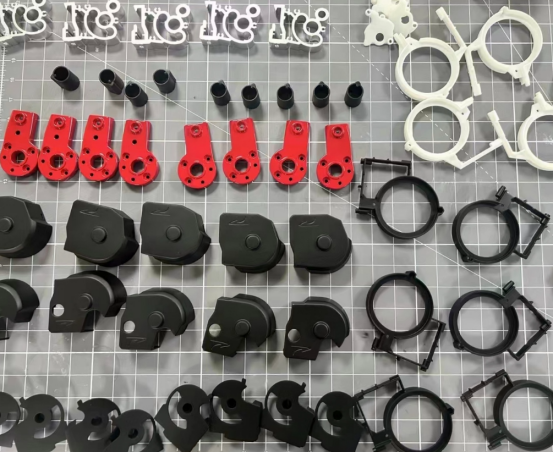
For custom CNC machining projects, Rapid-Model works from customer CAD models and technical drawings to manufacture metal and engineering-plastic components for prototyping and production applications.
Providing clear information about materials, tolerances, threads, surface finishes, and critical dimensions helps reduce manufacturing uncertainty and makes quotation and production more efficient.
Conclusion
CNC means Computer Numerical Control, a technology that uses programmed computer instructions to control machine tools.
In CNC machining, a digital design is converted into toolpaths and machine instructions that control operations such as milling, turning, drilling, and threading. This combination of automation, precision, repeatability, and manufacturing flexibility makes CNC an important technology in modern production.
For engineers and buyers, however, CNC is only part of the manufacturing process. Good results also depend on part design, material selection, tooling, machining strategy, tolerances, surface finish, and quality inspection.