What Is the Heat Treatment Process?
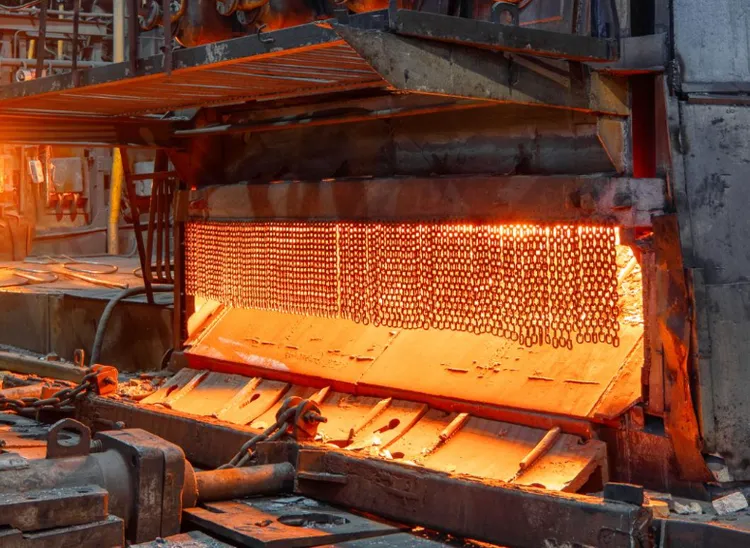
A Practical Guide for CNC Machined Metal Parts
Heat treatment is a controlled manufacturing process used to change the internal structure and mechanical properties of metal. Unlike CNC machining, which removes material to create a precise shape, heat treatment improves how the material performs. It can increase hardness, strength, toughness, wear resistance, machinability, and dimensional stability.
For engineers and buyers, heat treatment is important because material grade alone does not determine final part performance. Two parts made from the same steel can behave very differently if one is properly heat treated and the other is not. This is especially important for CNC machined parts used in machinery, automotive systems, tooling, robotics, industrial equipment, and other functional applications.
At Rapid-Model, we support customers with custom CNC machined parts from prototype to low-volume and production manufacturing. For many metal parts, machining accuracy, material selection, surface finishing, and heat treatment requirements must be considered together to achieve reliable final performance.
What Is Heat Treatment?
Heat treatment usually includes three basic stages: heating, holding, and cooling.
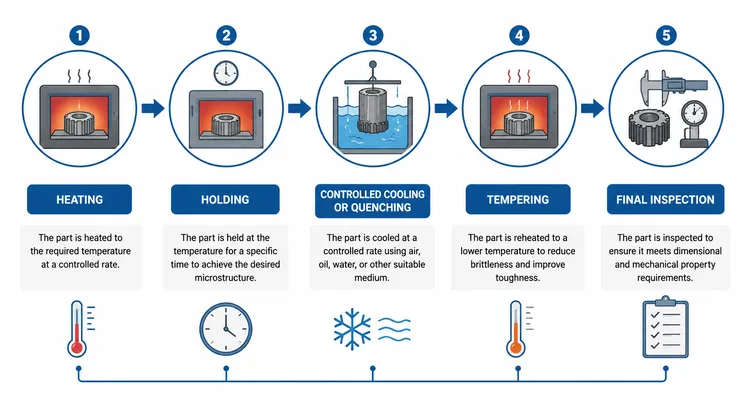
First, the metal is heated to a specified temperature. Then it is held at that temperature for a controlled period of time. Finally, it is cooled at a specific rate using air, furnace cooling, oil, water, gas, or another medium.
Different combinations of temperature, holding time, and cooling speed create different material properties. Slow cooling may soften the material and improve machinability, while rapid cooling can increase hardness. However, improper heat treatment may also cause distortion, cracking, or excessive internal stress.
This is why heat treatment should always be selected based on the material, part structure, tolerance requirements, and final working conditions.
Why Heat Treatment Matters for CNC Machined Parts
CNC machining can produce accurate dimensions and complex geometries, but heat treatment helps ensure that the part can withstand real working conditions. Many precision metal parts need both tight tolerances and specific mechanical properties.
Heat treatment is commonly used when a part requires:
- Higher hardness
- Better wear resistance
- Improved strength
- Better toughness
- Reduced internal stress
- Improved dimensional stability
- Longer service life
For example, shafts, gears, pins, bushings, molds, tooling components, and mechanical parts often require heat treatment. In some projects, heat treatment is performed after rough machining and before final precision machining. This helps control deformation and allows the final dimensions to be achieved more accurately.
Common Types of Heat Treatment Processes
Annealing
Annealing is used to soften metal, reduce hardness, improve ductility, and relieve internal stress. During annealing, the material is heated to a suitable temperature, held for a specific time, and then cooled slowly.
For CNC machining, annealing can make hard or stressed material easier to machine. It is often used before final machining when the material has been forged, cast, welded, or cold worked.
Normalizing
Normalizing is mainly used for steel. The material is heated above its critical temperature and then cooled in air. Compared with annealing, normalizing usually produces a finer and more uniform grain structure.
This process can improve strength, toughness, and material consistency. It is often used for forged or cast steel parts before CNC machining or further hardening.
Quenching
Quenching is a rapid cooling process. After the material is heated to the required temperature, it is quickly cooled in water, oil, gas, or another quenching medium.
For steel parts, quenching is commonly used to increase hardness. However, it can also create internal stress and distortion. Thin walls, deep cavities, sharp corners, and complex geometries are especially sensitive to quenching deformation.
For precision CNC machined parts, quenching must be carefully planned to avoid cracking or tolerance problems.
Tempering
Tempering is usually performed after quenching. A quenched steel part can be very hard but also brittle. Tempering reheats the part to a lower temperature to reduce brittleness and improve toughness.
The purpose of tempering is to create a better balance between hardness, strength, and ductility. Many functional steel components require both quenching and tempering to achieve stable mechanical performance.
Stress Relieving
Stress relieving reduces residual stress inside a part without significantly changing its hardness or strength. CNC machining, welding, casting, forging, and additive manufacturing can all introduce internal stress.
For precision parts, stress relieving is very useful. A common process route is rough machining, stress relieving, and then finish machining. This helps improve dimensional stability and reduce the risk of deformation after final machining.
Case Hardening
Case hardening increases surface hardness while keeping the core tougher and more ductile. Common methods include carburizing, nitriding, carbonitriding, and induction hardening.
This process is often used for gears, shafts, pins, bushings, and wear-resistant parts. These components need a hard surface to resist wear, but they also need a tough core to handle impact or load.
Heat Treatment and CNC Machining: Key Considerations
Heat treatment should be considered early in the manufacturing process, not after the part is already finished. The sequence of machining and heat treatment can affect cost, lead time, accuracy, and final quality.
A typical process may be:
Material selection → rough machining → heat treatment → finish machining → surface finishing → inspection
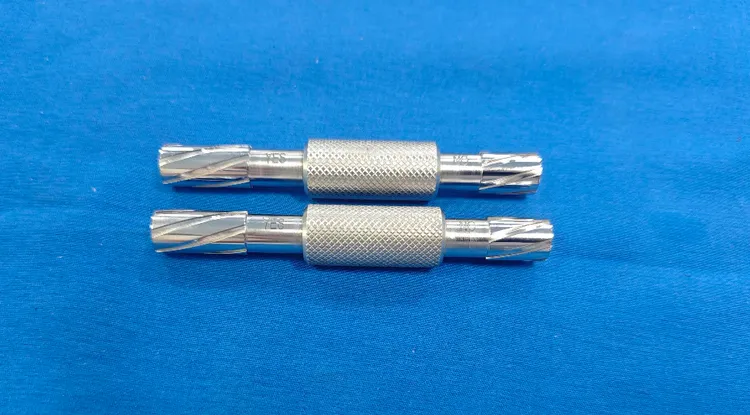
For high-precision parts, machining allowance is often needed before heat treatment because the part may slightly deform during heating and cooling. After heat treatment, final CNC machining, grinding, or inspection may be required to achieve the required tolerances.
Clear drawing requirements are also important. Customers should specify material grade, heat treatment method, hardness requirement, tolerance, surface finish, and inspection standard whenever possible.
Quality Inspection After Heat Treatment
After heat treatment, quality inspection helps confirm that the part meets both material and dimensional requirements. Common checks include hardness testing, dimensional inspection, visual inspection, surface hardness testing, case depth testing, and review of material certificates.
For precision CNC machined parts, hardness alone is not enough. The part must also meet drawing tolerances, surface finish requirements, and assembly needs.
At Rapid-Model, we support customers with CNC machining, material selection, finishing options, and inspection for custom metal parts. If your project requires heat-treated steel, aluminum, stainless steel, titanium, or other metal components, our engineering team can help review your drawings and recommend a practical manufacturing process.
Conclusion
Heat treatment is a critical process for improving the performance of metal parts. By controlling heating, holding, and cooling, manufacturers can improve hardness, strength, toughness, wear resistance, and dimensional stability.
For CNC machined parts, heat treatment affects not only material properties but also machining strategy, tolerance control, surface finishing, and final inspection. Choosing the right heat treatment process early can help reduce deformation, improve durability, and ensure the part performs reliably in real applications.
Rapid-Model provides custom CNC machining and manufacturing support for global customers. If you need precision machined parts with specific material or hardness requirements, we can help you evaluate the best process from prototype to production.
FAQ
What is the purpose of heat treatment?
The purpose of heat treatment is to improve metal properties such as hardness, strength, toughness, wear resistance, machinability, and dimensional stability.
Does heat treatment change part dimensions?
Yes. Heat treatment may cause slight deformation or dimensional change, especially after quenching. Precision parts may need finish machining after heat treatment.
What is the difference between quenching and tempering?
Quenching increases hardness by rapid cooling. Tempering is performed after quenching to reduce brittleness and improve toughness.
Should heat treatment be done before or after CNC machining?
It depends on the part. Many precision parts are rough machined first, then heat treated, and finally finish machined to meet tight tolerances.