O titânio é mais duro do que o aço carbono? Um guia abrangente de engenharia
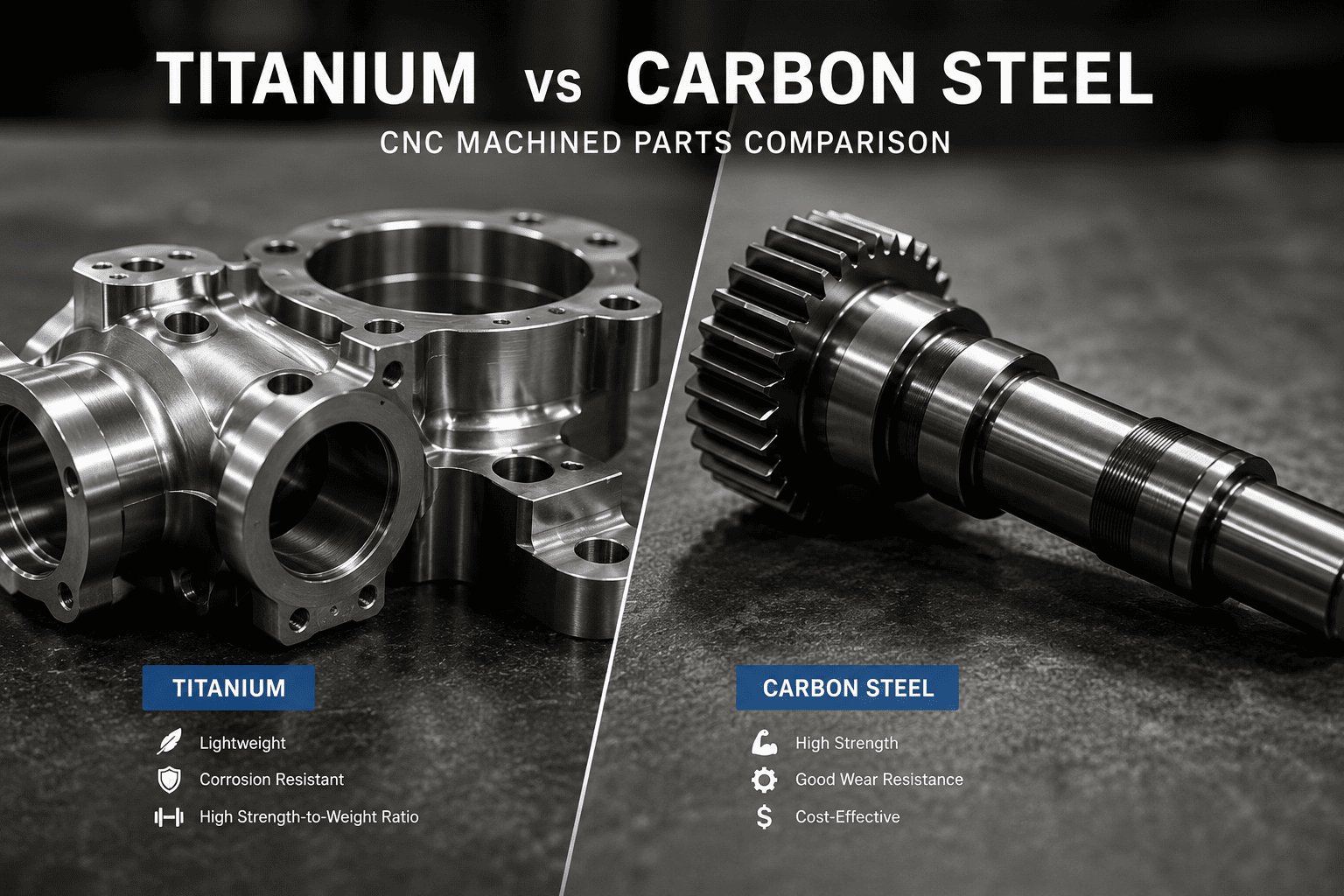
Quando engenheiros e designers de produtos comparam metais para usinagem CNC, uma das perguntas mais comuns é: o titânio é mais duro do que o aço carbono?
A resposta direta é: nem sempre. Enquanto o titânio é amplamente reconhecido como um material premium e de alto desempenho, sua dureza depende inteiramente do grau específico de titânio, do grau de aço e da condição de tratamento térmico.
Na usinagem CNC de precisão, simplesmente perguntar qual material é mais duro não é suficiente. A melhor pergunta é: qual material é mais adequado para a função, tolerância, requisitos de peso, ambiente corrosivo e orçamento da sua peça? Vamos mergulhar nos detalhes.
Titânio comercialmente puro vs. aço de carbono médio
O titânio comercial puro não é excepcionalmente duro. Por exemplo, o titânio de grau 2 é classificado em aproximadamente Rockwell B 80 (145 HV Vickers) de acordo com ASM / MatWeb dados.
Por outro lado, um aço de carbono médio comum como AISI 1045 pode atingir em torno de Rockwell B 84 (170 HV) em certas condições fornecidas. Isso significa que alguns aços de carbono comuns e não tratados são realmente mais duros do que o titânio comercialmente puro.
Ligas de titânio vs. alto carbono & Ferramenta Aço
A história muda quando olhamos para ligas de titânio. Ti-6Al-4V (Titânio de grau 5) é significativamente mais duro do que suas contrapartes comercialmente puras. O Ti-6Al-4V recocido tem uma dureza de cerca de Rockwell C 36 (349 HV). Isso torna o titânio de grau 5 mais duro do que muitos aços de carbono leve ou médio não tratados.
No entanto, o aço é incrivelmente versátil. Aço de alto carbono endurecido e aço de ferramentas (que foram extintos e temperados) podem facilmente exceder a dureza de até as ligas de titânio mais duras. Portanto, o titânio não é automaticamente mais duro do que o aço carbono; é inteiramente relativo às notas a serem comparadas. 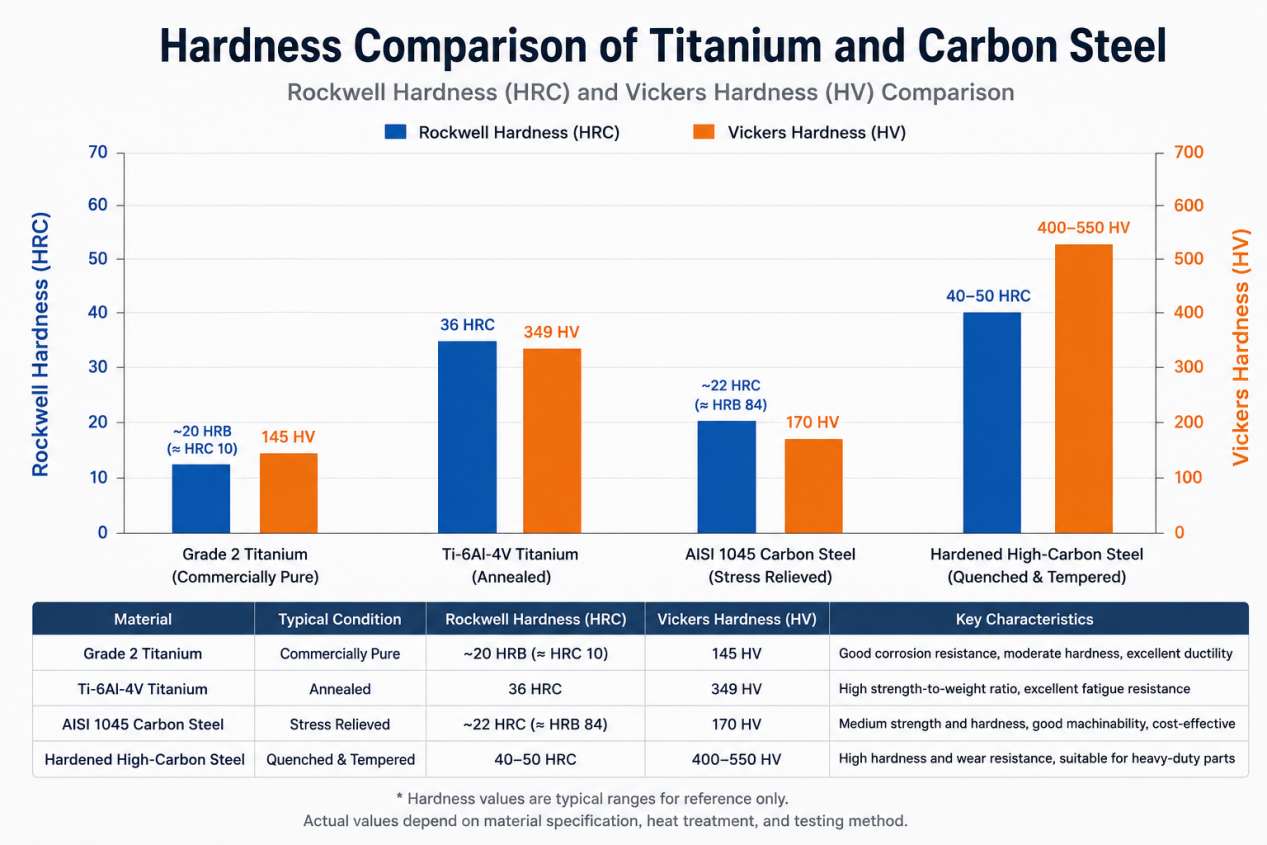
Comparação de Dureza de Titânio vs. Aço de Carbono
Materiais | Condição típica | Aproximadamente. Dureza | Significado prático |
grau 2 titânio | Comercialmente puro | HRB 80 / 145 HV | Good corrosion resistance, moderate hardness |
Ti-6Al-4V (grau 5) | Annealed alloy | HRC 36 / 349 HV | High strength-to-weight ratio, harder to machine |
AISI 1045 Steel | Hot rolled / stress relieved | HRB 84 / 170 HV | Economical medium-carbon steel |
High-Carbon Steel | Quenched & tempered | Often > Ti-6Al-4V | Better for highly wear-resistant parts |
Tool Steel | Heat treated | Much higher | Used for dies, punches, molds, and tooling |
Why "Hardness" Isn't Everything in Material Selection
The reason "carbon steel" is a tricky category is due to its carbon content and heat treatment variability:
• Low-carbon (mild) steel: Soft, ductile, and highly machinable.
• Medium-carbon steel: Offers a great balance of strength, hardness, and cost.
• High-carbon steel: Can be heat-treated to achieve extreme hardness and wear resistance.
Titanium’s true value does not lie in being the "hardest" metal. Its distinct advantages are its incredible strength-to-weight ratio, excellent corrosion resistance, and biocompatibility. This is why titanium is the go-to choice for aerospace components, medical implants, robotics, marine equipment, and high-performance automotive parts. It provides robust mechanical performance while significantly reducing weight.
Usinagem CNC Challenges: Why Titanium "Feels" Harder
In CNC machining, titanium can often feel much harder to machine than steel, even if its Rockwell hardness number is lower. Why?
Titanium has low thermal conductivity. This means that during machining, the cutting heat doesn't dissipate through the chip; instead, it stays concentrated near the cutting tool edge. This accelerates tool wear and creates challenges with surface finish, chatter, and dimensional stability.
How to Choose: Titanium or Carbon Steel?
Material selection should always be aligned with your engineering drawings and end-use application.
Choose Titanium when your project requires:
• Significant weight reduction without sacrificing strength.
• Extreme corrosion resistance (e.g., marine or chemical environments).
• Biocompatibility (medical devices).
• High performance in aerospace or robotic applications.
Choose Carbon Steel when your project requires:
• High hardness and wear resistance (achieved via heat treatment).
• Lower material and manufacturing costs.
• Strong structural performance where weight is not a strict limiting factor.
• Components like shafts, gears, fixtures, and general tooling. (Note: Carbon steel requires surface treatments like plating or black oxide to prevent rust). 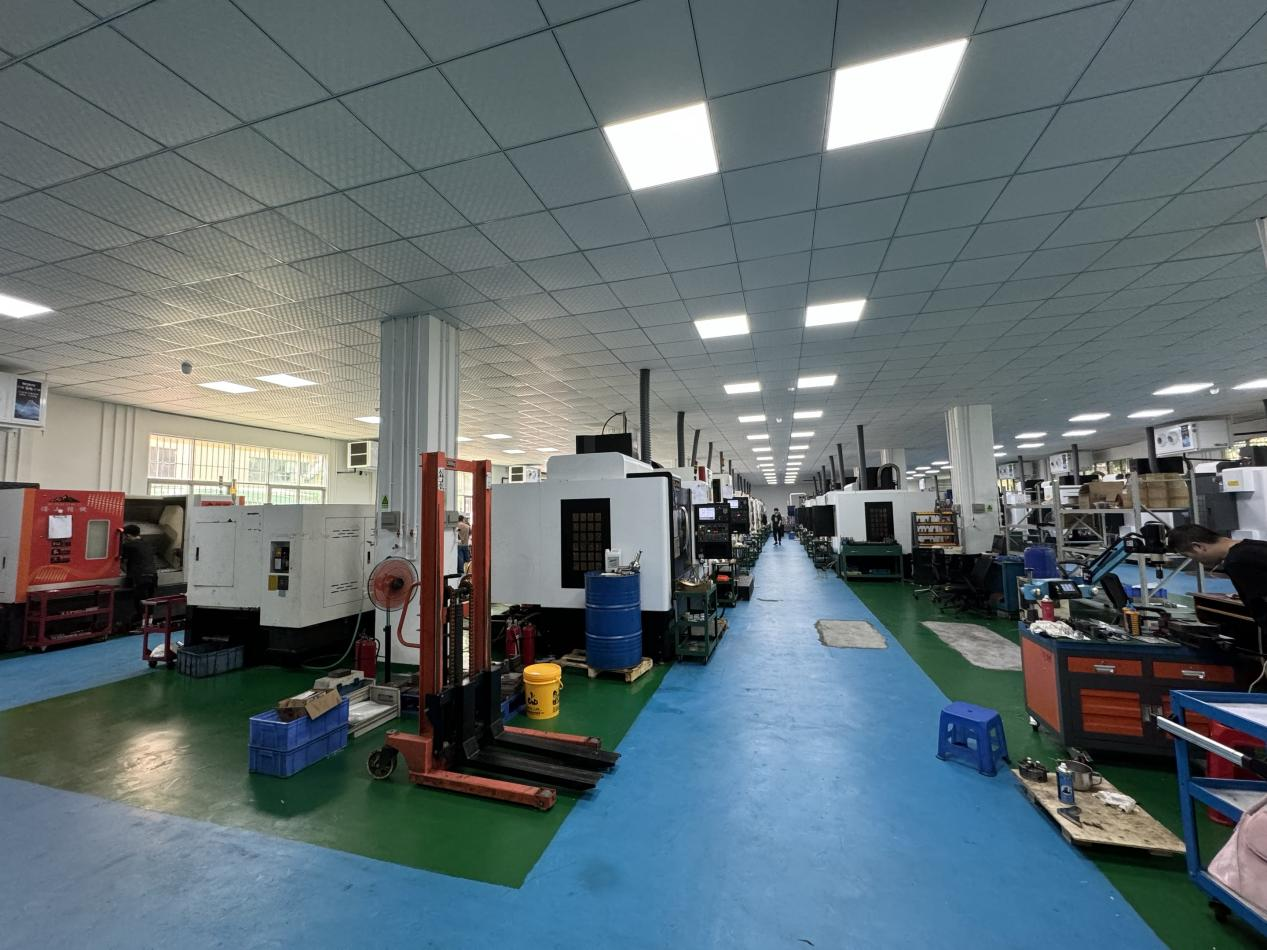
Professional CNC Machining Services at Modelo Rápido
A simple statement like "titanium is harder than carbon steel" can be misleading if the grade, condition, and application are not defined. For successful CNC projects, details matter: material grade, tolerance, surface finish, and production volume.
At Rapid-Model, we help our global customers evaluate materials from a practical, manufacturing-first perspective. As a premier Shenzhen-based CNC machining supplier, we provide end-to-end manufacturing solutions. From custom CNC machining, titanium and steel machining, to sheet metal fabrication—we take your project from rapid prototype to large-scale production seamlessly.
Final Verdict
Is titanium harder than carbon steel? Sometimes, but not always. Commercially pure titanium is often softer than medium-carbon steel. Grade 5 Titanium is harder than untreated steel, but hardened tool steel remains superior in pure hardness. Ultimately, hardness is just one factor. The best material is the one that perfectly balances strength, weight, wear, corrosion, precision, and cost for your specific part.