Guía completa de fresado de roscas: técnicas, herramientas y mejores prácticas para el mecanizado CNC
Resolución de problemas del mundo real:Al golpear herramientas se adhieren a materiales duros como el titanio o luchan por manejar hilos finos como 4" -80 UNJ, el fresado de rosca se convierte en la solución. Los informes de la industria revelan los siguientes beneficios de la fresadora de rosca:
- 47% más de vida útil de la herramienta en Inconel en comparación con el aprovechamiento (informe MachiningCloud 2023)
- Reducción de costes del 30%en agujeros mayores que 1" diámetro (estudio de caso Boeing SAE)
2. La física detrás del fresado de rosca
Innovación básica: El fresado de roscas utiliza un diámetro de herramienta más pequeño en comparación con la rosca, lo que le permite cortar roscas en agujeros más grandes con mayor precisión.
Interpolación helicoidal: La herramienta se mueve simultáneamente en un movimiento circular (X/Y) y axial (Z), creando roscas con una geometría superior.
Ventaja de la carga del chip: La fresadora de rosca genera 70% menos fuerza de corte que el troquelado convencional, lo que lo hace ideal para materiales difíciles de maquinar y reducir el desgaste de la herramienta.
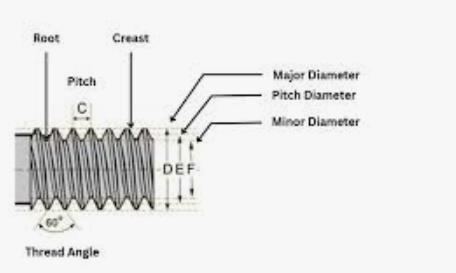
Visualización de la ruta de la herramienta:
3. Matriz de selección de molino de rosca (estándares globales)
La selección del molino de rosca adecuado depende del material, los requisitos de rosca y las condiciones de mecanizado. A continuación hay una guía útil:
| Tipo de herramienta | Mejor para | Consejos de velocidad/alimentación | Principales marcas |
|---|---|---|---|
| flauta recta | Aleaciones blandas, prototipo | 300-500 SFM, 0,003 "/diente | Kennametal |
| flauta helicoidal | Inoxidable, aeroespacial | 150-250 SFM, 0,002 "/diente | Sandvik Coromant |
| Punto único | Hardened steels (>45 HRC) | 80-120 SFM, 0.001″/tooth | Iscar |
NASA-Approved Practice: For A286 superalloy fasteners, use variable-helix tools with AlTiCrN coating (Ref: MSFC-STD-3676)
4. When to Choose Thread Milling vs. Tapping
Dominate These 5 Scenarios with Thread Milling:
- Large Diameters: Thread M120 holes on horizontal mills.
- Agujeros ciegos: Perfect threads to the bottom with controlled retract.
- Interrupted Cuts: Reliably thread cast iron with sand inclusions.
- Exotic Materials: Hastelloy, Waspaloy, and GRCop-42 copper alloys.
- Custom Threads: Produce UNJ, ACME, and NPT in the same setup.
Avoid Thread Milling When:
- Mass-producing M8×1.25 threads in 6061-T6 aluminum.
- Limited CNC interpolation capability.
- Shop only has manual machines.
5. Global Machining Parameters Cheat Sheet
| Material | SFM | IPT | DOC | Coolant Strategy |
|---|---|---|---|---|
| 7075-T6 Aluminum | 650 | 0.004″ | 1.5×Pitch | Air blast + MQL |
| 17-4PH Stainless | 180 | 0.0025″ | 1×Pitch | 8% Emulsion @ 800 psi |
| Ti-6Al-4V ELI | 110 | 0.0015″ | 0.8×Pitch | Through-tool cryo |
| D2 Tool Steel | 75 | 0.001″ | 0.5×Pitch | Dry machining |
Euro-Specific Tip: For CE-compliant shops, use minimum quantity lubrication (MQL) when machining copper alloys (per EU Directive 2023/178).
6. Advanced Troubleshooting Guide
| Symptom | Root Cause | Fix | Prevention |
|---|---|---|---|
| Thread chatter | Excessive tool overhang | Reduce L:D ratio below 4:1 | Use hydraulic expansion holder |
| Dimensional drift | Thermal expansion | Implement compensation +0.0003″/inch | Pre-cool workpiece |
| Poor surface finish | Chip recutting | Program full retract every 3 threads | Use compressed air blast |
| Tool fracture | Incorrect helix direction | Verify climb vs. conventional milling | Run spindle verification test |
7. Programming Pro Tips (Fanuc/Heidenhain/Siemens)
G-Code Essentials for Thread Milling:
G17 G90 G54 ; XY plane, absolute, work offset
G43 H01 Z1.0 ; Tool length comp
M03 S3500 ; Start spindle
G02 X0 Y0 I-0.5 Z-0.1 F20.0 ; Helical interpolation
; Repeat for thread depth (Z-increment = pitch)
G00 Z2.0 M05 ; Retract, stop spindle
CAM Software Settings:
- 85% radial engagement maximum
- Lead-in/lead-out ≥ 30° arc
- Always use centerline programming
8. 2024 Industry Innovations
- Smart Tooling: Kennametal’s NOVO chipbreaker technology reduces torque by 40%.
- Hybrid Processing: DMG MORI’s MillTap machines combine drilling and threading for faster setups.
- AI Optimization: Siemens NX Thread Advisor auto-generates cycle times, optimizing efficiency.
- Ultra-Precision: Sandvik’s CoroMill® 390 achieves Ra 0.8 μm finish in titanium.
9. Machinist’s FAQ (Field-Tested Answers)
- Q: Can I thread mill left-hand threads?
A: Yes, simply reverse the spindle rotation (M04) and adjust the helix direction (G03 for RH → G02 for LH). - Q: What’s the minimum hole size?
A: Commercially available tools can handle holes as small as #0-80 (0.060″/1.52mm) using micro-grain carbide tools. - Q: How to calculate cycle time?
A: Formula: Time = [(Depth ÷ Pitch) + 2] × (π × Hole Dia ÷ Feed Rate) + rapid moves. - Q: What are OSHA coolant requirements?
A: Use NSF-registered fluids with ≤0.5 mg/m³ aerosol exposure (29 CFR 1910.1000).
10. Partner Selection Criteria
When selecting a machining partner for mission-critical threads, prioritize the following certifications:
- AS9100 Rev D aerospace quality systems
- Nadcap AC7114 special process approval
- On-site CMM with Geomagic® Control X
“Demand these certifications for guaranteed thread quality and reliability.” – J. Richardson, Former SpaceX Manufacturing Lead
▼ Get Instant Thread Milling Solutions
Upload your drawing to receive a comprehensive DFM analysis within 3 hours:
- Material-specific tooling recommendations
- ISO 9001:2015 compliant process sheets
- Competitive pricing with ITAR options