Is Titanium Difficult to Machine? CNC Machining Challenges, Tool Wear & Design Tips
Titanium is challenging to machine, but it is not unmanageable. Its low thermal conductivity keeps a large share of cutting heat concentrated near the tool–workpiece interface; its strength at elevated temperature, chemical interaction with cutting tools, and relatively low elastic modulus add further demands. Together, these factors can accelerate tool wear, promote vibration, and make thin or slender features difficult to hold within tolerance. With suitable tooling, rigid workholding, controlled engagement, effective coolant delivery, and a design that accounts for titanium’s behavior, CNC machining can produce accurate, repeatable parts.
For engineers and buyers, the useful question is not simply whether titanium is difficult to machine. It is which alloy, geometry, tolerance, surface requirement, and production volume are involved—and whether the machining plan is designed around them.
1. Why is titanium difficult to machine?
Titanium’s value comes from a useful combination of strength-to-weight ratio, corrosion resistance, and performance in demanding environments. The same material characteristics that make it attractive in aerospace, medical equipment, energy, and high-performance machinery can also make it less forgiving during cutting.
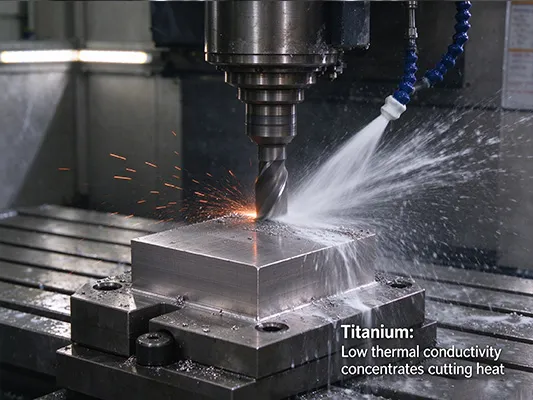
Low thermal conductivity concentrates heat
Compared with many common engineering metals, titanium transfers heat away from the cutting zone relatively poorly. Heat therefore concentrates around the cutting edge and the immediate contact area rather than being carried away efficiently by the workpiece or chip. High local temperatures can accelerate tool wear and promote chemical interaction between the tool and the work material. Simply increasing cutting speed to reduce cycle time can shorten tool life or destabilize the process if heat is not managed.
Titanium retains strength under cutting temperatures
Titanium alloys can retain considerable strength at elevated temperatures. The tool may therefore continue to experience high mechanical loading while also being exposed to concentrated heat. This places demanding conditions on the cutting edge and tool holder.
Chemical interaction and adhesion
At high cutting temperatures and contact pressures, titanium may chemically interact and adhere to the tool. Material can accumulate on the edge (Built-Up Edge) and then break away, damaging the tool or affecting the machined surface. The exact behavior depends on the alloy, tool coating, cutting conditions, and coolant strategy.
Relatively low elastic modulus increases deflection
Titanium has a lower elastic modulus (~110 GPa) than many carbon steels (~200 GPa)[1]. Thin walls, long unsupported sections, and slender tools can deflect under cutting forces. When the tool exits the cut, the part may spring back, leaving dimensional error or inconsistent wall thickness. Deflection is also a primary contributor to vibration and chatter.
2. Common CNC machining challenges
| Challenge | What causes it | Potential production effect | Typical control strategy |
|---|---|---|---|
| Rapid tool wear | Concentrated heat, high edge stress, adhesion, unsuitable tool grade | More tool changes, higher cost, inconsistent dimensions | Use titanium-appropriate tooling; validate speed, feed, engagement, and coolant together |
| Edge chipping | Interrupted cut, chatter, excessive engagement, or unsuitable edge | Surface damage, sudden tool failure, scrap | Improve rigidity and toolpath; check runout and cutting-edge condition |
| Notch wear | Localized wear near the depth-of-cut line | Unstable cutting and reduced tool life | Review depth-of-cut strategy, tool grade, and wear pattern with the toolmaker |
| Built-up material (BUE) | Titanium adheres to the cutting edge under heat/pressure | Poor finish, changing effective tool geometry, edge damage | Select suitable tool geometry and grade; avoid rubbing; monitor coolant delivery |
| Chatter and vibration | Tool/part deflection, long overhang, weak workholding | Poor finish, dimensional variation, premature tool damage | Shorten overhang, stiffen the setup, modify engagement or toolpath |
3. Titanium tool wear: symptoms, causes, and controls
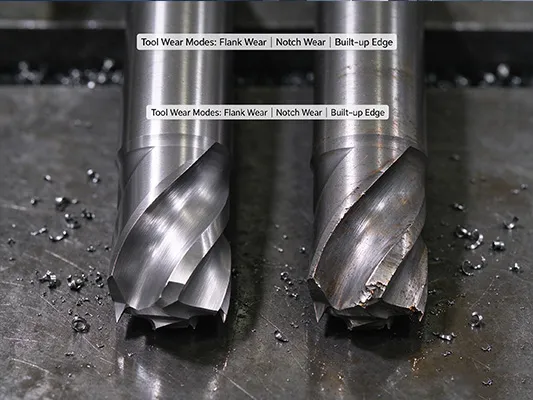
Tool wear is one of the largest process-control issues in titanium machining because small changes at the cutting edge can drastically affect dimensional consistency, finish, and cycle time.
| Wear mode | Common sign | What to review |
|---|---|---|
| Flank wear | Wear land along the tool’s clearance face | Tool grade, speed, cutting distance, and replacement threshold |
| Crater wear | Depression on the rake face | Tool material/coating suitability and cutting conditions |
| Notch wear | Localized damage around the depth-of-cut line | Depth-of-cut strategy, tool position, and toolmaker guidance |
A robust tool-life plan should define a measurable replacement rule—such as a maximum wear limit, number of parts, or a surface-finish trigger. Do not wait for catastrophic tool failure when a critical feature or high-value part is at risk.
4. Practical machining strategies
Select tooling for the alloy and operation
Do not assume one end mill, insert, or coating is ideal for all titanium. Commercially pure titanium (gummy) and alpha-beta alloys (hard and heat-generating) have different cutting behaviors. Consult the tooling manufacturer’s recommendations[2]. A “harder” or more heavily coated tool is not automatically better if the edge lacks the required sharpness or toughness.
Keep the machine, holder, and workholding rigid
Machine rigidity, spindle condition, holder grip, tool runout, and part clamping all affect the cutting edge. A rigid setup helps reduce vibration. For thin-wall parts, support should be designed so that clamping does not distort the component, and releasing the clamp does not create unacceptable springback.
Apply coolant consistently and effectively
Coolant helps manage heat and carry chips away, but its effectiveness depends on pressure, flow, and tool access. Through-tool or high-pressure coolant[3] is highly beneficial for titanium milling and drilling. However, coolant cannot compensate for an unstable setup or incorrect feeds and speeds.
5. Milling, turning, drilling, and threading considerations
- CNC milling: Sensitive to tool engagement and chip evacuation. Use an appropriate cutter, keep overhang short, and utilize trochoidal or adaptive toolpaths to maintain a consistent radial load.
- CNC turning: Monitor the depth-of-cut line for notch wear and verify the chip breaker is producing manageable chips. Do not allow a heavily worn edge to continue cutting high-value bar stock.
- Drilling: Confined holes make heat and chips difficult to manage. Deep holes require manufacturer-recommended drilling cycles, proper point geometry, and through-coolant to prevent drill seizure.
- Threading: Titanium's springback makes traditional tapping highly risky; taps can bind and snap inside the hole. Where possible, use thread milling instead of tapping to lower the risk of tool breakage and part scrap.
6. Design tips to make titanium parts easier to machine
| Design consideration | Common risk | Practical tip |
|---|---|---|
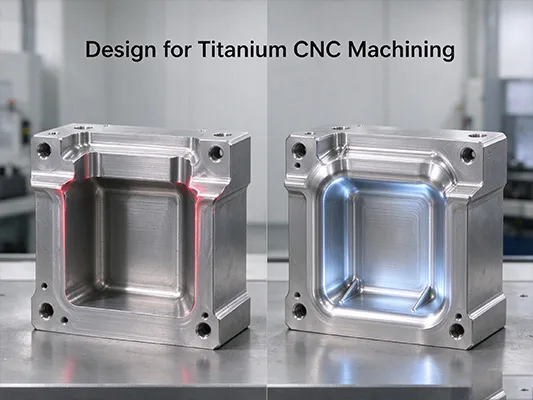
| Thin walls | Deflection, chatter, distortion after unclamping | Use thicker walls where performance permits; add ribs or support features. |
| Deep, narrow pockets | Long tool overhang, poor chip evacuation | Increase pocket radii; avoid unnecessary depth and narrow slots. |
| Tight tolerances everywhere | Additional finishing, inspection, and scrap risk | Apply tight tolerances only to functional or mating features. |
| Difficult-to-clamp geometry | Part movement or clamp-induced distortion | Add datum or sacrificial clamping features during the prototype phase. |
7. Does titanium grade affect machinability?
Yes. "Titanium" covers commercially pure grades and multiple alloys, which are not interchangeable:
- Commercially pure grades (e.g., Grade 2): Lower strength but highly ductile (gummy). Requires very sharp tools to prevent built-up edge (BUE).
- Grade 5 (Ti-6Al-4V): A high-strength alloy. Heat generation, low thermal conductivity, and abrasive tool wear are the primary challenges.
- Grade 23 (Ti-6Al-4V ELI): Similar machining behavior to Grade 5, but often requires stricter material lot traceability due to its use in medical and cryogenic applications.
8. Quality risks and inspection
A successful titanium CNC process must deliver more than a shiny surface. Depending on the part, inspection may need to cover geometric tolerances, surface finish (especially for fatigue-sensitive areas), and thread engagement.
Safety Note: Titanium chips and fine dust pose a severe flammability risk. Standard shop fire extinguishers (like water or CO2) can react explosively with burning titanium. Facilities machining titanium must implement strict housekeeping and have Class D fire extinguishers (combustible metals) immediately accessible.
9. What makes titanium CNC machining expensive?
Titanium parts cost more to machine than aluminum due to slower cutting speeds, specialized tooling, and longer cycle times. However, the ultimate cost driver is often unpredictable tool failure. If an end mill chips halfway through finishing a high-value aerospace component, the entire part may be scrapped. Rigorous tool-life management, lower tool-change thresholds, and multiple roughing/finishing setups are necessary insurance policies that add to the quoted cost.
10. Procurement checklist for titanium CNC machining
Before requesting a quotation, prepare:
- 2D drawing and 3D CAD model with defined critical datums.
- Exact titanium grade (e.g., ASTM B348 Grade 5) and required material certificates (MTRs).
- Expected repeat-order volume (to justify custom workholding/tooling investments).
- First-article inspection (FAI) and traceability requirements.
11. Frequently asked questions
Is titanium harder to machine than stainless steel?
Often, yes. While stainless steel work-hardens, titanium's combination of low thermal conductivity, high high-temperature strength, and low elastic modulus (springback) generally requires tighter process controls and slower cutting speeds than 304 or 316 stainless.
Is coolant necessary when machining titanium?
Yes. High-pressure coolant is heavily relied upon to manage the extreme heat concentrated at the cutting edge and to forcefully evacuate chips, preventing them from being recut and damaging the tool.
Technical References
- ASM International — "Machining and Chemical Shaping of Titanium". Overview of titanium machining requirements, machine rigidity, and cutting data.
- Seco Tools — "Your Guide to Efficient Titanium Machining". Manufacturer guidance on tooling, coolant, and process considerations.
- Sandvik Coromant — Titanium machining in aerospace applications. Guidance on high-pressure coolant, chip control, and titanium milling strategies.