Che cos'è la stampatura a inserto? Una guida completa al processo
Inserimento a iniezione È un processo di stampaggio a iniezione in cui un componente premanufacturato, chiamato inserto, viene posizionato all'interno di uno stampo prima che la plastica fusa venga iniettata attorno a esso.
Dopo che la plastica si raffredda e solidifica, l'inserimento diventa una parte integrata del componente stampato.
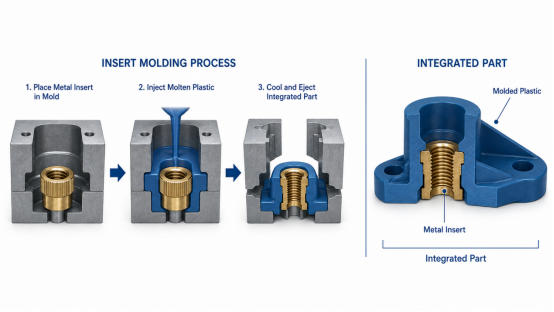
Metal inserts are especially common. Examples include threaded inserts, bushings, pins, electrical contacts, sleeves, and stamped metal components. By combining metal and plastic in a single molded part, insert molding can reduce secondary assembly while adding features that would be difficult to achieve with plastic alone.
How Does Insert Molding Work?
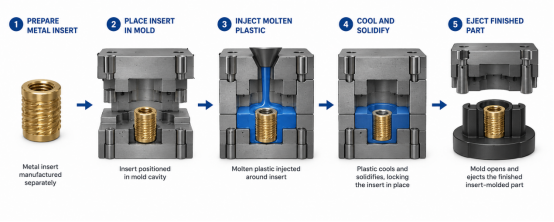
The basic insert molding process can be divided into several steps:
1. Prepare the Insert
The insert is manufactured before molding begins.
Depending on the product, it may be a:
· threaded brass insert;
· steel or stainless steel component;
· bushing or sleeve;
· pin;
· electrical contact;
· stamped metal part.
The insert geometry is important because the surrounding plastic must hold it securely after molding.
2. Place the Insert in the Mold
The insert is positioned accurately inside the injection mold.
For lower-volume production, inserts may be loaded manually. High-volume production can use robots or automated feeding systems to improve cycle time and positioning consistency. Industrial insert-molding systems can also integrate stamping and molding operations into automated production lines.
3. Close the Mold
The mold closes around the insert and holds it in the required position.
Proper insert location and retention are critical. If an insert moves while the mold closes or while plastic is injected, the finished part may have dimensional problems or the mold itself may be damaged.
4. Inject the Plastic
Molten thermoplastic is injected into the mold cavity and flows around the insert.
Features such as knurls, grooves, holes, undercuts, or other mechanical retention geometry can help lock a metal insert into the plastic after molding.
For metal-to-plastic insert molding, retention is generally achieved mechanically rather than by relying on chemical adhesion between the materials.
5. Cool and Eject the Part
The plastic cools and solidifies around the insert. The mold then opens and the completed insert-molded component is ejected.
The result is one integrated component containing both the molded plastic and the preformed insert.
6. Inspect the Finished Component
Inspection may include:
· insert position;
· molding dimensions;
· thread condition;
· flash;
· plastic coverage;
· cosmetic appearance;
· pull-out or torque performance when required.
Critical insert features should be clearly identified on the engineering drawing.
Common Types of Inserts
Insert molding can incorporate many different preformed components.
Threaded Inserts
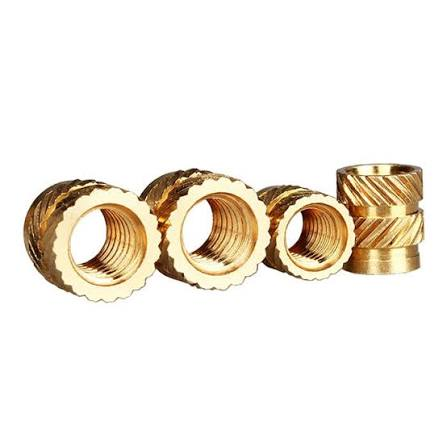
Threaded metal inserts provide durable internal threads inside plastic parts.
They are particularly useful when screws will be installed and removed repeatedly, because an integrated metal thread can offer better durability than threading directly into many plastics. Protolabs specifically identifies threaded inserts as a way to reinforce fastening capability in molded plastic components.
Bushings and Sleeves
Metal bushings can provide wear-resistant or dimensionally stable surfaces where shafts, pins, or other mating components interact with a plastic housing.
Electrical Contacts
Pins, terminals, contacts, and conductors can be molded directly into electrical or electronic components.
Stamped Metal Components
More complex stamped metal features can also be integrated into molded plastic. Insert molding manufacturers use combinations of precision press working and injection molding for applications such as electrical and automotive components.
What Materials Are Used for Insert Molding?
Insert Materials
Common metal insert materials include:
· brass;
· steel;
· stainless steel;
· other application-specific metals.
Brass is particularly common for threaded inserts, while steel and stainless steel are also widely available depending on required strength and corrosion resistance.
Plastic Materials
Many injection-molding thermoplastics can be used for insert molding, depending on the application.
Examples include:
· ABS;
· polypropylene (PP);
· polycarbonate (PC);
· acetal/POM;
· nylon;
· PBT and PPA;
· PPS;
· PEI;
· PEEK;
· TPU and other engineering polymers.
Material selection should consider mechanical strength, temperature, chemical exposure, shrinkage, electrical requirements, appearance, and the stresses created around the insert during molding and service. Commercial insert-molding capabilities cover a broad range of commodity and engineering resins.
Advantages of Insert Molding
Reduced Assembly
One of the biggest advantages is the ability to combine previously separate components during molding.
A threaded insert, electrical contact, or bushing does not necessarily need to be installed as a separate downstream assembly operation.
This can reduce part count and simplify manufacturing.
Stronger Fastening Features
Metal threaded inserts can provide durable fastening points in plastic components, especially where repeated assembly and disassembly are expected.
Integration of Different Material Properties
Insert molding allows engineers to use plastic where low weight, insulation, shape complexity, or moldability is useful while retaining metal where strength, wear resistance, conductivity, or threaded fastening is required.
Consistent Insert Position
When the mold and process are properly designed, inserts can be located accurately relative to molded plastic features.
This can be useful for electrical connectors, housings, mounting features, and precision mechanical assemblies.
Potential for Automated Production
Insert loading and molding can be integrated into automated production systems, especially at higher volumes. Some specialized production lines combine press forming, injection molding, and downstream operations.
Limitations and Challenges of Insert Molding
Insert molding also creates additional manufacturing considerations compared with standard injection molding.
More Complex Tooling
The mold must locate and retain the insert while allowing the plastic to flow around it.
This often makes mold design more complex than a comparable plastic-only component.
Insert Positioning
The insert must remain correctly located during mold closing and injection.
Variation in insert dimensions or poor retention can lead to misalignment, flash, incomplete encapsulation, or mold damage.
Knit Lines
As molten plastic flows around an insert, separate flow fronts may meet again on the opposite side. This can create a knit or weld line.
Depending on part geometry and loading, the area around the insert may require additional wall thickness, ribs, or other design changes. Protolabs specifically identifies knit lines around inserts as a design consideration.
Tempo di ciclo
Manual insert loading adds time to each molding cycle. Automation can reduce this issue but adds equipment and process complexity.
Higher Upfront Tooling Requirements
Insert molding is generally most economical when the integrated design justifies the additional mold and process complexity.
For very small quantities or frequently changing designs, separately installing an insert after molding may sometimes be more practical.
Insert Molding vs. Overmolding
Insert molding and overmolding are related processes, but they are not exactly the same.
In insert molding, a premanufactured component—commonly a metal insert—is placed into the mold and plastic is molded around it.
In overmolding, an additional material is molded over an existing substrate, often to combine two plastics or add an elastomeric layer to a rigid component. Typical examples include soft grips, seals, handles, and multi-material housings.
A simple way to distinguish them is:
Processo | Typical Combination | Example |
Stampaggio a inserto | Metal + Plastic | Brass threaded insert molded into plastic |
Sovrastampaggio | Plastic + Plastic / Elastomer | TPE grip molded over rigid plastic |
The terminology can overlap in industry, but the engineering intent is usually different.
Insert Molding vs. Heat-Set Inserts
Insert molding should also be distinguished from installing threaded inserts after a plastic part has already been molded.
With insert molding, the metal insert is placed inside the mold before plastic injection.
With a heat-set insert, the plastic component is molded first and the threaded insert is subsequently pressed into the plastic using heat.
Insert molding integrates the insert during the molding cycle, while heat-set installation is a secondary manufacturing operation.
The better solution depends on production volume, tooling, insert geometry, material, required strength, assembly requirements, and cost.
Important Insert Molding Design Considerations
Successful insert molding begins with good part and tooling design.
Important factors include:
· insert location and orientation;
· insert dimensional consistency;
· funzionalità di ritenzione meccanica;
· spessore della parete in plastica attorno all'inserimento;
· costole e geometria di supporto;
· retrazione del materiale;
· angoli di bozza;
· posizione della porta e flusso della plastica;
· posizione della linea di intreccio
· accesso alla matrice per il caricamento degli inserti;
· Tolleranze richieste per filo e inserto.
I principi standard dello stampaggio a iniezione, come l'opportuna inclinazione e lo spessore uniforme del muro, continuano a valere. L'inserimento introduce ulteriori preoccupazioni relative alla ritenzione, al flusso di stampaggio e alla posizionamento.
I designer dovrebbero anche evitare sezioni di plastica eccessivamente sottili attorno agli inserti metallici. Un materiale circostante adeguato aiuta a sostenere l'inserimento e a distribuire i carichi nel componente stampato.
Applicazioni comuni dello stampaggio a inserimento
I componenti insertati sono utilizzati in molti prodotti e settori industriali.
Le applicazioni tipiche includono:
· connessioni elettriche;
· alloggiamenti elettronici;
· componenti automobilistici;
· sensori;
· manopole e maniglie;
· componenti di dispositivi medici;
· alloggiamenti in plastica filettati;
· ingranaggi e assemblaggi meccanici;
· componenti degli utensili elettrici;
· attrezzature industriali.
L'inserimento di stampaggio è particolarmente utile quando un prodotto richiede la geometria e il peso ridotto della plastica stampata insieme alle proprietà funzionali specifiche fornite da un componente metallico. I fornitori di stampaggio a inserimento industriale utilizzano il processo in applicazioni elettroniche, automobilistiche, mediche, domestiche e altre di precisione.
L'inserimento dello stampaggio è adatto alla tua parte?
L'inserimento dello stampaggio è degno di considerazione quando un design contiene componenti che altrimenti dovrebbero essere assemblati nella parte in plastica dopo lo stampaggio.
Può essere particolarmente efficace per progetti che richiedono:
· filo metallico riutilizzabile;
· contatti elettrici integrati;
· boccelli resistenti all'usura;
· componenti metallici posizionati con precisione;
· operazioni di assemblaggio ridotte;
· strutture compatte multi-materiale.
Tuttavia, la decisione dovrebbe tenere conto della quantità di produzione, dei costi degli strumenti, delle tolleranze degli inserti, del materiale da stampare, della geometria, del carico meccanico e del livello di automazione richiesto.
Per le parti stampate a iniezione su misura, Rapid-Model può valutare il modello CAD, i disegni, i requisiti di inserimento, il materiale plastico, le tolleranze e la quantità di produzione per determinare un approccio di fabbricazione appropriato.
Fornire il file CAD dell'inserimento insieme al modello della parte stampata e alle dimensioni critiche rende la valutazione DFM e la quotazione più efficienti.
Conclusione
L'inserimento di stampaggio è un processo di stampaggio a iniezione in cui un componente pre-manufacturato viene posizionato all'interno di uno stampo prima che la plastica venga iniettata attorno ad esso.
Il processo è comunemente utilizzato per integrare inserti filettati, boccole, guaine, contatti elettrici e altri componenti metallici direttamente nelle parti in plastica.
I suoi principali vantaggi includono una ridotta assemblazione, caratteristiche di fissaggio durabili, integrazione di diverse proprietà dei materiali e una produzione efficiente di componenti complessi multi-materiale.
Buoni risultati, tuttavia, dipendono dalla posizione dell'inserimento, dalla ritenzione meccanica, dal flusso plastico, dallo spessore della parete, dalla selezione del materiale, dalla progettazione dello stampo e dal controllo dimensionale. Considerare questi fattori durante la fase di progettazione può migliorare significativamente la fattibilità di produzione e l'affidabilità di un componente stampato con inserimento.