What is Sheet Metal Fabrication?

Sheet metal fabrication is a fundamental and essential manufacturing process that involves transforming flat metal sheets into parts or structures with specific shapes and dimensions through a series of operations. In simple terms, sheet metal fabrication is the process of "shaping" and "assembling" metal sheets. This article consolidates professional resources to provide a comprehensive guide to help you deeply understand this forming technology.
1. Essence and Core Characteristics of Sheet Metal Fabrication
Sheet metal fabrication refers to a series of cold forming processes performed on metal sheets (typically 0.1mm to 6mm thick). The core lies in shaping, joining, and surface treatment to convert flat metal into functional three-dimensional components or products, without significantly changing the overall material thickness.
Core Characteristics include:
- Materials: Thin metal sheets such as cold-rolled steel, stainless steel, aluminum alloy, galvanized sheets, etc.
- Processing Principle: Mainly cold forming with high material utilization (usually 80%-95%), fundamentally different from CNC cutting (subtractive manufacturing).
- Product Advantages: Lightweight, reliable strength, high production efficiency, especially suitable for mass production, offering cost and lead time advantages.
2. Core Processes of Sheet Metal Fabrication
- Blanking/Cutting: Obtaining Raw Blanks
The first step is cutting large metal sheets into flat blanks per design requirements.
- Laser Cutting: High precision (±0.1mm), flexible, suitable for complex contours and various materials, ideal for advanced manufacturing.
- CNC Punching: Efficient and cost-effective for batch processing of regular holes and shapes.
- Plasma Cutting: Suitable for thicker sheets, fast but less precise, used for structural parts.
- Shearing: Simple straight cutting for rectangular blanks.
- Forming: Creating 3D Shapes
Applying external force to the blank to induce plastic deformation.
- Bending: The key forming process, using CNC press brakes with precision up to ±0.5°. Design must consider bend allowance and springback.
- Stamping: Using dies to form features like embossing, flanging, and louvers in one step, highly efficient for mass production.
- Rolling: Producing cylindrical or conical shapes.
- Joining/Assembly: Building Complete Structures
Combining multiple parts into the final product.
- Welding: The main permanent joining method, such as TIG (good appearance) and MIG (high efficiency).
- Riveting: Mechanical fastening for non-weldable or removable applications.
- Threaded Fastening: Using screws or bolts for easy assembly and maintenance.
- Surface Treatment: Enhancing Performance and Appearance
Critical for durability, aesthetics, and application range.
- Powder Coating: Colorful, corrosion-resistant, cost-effective, common for equipment enclosures.
- Anodizing: Mainly for aluminum alloys, increases hardness, wear resistance, and aesthetics, a premium treatment.
- Electroplating: Such as galvanizing (anti-rust) and chrome plating (decorative and wear-resistant).
- Brushing: Creates metal texture and improves tactile feel.
- Auxiliary Processes: Refining Details
- Deburring: Removes sharp edges after cutting and bending, essential for safety and quality.
- Drilling/Tapping: Adds mounting holes for assembly.
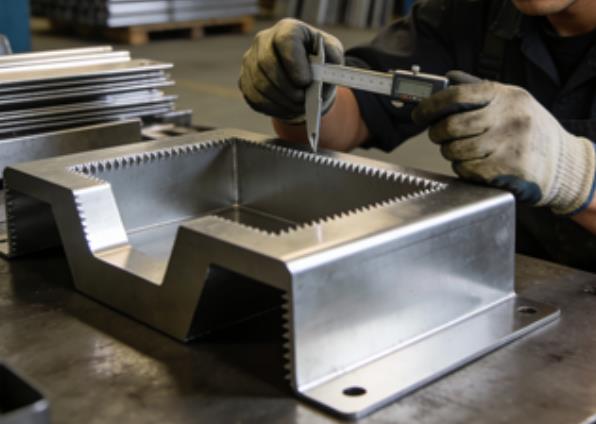
3. Key Differences Between Sheet Metal Fabrication and CNC Machining
| Comparison Aspect | Sheet Metal Fabrication | CNC Machining |
|---|---|---|
| Processing Principle | Cold forming + joining, minimal material removal | Material removal by cutting to form shapes |
| Ideal Parts | Thin sheet structures (enclosures, frames, shells) | Block or bar stock parts (complex surfaces, high precision) |
| Typical Precision | Medium (±0.1–0.5 mm) | High (±0.001–0.1 mm) |
| Economic Batch Size | Large batch with clear cost advantages | Small batch prototypes or high-precision parts preferred |
| Main Products | Covers, supports, housings | Gears, shafts, molds, precision parts |
Trade Tip: When clients require "enclosures, cabinets, brackets" in quantities over 100, sheet metal fabrication is preferred due to cost and lead time benefits.
4. Common Sheet Metal Materials and Selection Guide
| Material | Core Features | Typical Applications | Cost Level |
|---|---|---|---|
| Cold Rolled Steel (SPCC) | Low cost, easy to form, paintable | General equipment enclosures, internal supports, low-cost structures | Low |
| Stainless Steel (304/316) | Corrosion resistant, strong, hygienic | Medical devices, food machinery, outdoor cabinets, high-end appliances | Medium-High |
| Aluminum Alloy (5052/6061) | Lightweight, good conductivity, anodizable | Electronics enclosures, automotive parts, aerospace structures | Medium |
| Galvanized Steel (SGCC) | Basic rust protection, moderate cost | Distribution boxes, telecom cabinets, general industrial equipment | Low-Medium |
| Brass (H62) | Excellent conductivity, elegant appearance, antibacterial | Electrical connectors, decorative parts, precision instruments | High |
5. Extensive Industry Applications
- Electronics & Communications: Server chassis, 5G base station enclosures, router housings.
- Machinery Manufacturing: Machine guards, equipment frames, control consoles.
- Automotive: Body accessories, chassis parts, new energy battery enclosures.
- Medical Equipment: Medical device casings, diagnostic equipment frames (emphasizing cleanliness and corrosion resistance).
- New Energy: Photovoltaic inverter cabinets, energy storage battery cabinets, charging pile enclosures.
- Consumer Goods: Appliance housings, office furniture, kitchen equipment.
6. Key Considerations in Trade and Production Practice
- Drawing Standards: Provide common formats like DXF, STEP, or SolidWorks.
Clearly specify material grade and thickness, bend radius and allowance, surface treatment requirements (e.g., "Powder Coating, RAL 9005"), critical dimension tolerances. - Quotation Factors: Material cost (pay attention to stainless steel and aluminum price fluctuations), process complexity (cutting path length, bend count, weld length), surface finish standards, order volume (larger batches reduce unit cost).
- Quality Control & Standards: Specify general standards (e.g., ISO 9001) or regional standards (ASTM, DIN). Define key quality points like weld quality, salt spray test durations (e.g., "Galvanized parts, 72-hour neutral salt spray"), and deburring levels.
- Delivery Time Management: Typical lead times: small batch samples (7-15 days), mass production (15-30 days including surface treatment). Plan ahead including design confirmation, material procurement, and process validation.
Why Choose Rapid Model?
Rapid Model is equipped with professional machinery and experienced engineers, making us your reliable partner for sheet metal fabrication projects. We offer stable delivery lead times of 7 to 14 days and comprehensive online after-sales support. If products are damaged during shipping or found defective, we provide free returns and replacements.