Key Details to Note in CNC Parts Welding and Polishing Process
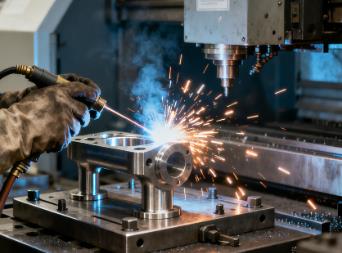
In CNC parts machining, welding and polishing require strict control over material protection, process management, equipment maintenance, and environmental safety. The following outlines essential details to ensure quality and precision throughout the process.
1. Welding Process Control
Material Protection and Pre-treatment
- Surface Cleaning: Remove protective film, oil, and oxide layers (≤0.05mm) from both sides of the weld area. For high-precision components such as those used in semiconductors, perform acid pickling and passivation to eliminate free ferrite.
- Scratch Prevention: Avoid direct contact with the workpiece surface. Use smooth wooden blocks or pearl cotton to prevent scratches or damage caused by metal debris and spatter.
Welding Process Optimization
- Avoid Over-welding: Control weld size using a fillet weld gauge to prevent material waste and deformation.
- Process Selection:
- TIG Welding: Ideal for parts with high appearance requirements such as food-grade and medical components.
- MIG Welding: Efficient for thick plates (≥3mm), though requiring longer post-processing time.
- Automation: Robotic welding improves consistency, efficiency, and reduces human error.
Equipment Maintenance and Consumable Management
- Inspect welding equipment regularly to avoid arc instability or voltage drops.
- Use filler metals and shielding gases efficiently; clean base material surfaces to reduce contamination.
Welding Defect Prevention
- Maintain proper assembly gaps to avoid burn-through or deformation. For instance, a ¼-inch fillet is suitable for zero-gap joints.
- Remove spatter gently with a scraper to minimize polishing difficulty later.
2. Polishing Process Control
Pre-polishing Preparation
- Clean weld areas using alcohol or deionized water. For precision parts, conduct ultrasonic cleaning (40kHz, 50–60°C, 10–15 min).
- Repair defects such as porosity or scratches (≥0.2mm) through TIG welding and leveling before polishing.
Polishing Process Selection
- Rough Polishing: Use flap wheels (grit 60–80) or belt grinders (grit 120–180) to remove weld beads; Ra ≤3.2μm.
- Intermediate Polishing: Use nylon or cloth wheels with green compound; Ra ≤1.6μm; polish crosswise to remove previous marks.
- Fine Polishing: Use wool wheels with diamond paste (W5–W10) or white compound to achieve Ra ≤0.4μm. For food-grade parts, apply electropolishing (10–30A/dm², 5–10 min) to reach Ra ≤0.1μm.
- Special Materials:
- Aluminum Alloy: Apply chemical or electrochemical polishing for aerospace components.
- Stainless Steel: Use graded diamond paste (9μm→6μm→3μm) to avoid orange peel or pitting.
Polishing Quality Control
- Visual Check: Under 500 lux light, surfaces should have no scratches, color difference, or orange peel.
- Roughness Test: Ra variation ≤±0.1μm across five measured points.
- Salt Spray Test: 48h test (5% NaCl, 35°C) shows no red rust.
- Edge Treatment: Round edges (R≥0.5mm) to avoid stress concentration; passivate sharp corners to protect operators.
3. Environment and Safety Control
- Ventilation: Maintain clean airflow to prevent dust buildup. For polishing accuracy ≤1μm, operate in a cleanroom environment.
- Safety Protection: Operators must wear goggles, masks, and gloves to prevent dust and chemical exposure.