Vad är infärgad formning? En komplett guide till processen
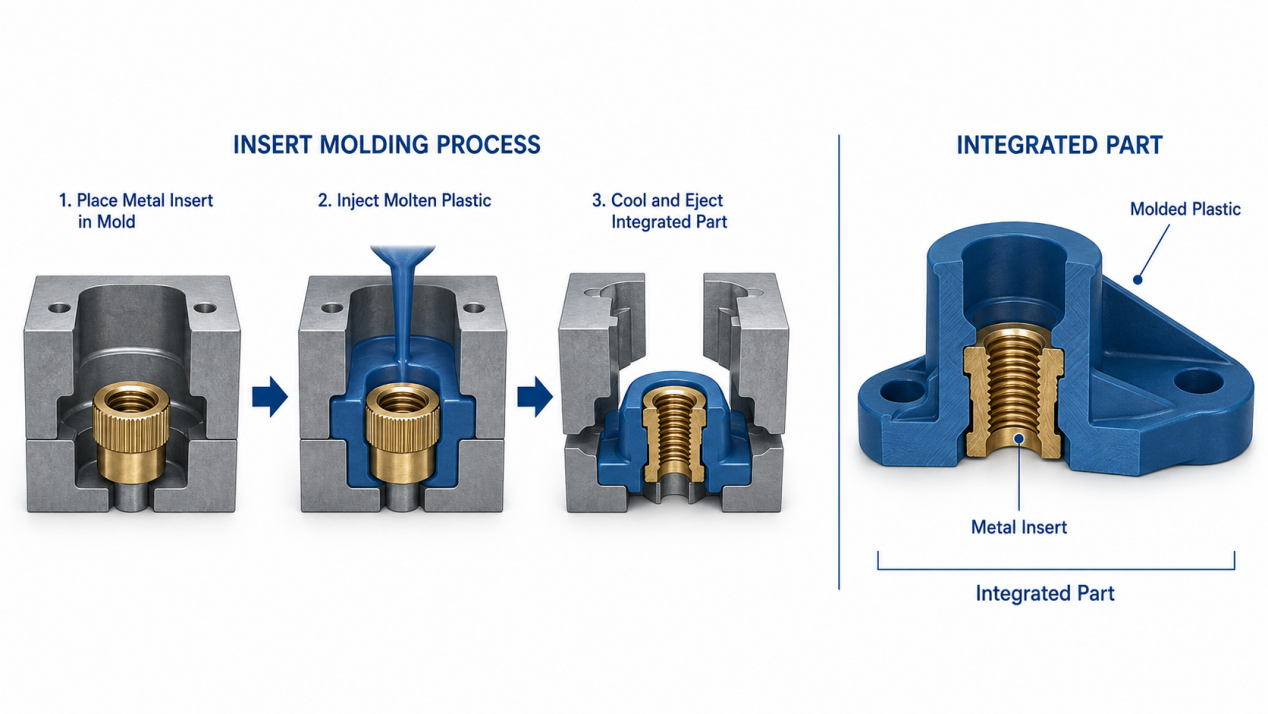 Metallinsatser är särskilt vanliga. Exempel inkluderar trådade insatser, bussar, nypor, elektriska kontakter, skalor och stämpelade metallkomponenter. Genom att kombinera metall och plast i en enda formad del kan insatssprutning minska sekundär montering samtidigt som den lägger till funktioner som skulle vara svåra att uppnå med plast ensam.
Hur fungerar inläggsmotiv?
Grundläggande insättningssmältprocess kan delas in i flera steg:
1. Förbered infästningen
Infästningen tillverkas innan formningsprocessen börjar.
Beroende på produkten kan det vara en:
<!--[if !supportLists]-->· <!--[endif]-->trådade bronsinsättning;
<!--[if !supportLists]-->· <!--[endif]-->stål- eller rustfritt stålskomponent;
<!--[if !supportLists]-->· <!--[endif]-->bushing eller skiva;
<!--[if !supportLists]-->· <!--[endif]-->pin;
<!--[if !supportLists]-->· <!--[endif]-->elektriskt kontakt;
<!--[if !supportLists]-->· <!--[endif]-->stämplad metalldel.
Inläggningens geometri är viktig eftersom omgivande plast måste hålla det säkert efter formning.
2. Placera infästningen i formen
Inskänningen är exakt positionerad inuti injektionsformen.
För mindre produktion kan inläggas läggas in manuellt. Större produktion kan använda robotar eller automatiska fyllsystem för att förbättra cykeltiden och positioneringskonsekvensen. Industriella inläggningssystem kan också integrera stämpel- och formningsoperationer i automatiserade produktionslinjer.
3. Stäng formen
Formen stängs runt inlägget och håller det i den önskade positionen.
Rätt inläggningsposition och tillräcklig fasthetsförsäkring är avgörande. Om en inläggning rör sig när formen stängs eller när plast injiceras kan det färdiga delar ha dimensionella problem eller formen själv kan skadas.
4. Injicera plastiken
Smältet termoplastiskt material injiceras i moldkaviten och strömmar runt inlägget.
Funktioner som knurlningar, fyringar, hål, understöd eller andra mekaniska fasthållningsgeometrier kan hjälpa till att låsa en metallinlägg i plast efter formning.
För metall-till-plast infärgning uppnås fasthållning vanligtvis mekaniskt snarare än genom att bero på kemisk adhesjon mellan materialen.
5. Kyla och kasta bort delen
Plastiken kyls och fastnar runt inlägget. Formen öppnas sedan och färdigtryckt inläggsmodulerade komponenten släpps ut.
Resultatet är en integrerad komponent som innehåller både den formade plasten och den förformade infästningen.
6. Kontrollera den färdiga komponenten
Inspektion kan omfatta:
<!--[if !supportLists]-->· <!--[endif]-->infästningsposition;
<!--[if !supportLists]-->· <!--[endif]-->formningsdimensioner;
<!--[if !supportLists]-->· <!--[endif]-->trådskick;
<!--[if !supportLists]-->· <!--[endif]-->flash;
<!--[if !supportLists]-->· <!--[endif]-->plastförsäkran;
<!--[if !supportLists]-->· <!--[endif]-->cosmetisk utseende;
<!--[if !supportLists]-->· <!--[endif]-->Pull-out eller torkprestanda vid behov.
Kritiska infästningsfunktioner ska tydligt identifieras i konstruktionsritningen.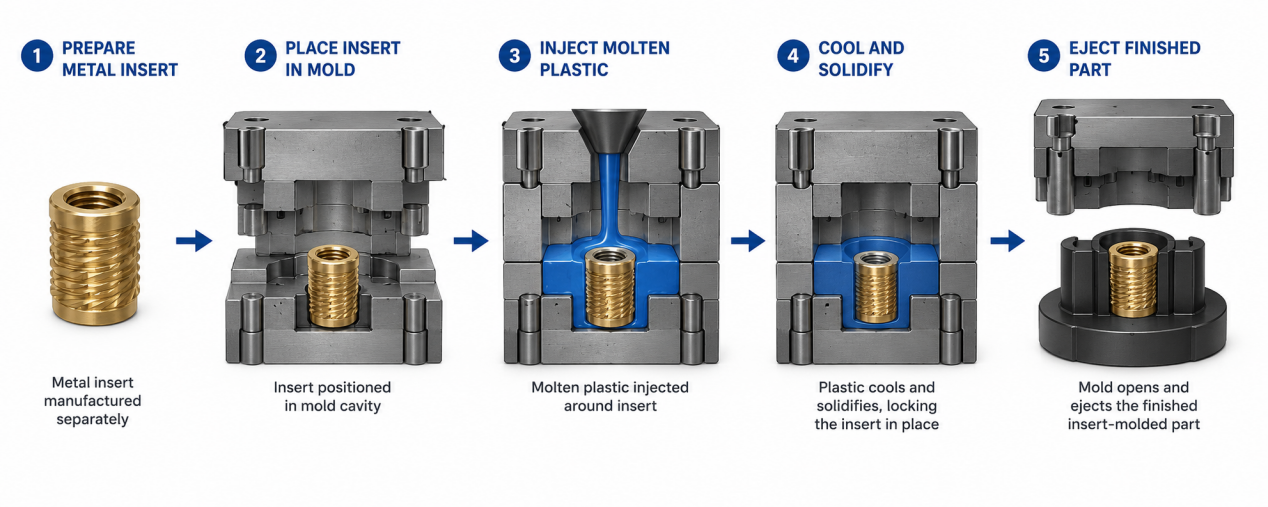
Vanliga typer av infästningar
Insermoldning kan integrera många olika förformade komponenter.
Trådrundor
Trådade metallinsatser ger hållbara inre trådar i plastdelar.
De är särskilt användbara när skruvar kommer att monteras och demonteras flera gånger, eftersom en integrerad metalltråd kan erbjuda bättre hållbarhet än att borra tråd direkt i många plastmaterial. Protolabs identifierar särskilt trådade infäster som en metod att förstärka fastighetsförmågan i formade plastkomponenter.
Bushings och skivor
Metallmuffar kan ge slitagebeständiga eller dimensionellt stabila ytor där axlar, stänger eller andra samverkande komponenter interagerar med en plastkassa.
Elektriska kontakter
Pins, termer, kontakter och leder kan formas direkt in i elektriska eller elektroniska komponenter.
Stämpelade metallkomponenter
Mer komplexa stämpelade metallfunktioner kan också integreras i formade plast. Insettmoldningsfabrikanter använder kombinationer av precisionstrykning och injektionsformning för tillämpningar som elektriska och automobila komponenter.
Vilka material används vid infästningsformning?
Infoga material
Vanliga metallinsattsmaterial inkluderar:
<!--[if !supportLists]-->· <!--[endif]-->brass;
<!--[if !supportLists]-->· <!--[endif]-->stål;
<!--[if !supportLists]-->· <!--[endif]-->mellanliggande stål;
<!--[if !supportLists]-->· <!--[endif]-->andra metallar som är specifika för applikation.
Bronsinkoppar är särskilt vanligt för trådinsatser, medan stål och mässing också är allmänt tillgängliga beroende på den önskade styrkan och korrosionsbeständigheten.
Plastmaterial
Många injektionsformade termoplastiska material kan användas för inspänning, beroende på tillämpningen.
Exempel inkluderar:
<!--[if !supportLists]-->· <!--[endif]-->ABS;
<!--[if !supportLists]-->· <!--[endif]-->polypropylen (PP);
<!--[if !supportLists]-->· <!--[endif]-->polycarbonat (PC);
<!--[if !supportLists]-->· <!--[endif]-->acetal/POM;
<!--[if !supportLists]-->· <!--[endif]-->nylon;
<!--[if !supportLists]-->· <!--[endif]-->PBT och PPA;
<!--[if !supportLists]-->· <!--[endif]-->PPS;
<!--[if !supportLists]-->· <!--[endif]-->PEI;
<!--[if !supportLists]-->· <!--[endif]-->PEEK;
<!--[if !supportLists]-->· <!--[endif]-->TPU and other engineering polymers.
Material selection should consider mechanical strength, temperature, chemical exposure, shrinkage, electrical requirements, appearance, and the stresses created around the insert during molding and service. Commercial insert-molding capabilities cover a broad range of commodity and engineering resins.
Advantages of Insert Molding
Reduced Assembly
One of the biggest advantages is the ability to combine previously separate components during molding.
A threaded insert, electrical contact, or bushing does not necessarily need to be installed as a separate downstream assembly operation.
This can reduce part count and simplify manufacturing.
Stronger Fastening Features
Metal threaded inserts can provide durable fastening points in plastic components, especially where repeated assembly and disassembly are expected.
Integration of Different Material Properties
Insert molding allows engineers to use plastic where low weight, insulation, shape complexity, or moldability is useful while retaining metal where strength, wear resistance, conductivity, or threaded fastening is required.
Consistent Insert Position
When the mold and process are properly designed, inserts can be located accurately relative to molded plastic features.
This can be useful for electrical connectors, housings, mounting features, and precision mechanical assemblies.
Potential for Automated Production
Insert loading and molding can be integrated into automated production systems, especially at higher volumes. Some specialized production lines combine press forming, injection molding, and downstream operations.
Limitations and Challenges of Insert Molding
Insert molding also creates additional manufacturing considerations compared with standard injection molding.
More Complex Tooling
The mold must locate and retain the insert while allowing the plastic to flow around it.
This often makes mold design more complex than a comparable plastic-only component.
Insert Positioning
The insert must remain correctly located during mold closing and injection.
Variation in insert dimensions or poor retention can lead to misalignment, flash, incomplete encapsulation, or mold damage.
Knit Lines
As molten plastic flows around an insert, separate flow fronts may meet again on the opposite side. This can create a knit or weld line.
Depending on part geometry and loading, the area around the insert may require additional wall thickness, ribs, or other design changes. Protolabs specifically identifies knit lines around inserts as a design consideration.
Cykeltid
Manual insert loading adds time to each molding cycle. Automation can reduce this issue but adds equipment and process complexity.
Higher Upfront Tooling Requirements
Insert molding is generally most economical when the integrated design justifies the additional mold and process complexity.
For very small quantities or frequently changing designs, separately installing an insert after molding may sometimes be more practical.
Insert Molding vs. Overmolding
Insert molding and overmolding are related processes, but they are not exactly the same.
In insert molding, a premanufactured component—commonly a metal insert—is placed into the mold and plastic is molded around it.
In overmolding, an additional material is molded over an existing substrate, often to combine two plastics or add an elastomeric layer to a rigid component. Typical examples include soft grips, seals, handles, and multi-material housings.
A simple way to distinguish them is:
Behandla | Typical Combination | Example |
Insatsgjutning | Metal + Plastic | Brass threaded insert molded into plastic |
Övergjutning | Plastic + Plastic / Elastomer | TPE grip molded over rigid plastic |
The terminology can overlap in industry, but the engineering intent is usually different.
Insert Molding vs. Heat-Set Inserts
Insert molding should also be distinguished from installing threaded inserts after a plastic part has already been molded.
With insert molding, the metal insert is placed inside the mold before plastic injection.
With a heat-set insert, the plastic component is molded first and the threaded insert is subsequently pressed into the plastic using heat.
Insert molding integrates the insert during the molding cycle, while heat-set installation is a secondary manufacturing operation.
The better solution depends on production volume, tooling, insert geometry, material, required strength, assembly requirements, and cost.
Important Insert Molding Design Considerations
Successful insert molding begins with good part and tooling design.
Important factors include:
<!--[if !supportLists]-->· <!--[endif]-->insert location and orientation;
<!--[if !supportLists]-->· <!--[endif]-->insert dimensional consistency;
<!--[if !supportLists]-->· <!--[endif]-->mechanical retention features;
<!--[if !supportLists]-->· <!--[endif]-->plastic wall thickness around the insert;
<!--[if !supportLists]-->· <!--[endif]-->ribs and supporting geometry;
<!--[if !supportLists]-->· <!--[endif]-->material shrinkage;
<!--[if !supportLists]-->· <!--[endif]-->draft angles;
<!--[if !supportLists]-->· <!--[endif]-->gate location and plastic flow;
<!--[if !supportLists]-->· <!--[endif]-->knit-line location;
<!--[if !supportLists]-->· <!--[endif]-->mold access for insert loading;
<!--[if !supportLists]-->· <!--[endif]-->required thread and insert tolerances.
Standard injection-molding principles such as suitable draft and consistent wall thickness still apply. The insert introduces additional concerns involving retention, molding flow and positioning.
Designers should also avoid unnecessarily thin plastic sections around metal inserts. Adequate surrounding material helps support the insert and distribute loads into the molded component.
Common Applications of Insert Molding
Insert-molded components are used in many products and industries.
Typical applications include:
<!--[if !supportLists]-->· <!--[endif]-->electrical connectors;
<!--[if !supportLists]-->· <!--[endif]-->electronic housings;
<!--[if !supportLists]-->· <!--[endif]-->automotive components;
<!--[if !supportLists]-->· <!--[endif]-->sensors;
<!--[if !supportLists]-->· <!--[endif]-->knobs and handles;
<!--[if !supportLists]-->· <!--[endif]-->medical-device components;
<!--[if !supportLists]-->· <!--[endif]-->threaded plastic housings;
<!--[if !supportLists]-->· <!--[endif]-->gears and mechanical assemblies;
<!--[if !supportLists]-->· <!--[endif]-->power-tool components;
<!--[if !supportLists]-->· <!--[endif]-->industrial equipment.
Insert molding is especially useful when a product requires the geometry and low weight of molded plastic together with specific functional properties provided by a metal component. Industrial insert-molding suppliers use the process across electronics, automotive, medical, appliance, and other precision applications.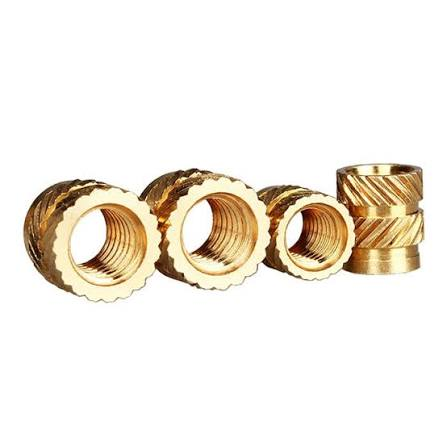
Is Insert Molding Right for Your Part?
Insert molding is worth considering when a design contains components that would otherwise need to be assembled into the plastic part after molding.
It can be particularly effective for designs requiring:
<!--[if !supportLists]-->· <!--[endif]-->reusable metal threads;
<!--[if !supportLists]-->· <!--[endif]-->integrated electrical contacts;
<!--[if !supportLists]-->· <!--[endif]-->wear-resistant bushings;
<!--[if !supportLists]-->· <!--[endif]-->precisely located metal components;
<!--[if !supportLists]-->· <!--[endif]-->reduced assembly operations;
<!--[if !supportLists]-->· <!--[endif]-->compact multi-material structures.
However, the decision should consider production quantity, tooling cost, insert tolerances, molding material, geometry, mechanical loading, and the required level of automation.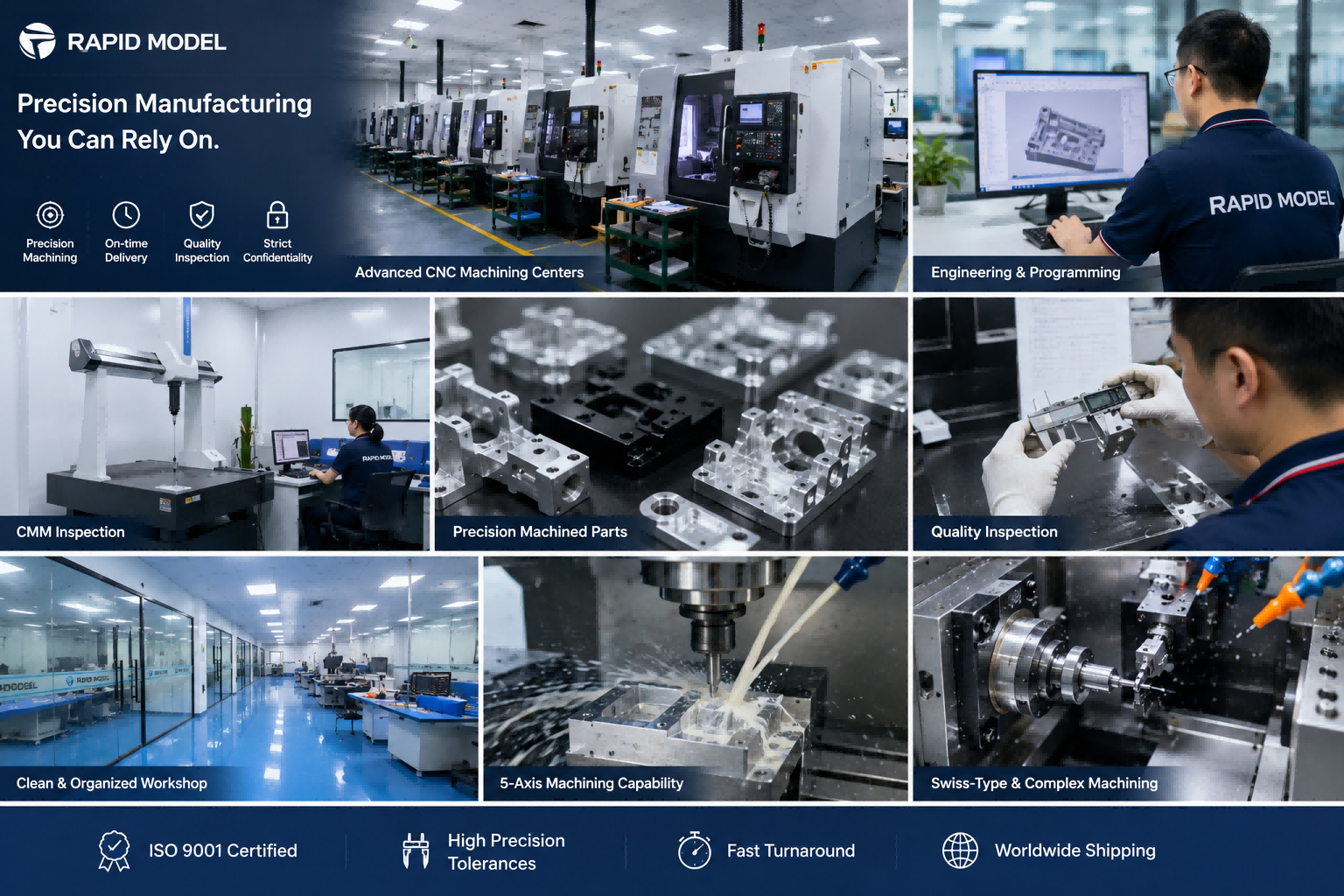
For custom injection-molded parts, Rapid-Model can evaluate the CAD model, drawings, insert requirements, plastic material, tolerances, and production quantity to determine an appropriate manufacturing approach.
Providing the insert CAD file together with the molded-part model and critical dimensions makes DFM evaluation and quotation more efficient.
Slutsats
Insert molding is an injection molding process that places a premanufactured component inside a mold before plastic is injected around it.
The process is commonly used to integrate threaded inserts, bushings, sleeves, electrical contacts, and other metal components directly into plastic parts.
Its main benefits include reduced assembly, durable fastening features, integration of different material properties, and efficient production of complex multi-material components.
Good results, however, depend on insert positioning, mechanical retention, plastic flow, wall thickness, material selection, mold design, and dimensional control. Considering these factors during the design stage can significantly improve the manufacturability and reliability of an insert-molded component.