Titanium vs. Aluminum: Which Is Better?
Titanium vs. Aluminum: Which Is Better
for Your Project?
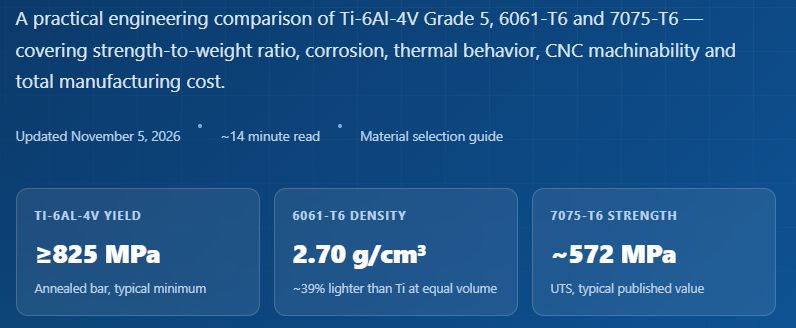
In this guide
- Quick comparison
- Weight and density
- Strength and stiffness
- Corrosion resistance
- Temperature and thermal
- CNC machinability
- Material and manufacturing cost
- Industry applications
- Design for CNC parts
- How to choose
- Perguntas frequentes
- Conclusion
Choosing between titanium and aluminum is not simply a question of which metal is stronger or lighter. It is an engineering decision that affects component weight, structural performance, corrosion resistance, manufacturing costs, machining time, and long-term product reliability.
For aerospace engineers, product designers, procurement managers, and manufacturers, selecting the wrong material can create unnecessary production expenses, excessive component weight, premature wear, or performance limitations.
Both metals offer excellent engineering advantages, but they serve different purposes. Titanium is particularly valuable when high strength, corrosion resistance, and performance under demanding conditions are essential. Aluminum is often the more economical choice when low weight, efficient machining, thermal conductivity, and competitive production costs are priorities.
Titanium is better for applications requiring exceptional strength-to-weight performance, corrosion resistance, and higher-temperature capability. Aluminum is generally better where low weight, easy CNC machining, heat dissipation, and lower manufacturing costs matter most. The best choice depends on the specific alloy, operating environment, geometry, and performance requirements of the component.
In this guide, we compare Ti-6Al-4V Grade 5 titanium against two widely used CNC aluminum alloys, 6061-T6 e 7075-T6, to help you make a practical material selection.
Titanium vs. Aluminum: Quick Comparison
Before examining individual properties, it is helpful to understand how the most common grades compare. The table below summarizes typical published values; always confirm against the actual purchase specification and material certificate for production.
| Propriedade | Ti-6Al-4V Grade 5 | Aluminum 6061-T6 | Aluminum 7075-T6 |
|---|---|---|---|
| Density | 4.43 g/cm³ | 2.70 g/cm³ | 2.81 g/cm³ |
| Ultimate tensile strength | ≥895 MPa* | ~310 MPa | ~572 MPa |
| Yield strength | ≥825 MPa* | ~276 MPa | ~503 MPa |
| Elastic modulus | 105–115 GPa | ~68.9 GPa | ~71–72 GPa |
| Thermal conductivity (25°C) | ~6.6 W/m·K | ~167 W/m·K | ~130 W/m·K |
| Thermal expansion coefficient | ~9 × 10⁻⁶ /K | ~23.6 × 10⁻⁶ /K | ~23 × 10⁻⁶ /K |
| Machinability | Challenging | Excellent | Good; more demanding than 6061 |
| Relative material cost | High | Low to moderate | Moderate to high |
| Typical applications | Aerospace, medical, high-performance | Housings, brackets, automation | Aircraft structures, high-load parts |
*Titanium values are minimum mechanical properties for the referenced annealed bar condition (per ASTM B348 / AMS 4928 minimums). Aluminum values are representative published values. Actual properties depend on product form, dimensions, heat treatment, material specification, and supplier certification. These figures are comparative guidance, not design allowables. 7075-T6 properties vary with product thickness.
1. Titanium vs. Aluminum: Which Is Lighter?
Weight is often the first consideration when engineers compare titanium and aluminum, particularly in aerospace, robotics, automotive, and portable equipment applications.
Density comparison
Density determines how much a material weighs for a given volume.
Density (g/cm³) — lower is lighter
Titânio60617075
For the same component volume, aluminum 6061 weighs approximately 39% less than Ti-6Al-4V. Put another way, titanium is approximately 64% heavier than 6061 aluminum at equal volume.
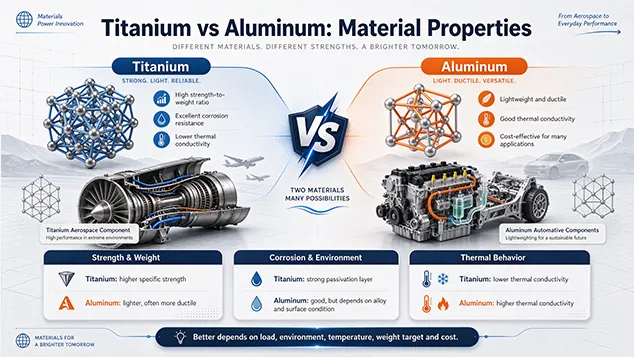
Does titanium still have an advantage in lightweight engineering?
Yes. Titanium's advantage is not that it is lighter than aluminum. It is that it provides much higher strength while remaining relatively lightweight compared with steel and many other structural metals.
Consider two different design situations:
- Same part geometry: Aluminum generally produces the lighter component.
- Same structural load requirement: Titanium may allow a component to use a smaller or thinner cross-section, depending on the design and loading conditions.
This distinction matters when engineers are optimizing complete assemblies rather than simply comparing equal-sized blocks of material. For example, an aerospace bracket may justify titanium if its load requirements and available installation space make strength and section size more important than the initial material cost.
2. Titanium vs. Aluminum: Which Is Stronger?
Titanium generally offers higher mechanical strength than common aluminum alloys. However, high-strength aluminum alloys such as 7075-T6 can approach titanium in certain strength-to-weight comparisons.
Tensile and yield strength
Tensile strength measures the maximum stress a material can withstand before breaking; yield strength indicates the stress at which permanent deformation begins. For components subjected to repeated loads, clamping forces, bending, or high structural stress, yield strength is often the more useful initial design limit.
Yield strength (MPa) — higher is stronger
Titânio60617075
Using the representative grades in this comparison:
- Ti-6Al-4V Grade 5: at least 895 MPa UTS e 825 MPa yield for the referenced bar condition.
- Aluminum 6061-T6: approximately 310 MPa UTS e 276 MPa yield.
- Aluminum 7075-T6: approximately 572 MPa UTS e 503 MPa yield.
Strength-to-weight ratio: Does titanium always win?
Strength-to-weight ratio measures how much strength a material provides for its mass. The simplified screening ratios below use yield strength divided by density.
| Materiais | Yield strength (MPa) | Density (g/cm³) | Yield / density (MPa·cm³/g) |
|---|---|---|---|
| Ti-6Al-4V | 825 | 4.43 | 186 |
| 6061-T6 | 276 | 2.70 | 102 |
| 7075-T6 | 503 | 2.81 | 179 |
Screening indicator only — not a design allowable. The ratio does not account for buckling, fatigue, joint efficiency, stress concentrations, or manufacturing tolerances.
These simplified ratios show why titanium is attractive for demanding structural applications. They also demonstrate that 7075 aluminum can provide a competitive strength-to-weight ratio, despite having lower absolute strength.
What about stiffness and fatigue?
Strength and stiffness are not the same thing. Stiffness describes how much a component elastically deforms under an applied load; it is closely related to Young's modulus and component geometry.
Ti-6Al-4V has an elastic modulus of approximately 105–115 GPa, compared with approximately 69 GPa for 6061-T6. Titanium is therefore stiffer for the same geometry and loading arrangement. However, aluminum's lower density means its stiffness-to-weight ratio is broadly comparable to titanium's for these common alloys.
Ti-6Al-4V generally exhibits higher fatigue strength than 6061-T6 and 7075-T6, but fatigue performance depends strongly on surface finish, notch geometry, mean stress, and environment. Use fatigue design data for the specific alloy and condition; do not infer fatigue life from tensile data alone.
3. Titanium vs. Aluminum: Which Has Better Corrosion Resistance?
Corrosion resistance determines how reliably a component performs when exposed to moisture, chemicals, saltwater, industrial fluids, or changing environmental conditions.
Titanium corrosion resistance
Titanium naturally forms a stable, protective oxide layer on its surface. This passive film is responsible for its outstanding corrosion resistance in many environments. Grade 5 titanium is commonly selected for:
- Marine and offshore equipment.
- Chemical processing components.
- Medical and biomedical devices.
- Aerospace components exposed to demanding environments.
- High-performance industrial equipment.
For critical applications, the actual chemical concentration, temperature, crevice geometry, and operating conditions must still be evaluated. Titanium is corrosion-resistant, not universally corrosion-proof.
Aluminum corrosion resistance
Aluminum also forms a naturally occurring oxide film that protects its surface from further oxidation. Many aluminum alloys provide excellent corrosion resistance in normal atmospheric environments. However, aluminum can be vulnerable to localized corrosion, particularly in chloride-containing environments such as seawater. Different aluminum grades perform differently:
- 6061: Good general-purpose corrosion resistance and a versatile engineering choice.
- 5052: Often preferred for marine environments and corrosion-sensitive sheet-metal applications.
- 7075: High strength, but more attention is required for corrosion and stress-corrosion-cracking performance.
What happens when titanium and aluminum are connected?
An important design issue arises when titanium and aluminum are used together in an electrically conductive environment. Because titanium is generally more noble than aluminum in seawater, direct electrical contact in the presence of an electrolyte can create a galvanic corrosion risk for the aluminum component.
The severity depends on the potential difference, the anode-to-cathode area ratio, electrolyte conductivity, and exposure duration. A small aluminum anode coupled to a large titanium cathode is particularly unfavorable. Engineers should evaluate:
- Electrical contact between dissimilar metals.
- Exposure to moisture, saltwater, or other electrolytes.
- The relative exposed surface areas of the two metals.
- Protective coatings, sealants, insulating washers, or isolation sleeves.
For outdoor, marine, and offshore assemblies, galvanic compatibility should be evaluated at the complete assembly level rather than assuming that both materials will remain corrosion-free independently.
4. Titanium vs. Aluminum: Which Performs Better at High Temperatures?
Operating temperature is another important factor when selecting metal for CNC-machined components. Although both materials have useful thermal properties, they perform very differently when exposed to heat.
High-temperature mechanical performance
Titanium alloys generally retain useful mechanical strength at higher service temperatures than common 6061 and 7075 aluminum alloys. Ti-6Al-4V is therefore frequently considered for aerospace structures, engine-related hardware, and components exposed to elevated temperatures.
Aluminum alloys are more appropriate for many normal industrial, automotive, and electronic applications, but their strength can decrease with elevated temperature exposure. Heat-treatment condition and exposure duration are particularly important when working with precipitation-hardened alloys.
Thermal conductivity
Thermal conductivity measures how effectively a material transfers heat.
Thermal conductivity at ~25°C (W/m·K) — higher conducts heat better
Titânio60617075
Aluminum 6061 transfers heat far more efficiently than Ti-6Al-4V. This makes aluminum particularly useful for heat sinks, electronic enclosures, thermal management plates, and cooling-related components. 7075-T6 conducts heat less efficiently than 6061-T6 but still far better than titanium.
Thermal expansion and dimensional stability
Thermal expansion describes how much a material changes dimensions when its temperature changes. Ti-6Al-4V has a thermal expansion coefficient of approximately 9 × 10⁻⁶/K, whereas 6061 aluminum is approximately 23.6 × 10⁻⁶/K.
Titanium generally experiences less dimensional expansion than aluminum for the same temperature change and original length. This can be beneficial in applications requiring dimensional stability across changing operating temperatures, although component geometry, constraints, and material interfaces must also be considered.
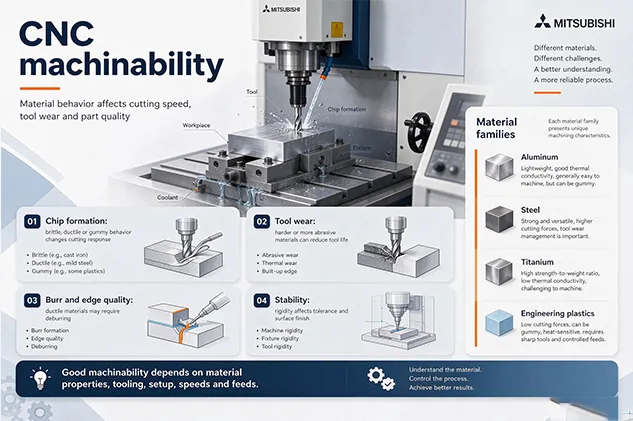
5. Titanium vs. Aluminum: Which Is Easier to CNC Machine?
For manufacturers and procurement engineers, machinability is one of the most important differences between titanium and aluminum. Two metals may satisfy the same mechanical requirements but have significantly different production costs because of cutting speed, tooling consumption, machining time, chip formation, and inspection requirements.
CNC aluminum machining
Aluminum is generally easier and faster to machine than titanium. Common advantages include:
- Higher achievable cutting speeds.
- Lower cutting forces for typical aluminum machining operations.
- Efficient material removal.
- Good surface finish potential.
- Relatively low cutting-tool wear under suitable conditions.
- Excellent suitability for high-volume CNC machining.
6061 aluminum is particularly attractive because of its balanced strength, machinability, availability, and cost. 7075 aluminum offers higher strength but requires careful attention to cutting conditions, distortion, and dimensional stability, especially for thin-walled or complex parts.
CNC titanium machining
Titanium is significantly more challenging to machine, particularly when working with Ti-6Al-4V. The main reason is its combination of mechanical strength, low thermal conductivity, and chemical reactivity at elevated machining temperatures. Several manufacturing challenges need to be controlled:
1. Heat concentration
Titanium does not dissipate cutting heat as effectively as aluminum. A large proportion of machining heat can remain concentrated near the cutting edge and tool-workpiece interface.
2. Tool wear
High temperatures and chemical interactions can accelerate tool wear. Tool selection, cutting speed, coolant delivery, and chip evacuation all influence tool life.
3. Cutting forces and deflection
Higher cutting forces make machine rigidity, fixture design, spindle performance, and workpiece support particularly important. Titanium's relatively low elastic modulus also contributes to part deflection and chatter in thin-wall sections.
4. Dimensional accuracy
Thin walls, deep cavities, small internal radii, and complex geometries increase the risk of machining instability and dimensional variation.
5. Production efficiency
Compared with aluminum, titanium machining generally requires more specialized process planning and can involve longer cycle times and higher tooling costs.
How manufacturers control titanium CNC machining challenges
A reliable titanium machining process normally requires a coordinated approach rather than simply reducing cutting speed.
- Tool selection: Select suitable carbide tools and coatings for the specific titanium alloy and operation. Positive rake, sharp edges, and large helix angles are commonly used to reduce work hardening and heat buildup; confirm the exact geometry with the machine shop.
- Cutting parameters: Establish appropriate cutting speeds, feed rates, and depth of cut to manage heat and cutting forces.
- Coolant delivery: Provide adequate and consistent cooling to the cutting zone. High-pressure coolant can improve chip evacuation and heat removal in deep features.
- Machine rigidity: Use a stable machining platform and secure workholding to prevent vibration and movement.
- Toolpath optimization: Reduce unnecessary tool engagement and avoid conditions that cause excessive heat accumulation.
- In-process inspection: Monitor important dimensions and surface conditions throughout the manufacturing process.
Learn more about aluminum CNC machining services e titanium CNC machining capabilities.
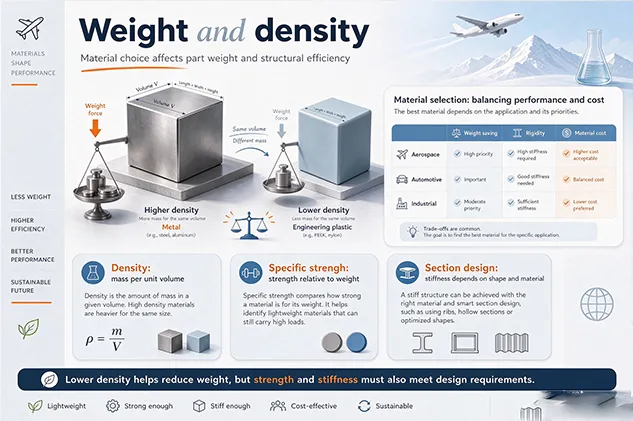
6. Titanium vs. Aluminum: Which Is More Expensive?
In most conventional CNC procurement situations, titanium is considerably more expensive than aluminum. However, comparing only the price per kilogram does not provide an accurate estimate of the total manufacturing cost.
Why does titanium cost more?
- More complex raw-material production and processing.
- Higher purchase prices for common engineering titanium alloys.
- More difficult cutting conditions.
- Greater tooling and process-control requirements.
- Longer machining cycles in many applications.
- Additional attention to quality control and critical dimensions.
Why is aluminum more economical?
Aluminum is generally less expensive to purchase and easier to process. It also supports higher machining productivity for many components. These advantages can be especially important when manufacturing large quantities of industrial components.
What determines the final CNC machining price?
Cost factor Impact on manufacturing cost Raw material Grade, dimensions, stock availability, and material certification. Part geometry Deep cavities, thin walls, internal features, and complex surfaces. Material removal Amount of stock removed and machining difficulty. Machining time Cutting speed, feed rate, number of setups, and toolpath complexity. Tooling Tool type, tool life, replacement frequency, and special tooling. Surface treatment Anodizing, polishing, blasting, passivation, or other finishing operations. Quality requirements Tight tolerances, CMM inspection, material certificates, and inspection reports. Order quantity Setup costs, production efficiency, process repeatability, and batch size.
| Cost factor | Impact on manufacturing cost |
|---|---|
| Raw material | Grade, dimensions, stock availability, and material certification. |
| Part geometry | Deep cavities, thin walls, internal features, and complex surfaces. |
| Material removal | Amount of stock removed and machining difficulty. |
| Machining time | Cutting speed, feed rate, number of setups, and toolpath complexity. |
| Tooling | Tool type, tool life, replacement frequency, and special tooling. |
| Surface treatment | Anodizing, polishing, blasting, passivation, or other finishing operations. |
| Quality requirements | Tight tolerances, CMM inspection, material certificates, and inspection reports. |
| Order quantity | Setup costs, production efficiency, process repeatability, and batch size. |
Example: A CNC aluminum bracket vs. a titanium bracket
Suppose an industrial equipment manufacturer needs 500 precision mounting brackets. If the bracket operates under moderate mechanical loads and normal environmental conditions, 6061-T6 aluminum may be more economical because it offers sufficient strength with efficient machining and relatively low material costs.
If the bracket is exposed to high loads, elevated temperatures, or a corrosive operating environment, Ti-6Al-4V may provide greater long-term engineering value despite a higher purchase price. The correct comparison should therefore include the complete part lifecycle, including manufacturing expenses, maintenance, weight reduction, and expected service life.
7. Titanium vs. Aluminum: Which Is Better for Different Industries?
Different industries have different priorities. The best material for aerospace may not be the best material for industrial automation or consumer electronics.
| Industry / Application | Recommended starting point | Main consideration |
|---|---|---|
| Aerospace structures | Ti-6Al-4V / 7075 aluminum | Strength, fatigue, weight, and operating temperature. |
| Robot frames | 6061 / 7075 aluminum | Low mass, structural rigidity, and manufacturing cost. |
| Medical implants | Appropriate titanium grade (e.g., Grade 23 ELI) | Biocompatibility, ISO 5832-3 / ASTM F136, and regulatory requirements. |
| Electronics housings | 6061 aluminum | Heat dissipation, appearance, and machining efficiency. |
| Marine components | Titanium / suitable marine aluminum alloy | Corrosion resistance and galvanic compatibility. |
| High-performance fixtures | 7075 aluminum / titanium | Strength, stiffness, and design envelope. |
Aeroespacial
Typical choice: Titanium or high-strength aluminum, depending on the component. Titanium is valuable for highly loaded structural components, fasteners, and applications where corrosion resistance and elevated-temperature capability are important. 7075 aluminum remains attractive for lightweight structural parts where its strength, machinability, and lower material cost offer an advantage.
Automotive and motorsports
Typical choice: Aluminum for general components; titanium for demanding performance parts. Aluminum is widely used for housings, brackets, structural parts, and thermal management components. Titanium may be selected for high-performance fasteners, specialized exhaust-related components, and other applications where strength and temperature capability justify the additional cost.
Medical equipment
Typical choice: Titanium for suitable implant and critical medical applications; aluminum for non-implant equipment structures.
Titanium is important in medical engineering because selected grades offer biocompatibility, corrosion resistance, and strong mechanical performance. Ti-6Al-4V ELI Grade 23 is commonly considered for implant-related applications where extra-low interstitial content is required.
Grade 23 differs from Grade 5 mainly in lower interstitial limits (O, N, H, Fe), which improve ductility and fracture toughness. Implant use also requires compliance with ISO 5832-3, ASTM F136, and applicable regulatory requirements. Aluminum can be suitable for equipment housings, support structures, fixtures, and other non-implant components.
Robotics and industrial automation
Typical choice: Aluminum for most structures and housings; titanium for specialized high-load components. Aluminum offers an attractive balance of low weight, machinability, and cost for robot frames, motor housings, mounting brackets, and automation equipment components. 7075 aluminum is worth evaluating for highly loaded mechanical parts, while titanium can be justified for joints, precision structural connections, and weight-sensitive components with demanding strength requirements.
Marine and chemical equipment
Typical choice: Titanium for highly corrosive or demanding environments, subject to material compatibility assessment. Titanium is particularly attractive for suitable seawater and chemical-processing applications. Aluminum can still perform effectively in many marine applications, especially with appropriate alloy selection and protective design. The specific operating chemistry, chloride concentration, temperature, flow conditions, and dissimilar-metal connections should always be considered.
Consumer electronics and thermal management
Typical choice: Aluminum for heat dissipation and cost-effective enclosures; titanium for specialized premium components. Aluminum's thermal conductivity and CNC machinability make it a practical choice for electronic housings, cooling plates, and heat sinks. Titanium may be selected for products where appearance, strength, corrosion resistance, and distinctive material characteristics justify higher manufacturing costs.
8. Design Considerations for Titanium and Aluminum CNC-Machined Parts
Choosing the correct material is only the beginning. Good design-for-manufacturing decisions can significantly reduce production cost while improving component quality.
1. Optimize wall thickness
Thin walls can be challenging in both aluminum and titanium machining. In aluminum, thin sections can deform under clamping pressure or as residual stress is released during material removal. In titanium, high cutting forces and machining heat create additional challenges. Avoid unnecessarily thin walls and consider adding ribs or support features where practical.
2. Review internal radii and corner geometry
Small internal corners often require small-diameter cutting tools, additional machining passes, and more complicated toolpaths. Where functional requirements allow, use larger internal radii to improve cutting conditions and reduce cycle time.
3. Consider material temper and stress relief
Aluminum 6061-T651 and 7075-T651 are commonly considered for precision applications requiring improved dimensional stability compared with their corresponding T6 stress-relief conditions. For complex parts, engineers should consider the material's initial stress condition, machining sequence, and the possibility of deformation after stock removal.
4. Select the correct surface finish
Surface finishing requirements should be established before selecting the material.
- Aluminum: Anodizing, hard anodizing, bead blasting, polishing, and conversion coatings may be suitable depending on the application.
- Titanium: Mechanical polishing, bead blasting, passivation (typically nitric or citric acid to remove free iron contamination, not to thicken the native oxide), and suitable specialized coatings can be considered according to functional and cosmetic requirements.
Remember that surface treatment can affect dimensions, appearance, friction, wear resistance, and corrosion performance. Critical features should be inspected after finishing.
5. Establish realistic tolerances
Not every dimension needs the same level of precision. Applying extremely tight tolerances to non-critical features can increase inspection time, machining difficulty, and production cost. Identify critical-to-quality dimensions, specify appropriate geometric tolerances, and ensure that your machining supplier understands the functional requirements of each feature.
6. Consider production quantity
Material selection should account for the entire production plan. A material that is economical for a single prototype may not be the most economical choice for 5,000 or 20,000 production components. Aluminum generally offers strong advantages in high-volume manufacturing because of its efficient machining characteristics. Titanium can still be the better investment when its technical advantages are necessary to meet product performance requirements.
How to Choose Between Titanium and Aluminum: A Practical Decision Framework
Before finalizing a material specification, use the following six-step process.
Step 1 — Define the mechanical load
Determine tensile, compressive, bending, torsional, and fatigue requirements. Identify maximum load, load cycles, safety factor, and acceptable deformation.
Determine tensile, compressive, bending, torsional, and fatigue requirements. Identify maximum load, load cycles, safety factor, and acceptable deformation.
Step 2 — Establish the weight target
Calculate maximum permitted component weight and compare material options using the finished part geometry. Do not assume titanium automatically produces a lighter part.
Calculate maximum permitted component weight and compare material options using the finished part geometry. Do not assume titanium automatically produces a lighter part.
Step 3 — Identify environmental conditions
Evaluate temperature, moisture, chemicals, saltwater exposure, wear, and contact with dissimilar metals. Assess the complete assembled system for corrosion.
Evaluate temperature, moisture, chemicals, saltwater exposure, wear, and contact with dissimilar metals. Assess the complete assembled system for corrosion.
Step 4 — Evaluate CNC manufacturing feasibility
Discuss complex features, thin walls, machining setups, tooling requirements, and surface-finish expectations with your manufacturing partner.
Discuss complex features, thin walls, machining setups, tooling requirements, and surface-finish expectations with your manufacturing partner.
Step 5 — Compare total manufacturing cost
Evaluate material costs, machining hours, tooling, finishing, inspection, scrap risk, and expected order quantities. Lower raw-material price does not automatically mean lower final component cost.
Evaluate material costs, machining hours, tooling, finishing, inspection, scrap risk, and expected order quantities. Lower raw-material price does not automatically mean lower final component cost.
Step 6 — Validate the actual material specification
Confirm exact alloy, temper, applicable material standards, required certification, and supplier traceability. Use material test reports and design allowables for demanding applications.
Final material selection rule- Escolha6061-T6 aluminumwhen balanced strength, low weight, good machinability, and cost efficiency are the priorities.
- Escolha7075-T6 alumíniowhen greater strength is needed without moving to a more expensive titanium solution.
- EscolhaTi-6Al-4V Grade 5when high absolute strength, corrosion performance, higher-temperature capability, and demanding structural requirements justify its additional cost.
Confirm exact alloy, temper, applicable material standards, required certification, and supplier traceability. Use material test reports and design allowables for demanding applications.
- Escolha6061-T6 aluminumwhen balanced strength, low weight, good machinability, and cost efficiency are the priorities.
- Escolha7075-T6 alumíniowhen greater strength is needed without moving to a more expensive titanium solution.
- EscolhaTi-6Al-4V Grade 5when high absolute strength, corrosion performance, higher-temperature capability, and demanding structural requirements justify its additional cost.
Perguntas frequentes
Is titanium stronger than aluminum?
Yes. Ti-6Al-4V Grade 5 generally has significantly higher tensile and yield strength than 6061-T6 and typical 7075-T6 aluminum. However, 7075 aluminum has an excellent strength-to-weight ratio and can be a more economical option for many high-strength applications.
The correct comparison should include the precise alloy, temper, product form, loading conditions, and component geometry.
Is aluminum lighter than titanium?
Yes. Aluminum is significantly lighter than titanium at the same volume. Aluminum 6061-T6 has a density of approximately 2.70 g/cm³, while Ti-6Al-4V is approximately 4.43 g/cm³. An equal-volume aluminum component can weigh approximately 39% less than its Ti-6Al-4V equivalent.
However, the final weight comparison may change when different component geometries are designed to meet the same structural requirements.
Is titanium more expensive to CNC machine than aluminum?
Generally, yes. Titanium is more difficult to machine because of its low thermal conductivity, high cutting forces, and chemical interaction with cutting tools at elevated temperatures. These factors can increase machining time, tooling costs, and process-control requirements.
Aluminum is generally faster and more economical to CNC machine, making it particularly attractive for prototypes, repeat orders, and high-volume production.
Should I choose titanium or 7075 aluminum for aerospace components?
Both materials are used in aerospace engineering, but they serve different purposes. Ti-6Al-4V offers high absolute strength, good corrosion resistance, and useful elevated-temperature performance. Aluminum 7075 offers high strength with substantially lower density and can reduce material and manufacturing costs.
The choice depends on fatigue life, structural loading, operating temperature, corrosion exposure, joining requirements, design geometry, and applicable aerospace specifications.
Can titanium and aluminum be joined directly?
They can be joined mechanically, but direct electrical contact in the presence of an electrolyte (such as seawater or condensation) creates a galvanic corrosion risk for the aluminum. Use insulating washers, isolating sleeves, sealants, or protective coatings, and evaluate the assembly at the system level. Avoid a small aluminum anode coupled to a large titanium cathode, which is the most unfavorable area ratio.
Does titanium have better fatigue performance than aluminum?
Ti-6Al-4V generally exhibits higher fatigue strength than 6061-T6 and 7075-T6, but fatigue performance depends strongly on surface finish, notch geometry, mean stress, and environment. Use fatigue design data for the specific alloy and condition; do not infer fatigue life from tensile data alone.
What is the difference between Grade 5 and Grade 23 titanium?
Both are Ti-6Al-4V alloys, but Grade 23 (Ti-6Al-4V ELI) has lower interstitial limits for oxygen, nitrogen, hydrogen, and iron. This improves ductility and fracture toughness. Grade 23 is commonly specified for implant and cryogenic applications, subject to compliance with ISO 5832-3, ASTM F136, and applicable regulatory requirements.
Conclusion: Titanium or Aluminum — Which Should You Choose?
There is no universally superior material between titanium and aluminum. Each offers a different balance of mechanical performance, manufacturing efficiency, and cost.
Titanium is the stronger choice for demanding engineering applications where high strength, corrosion resistance, and thermal stability are essential. It is particularly valuable in aerospace, medical, marine, and specialized industrial components.
Aluminum is often the better commercial and manufacturing choice when lightweight construction, excellent machinability, thermal conductivity, and competitive production costs are the primary requirements.
For many CNC machining projects, the most sensible approach is to compare 6061 aluminum, 7075 aluminum, and Ti-6Al-4V before finalizing the design. This helps engineers identify the best balance between performance, weight, manufacturability, and total production cost.