5-Axis Machining: The Pinnacle of Complex Part Manufacturing
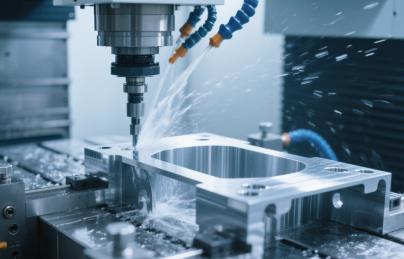
5-axis machining is not merely a machine with more axes—it represents the crown jewel of CNC (Computer Numerical Control) manufacturing. More than a technological upgrade, it embodies a philosophical shift: moving from “How do we make this part?” to “How can we produce this part in the optimal way, in a single setup?” This capability has made it indispensable in high-precision industries such as aerospace, medical devices, and automotive engineering.
Core Evolution: From Limited Motion to Full 3D Freedom
Understanding the value of 5-axis machining becomes clearer when compared to traditional 3-axis machining.
The 3-axis world (2D thinking)
Traditional 3-axis machines (X, Y, Z linear axes) extend two-dimensional thinking into machining. They excel at prismatic parts—components with flat surfaces and perpendicular holes. However, when it comes to angled surfaces, deep cavities, or complex freeform curves, their limitations become obvious. Engineers must rely on complicated fixtures and multiple setups. Each re-clamping not only consumes time but also introduces accumulated errors, compromising precision.
The 5-axis world (3D thinking)
5-axis technology adds two rotational axes (commonly A/C, A/B, or B/C), enabling true three-dimensional machining. The tool can tilt and rotate like a human wrist, approaching the part from virtually any angle. This is not just “two more axes”—it’s giving manufacturing full spatial freedom.
Transformative Advantages: Beyond Simple Geometry
This newfound freedom brings several transformative benefits, reshaping design and manufacturing possibilities.
“Complete in a single setup”
Perhaps the most powerful advantage of 5-axis machining is eliminating multiple setups, thereby removing cumulative error. For a critical aerospace turbine blade, this means maintaining surface profile tolerances within ±0.02 mm, ensuring both aerodynamic performance and structural integrity.
Unlocking unprecedented geometries
5-axis machining is the key to complex, organic shapes (freeform surfaces). From high-efficiency impellers in turbines, to anatomically precise medical implants, to lightweight automotive structures, 5-axis machining handles undercuts, deep cavities, and compound curves that would be impossible or prohibitively expensive with 3-axis methods.
The virtuous cycle of quality, efficiency, and cost
- Superior surface finish: Techniques such as tangential machining or tool-tip following keep the cutter at the optimal contact angle with the surface. This improves surface quality (e.g., achieving Ra 0.8 µm on molds) and greatly reduces manual polishing requirements.
- Significant efficiency gains: Shorter setups, reduced machine time, and the use of shorter, stiffer tools accelerate complex part production by several times.
- Extended tool life: Optimized cutting angles and more uniform tool load reduce wear, lowering long-term operating costs.
Cross-Industry Highlights: From Labs to Production Lines
The value of 5-axis machining manifests across cutting-edge industries:
- Aerospace: Machining turbine blades from tough titanium or nickel-based superalloys requires precise strategies. From low-stress roughing with trochoidal milling to 5-axis finishing for perfect blade profiles, every step ensures maximum precision and material integrity.
- Medical technology: For cobalt-chromium or titanium joint implants, 5-axis machining achieves geometries and mirror-like surface finishes essential for biomechanical function (post-polishing can reach Ra ≤ 0.05 µm). Such precision directly impacts patient recovery and implant longevity.
- New energy vehicles: In lightweight and integrated designs, 5-axis machining excels. Complex aluminum battery housings or motor casings with multi-directional cooling channels can be fully machined in a single setup, guaranteeing perfect alignment of sealing surfaces—a feat beyond conventional methods.
Future Outlook: Smart Manufacturing and Digital Twins
5-axis machining is not an endpoint—it is a cornerstone for the intelligent factory. Complementing additive manufacturing (3D printing), it transforms near-net-shape complex blanks into high-precision final parts.
With Industry 4.0, 5-axis machines are increasingly integrated into digital ecosystems. Real-time monitoring via in-machine measurement systems, combined with digital twin simulations, allows virtual process optimization, predictive tool-life management, and “first-time-right” production.
Conclusion
5-axis machining has evolved from a “premium option” into an essential technology for complex, high-performance part production. It is not just about machine motion—it’s about pushing design boundaries, achieving ultimate precision, and enabling sustainable productivity. As global industries advance toward smarter, more integrated manufacturing, 5-axis machining will remain the foundation turning the boldest engineering designs into reality.